Sale!

Abaqus VUEL Tutorial | Essential Fundamentals for Peridynamics

Original price was: £249.00.Current price is: £199.00.

🎓 Student: £149

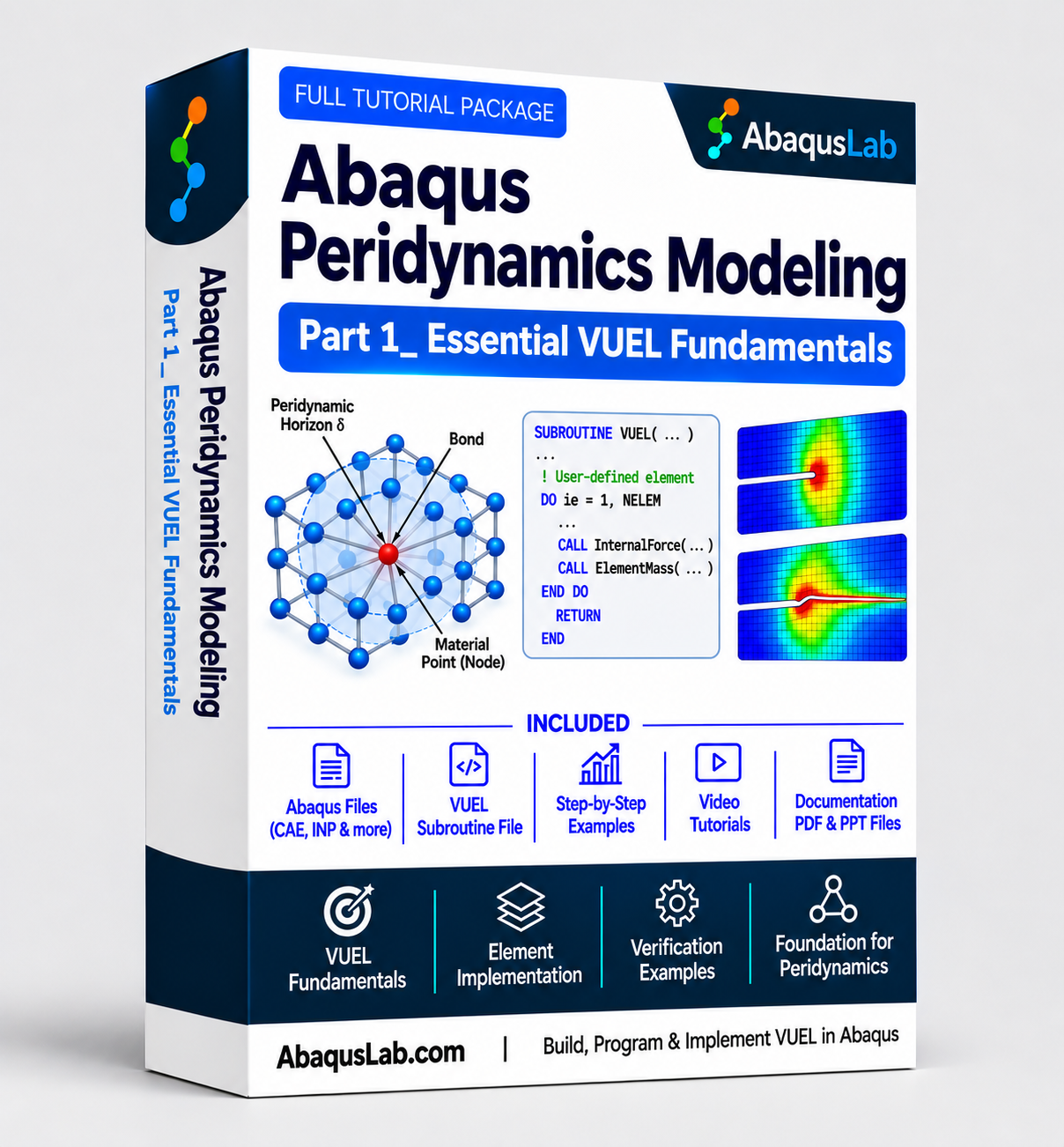
Learn the fundamentals of Abaqus VUEL programming and implement user-defined elements using Fortran in Abaqus/Explicit. The tutorial provides the essential foundation for advanced peridynamics modeling, including user-element development, internal force calculations, and peridynamic fracture simulation.

Everything you need in one package:

✓ Step-by-step video tutorials — from VUEL fundamentals to practical implementation
✓ Abaqus VUEL fundamentals and Fortran programming
✓ User-defined element formulation and implementation
✓ Element connectivity, nodes, and degrees of freedom (DOFs)
✓ Internal force calculations and element mass matrices
✓ VUEL subroutine structure, arguments, and implementation
✓ Abaqus/Explicit model setup and simulation workflow
✓ Fortran compilation, debugging, and troubleshooting
✓ Practical user-element examples and numerical verification
✓ Displacement, force, and simulation results interpretation
✓ Abaqus simulation files and VUEL Fortran source code
✓ Foundation for advanced peridynamics and fracture modeling
✓ Technical documentation and supporting tutorial materials

🚀 Order Custom CP Project 🔬 Continue to Part 2__Peridynamics Tutorial & Implementation
Categories: ,

Description

Abaqus Peridynamics Modeling Learning Path — Parts 1–2 and Complete Suite

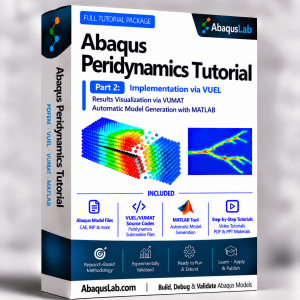
The AbaqusLab Peridynamics Modeling Suite begins with Essential VUEL Fundamentals in Part 1, covering Abaqus/Explicit user-element programming, element definitions, degrees of freedom, internal forces, and element mass calculations. Part 2 progresses to Abaqus Peridynamics Modeling, including peridynamic fracture simulation, implementation via VUEL, results visualization via VUMAT, and automatic model generation with MATLAB. Recommended study order: Part 1 → Part 2.

Part 1 — Essential VUEL Fundamentals

  • ⚙️ Abaqus/Explicit VUEL programming
  • 💻 Fortran user-element implementation
  • 📐 Element definition, nodes & DOFs
  • 🔧 Internal forces & mass calculations
£249
£199   Student: £149

Explore Part 1 →

Part 2 — Abaqus Peridynamics Tutorial

  • ⚙️ Peridynamics implementation via VUEL
  • 💻 Results visualization via VUMAT
  • 📐 Automatic model generation with MATLAB
  • 📊 Peridynamic fracture simulation
£699
£449   Student: £349

Explore Part 2 →

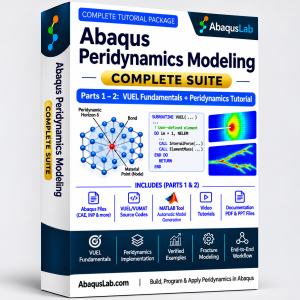
COMPLETE ABAQUS PERIDYNAMICS SUITE

Complete Abaqus Peridynamics Modeling Suite — Parts 1–2

  • Complete Parts 1–2 learning path
  • Essential Abaqus VUEL fundamentals
  • Fortran user-element programming
  • Element definitions and degrees of freedom
  • Internal force and mass calculations
  • Peridynamics implementation via VUEL
  • Results visualization via VUMAT
  • Automatic model generation with MATLAB
  • Peridynamic fracture modeling


£899
£529   Student: £399

Explore Complete Suite →

What's Included?

This tutorial package provides a complete practical workflow for modelling and implementing the subject covered by the product in Abaqus. It includes the Abaqus model files, user-subroutine source code, step-by-step tutorial videos, and supporting training materials needed to follow and reproduce the modelling workflow.

Abaqus Model Files

Complete Abaqus model files used throughout the tutorial, including CAE and input files where applicable. The supplied models allow you to follow the examples directly and examine the modelling setup, analysis steps, material definitions, loading, boundary conditions, and output requests.

User Subroutine Files

The relevant Abaqus user-subroutine source files used in the modelling workflow, including UMAT, UMATHT, UEL, or other applicable Abaqus subroutines. The source files are provided together with the tutorial so that you can examine how the required behaviour is implemented and use the supplied implementation as a starting point for your own models.

Step-by-Step Tutorial Videos

Detailed tutorial videos explaining the modelling procedure from model setup through analysis and post-processing. The videos demonstrate how the supplied Abaqus files and user subroutines are used and explain the important modelling and implementation steps.

Training Materials

Supporting PDF and PowerPoint training materials covering the concepts, modelling approach, implementation details, and practical workflow presented in the tutorial.

Complete Practical Workflow

The different components are provided as one integrated tutorial package. You can study the modelling concepts, inspect the Abaqus files, examine the user-subroutine implementation, follow the tutorial videos, and reproduce the demonstrated simulations as you progress through the tutorial.

Important Information

Prerequisites

A basic understanding of finite element modelling and Abaqus is recommended. Users should be familiar with creating Abaqus models, defining materials, applying loads and boundary conditions, running analyses, and reviewing simulation results.

Understanding of User Subroutines

The tutorial includes the relevant user-subroutine implementations and explains their role in the modelling workflow. Basic familiarity with Abaqus user subroutines is helpful, but the supplied examples and tutorial videos are designed to guide you through the implementation used in the models.

Abaqus and Software Requirements

A compatible licensed version of Abaqus is required to run the supplied models. Where user subroutines are compiled, an appropriate Fortran compiler and compatible Abaqus development environment may also be required.

Research and Engineering Applications

The tutorial is intended for engineers, researchers, postgraduate students, and Abaqus users working on computational mechanics problems. The examples provide a practical modelling workflow that can be adapted to different geometries, materials, loading conditions, and research problems.

Model Verification and Adaptation

The supplied examples demonstrate a specific modelling and implementation workflow. For research or engineering applications, the models should be adapted to the relevant material properties, loading conditions, geometry, and experimental or literature data. Appropriate verification and validation should be performed for the intended application.

Scope of the Tutorial

This product focuses on the practical implementation of the modelling approach covered by the tutorial in Abaqus. More advanced extensions, different physical assumptions, or application-specific formulations may require additional modelling, calibration, or user-subroutine development.

Reviews

There are no reviews yet.

Be the first to review “Abaqus VUEL Tutorial | Essential Fundamentals for Peridynamics”

Your email address will not be published. Required fields are marked *