

Description
Abaqus Crystal Plasticity UMAT Tutorial | CPFEM Implementation
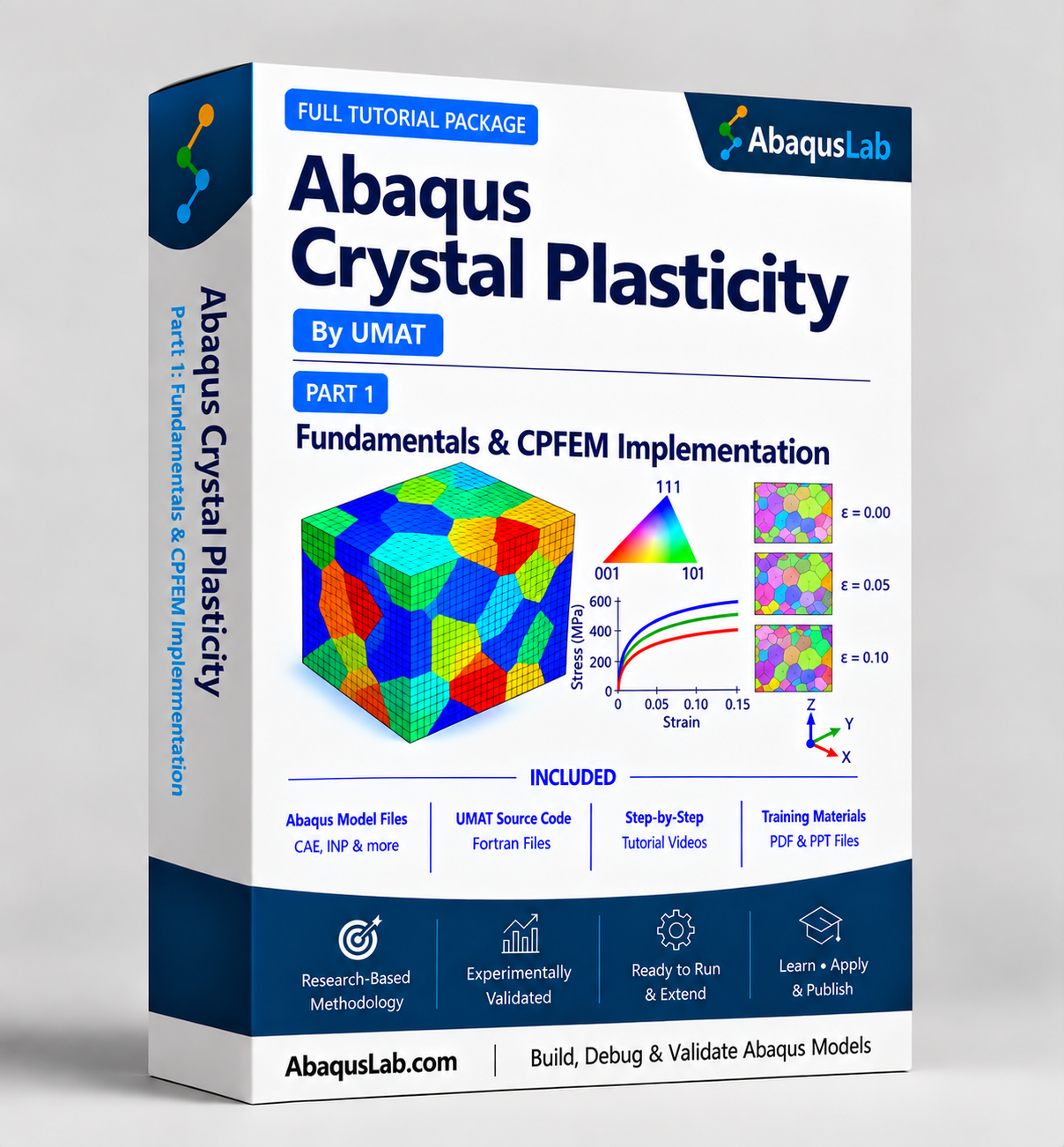
This comprehensive Abaqus Crystal Plasticity UMAT Tutorial presents a practical workflow for understanding and implementing Abaqus Crystal Plasticity from the constitutive formulation to a working finite element simulation. The tutorial explains Crystal Plasticity in Abaqus through a complete Crystal Plasticity UMAT implementation and introduces the Crystal Plasticity Finite Element Method (CPFEM) for modeling crystallographic slip, anisotropic plastic deformation, hardening, nonlinear constitutive response, and polycrystalline material behavior. Rather than treating the UMAT as a black box, the crystal plasticity equations, numerical algorithms, Fortran implementation, material Jacobian, state variables, and Abaqus model are explained step by step.
What Is Abaqus Crystal Plasticity?
Abaqus Crystal Plasticity is a computational approach for modeling the deformation of crystalline materials by explicitly representing crystallographic deformation mechanisms such as slip on individual crystal slip systems.
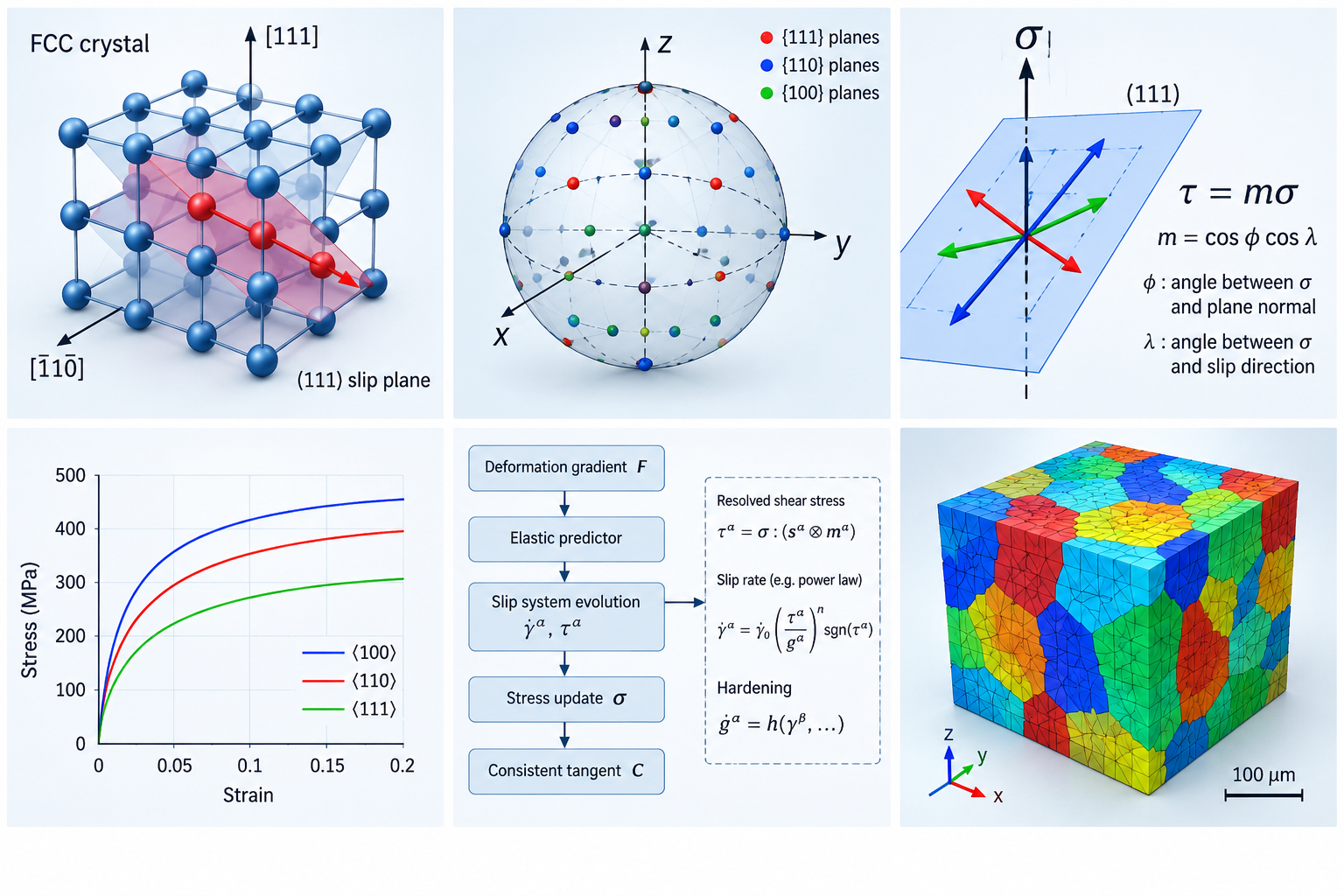
Unlike conventional phenomenological plasticity models that primarily describe material response at the macroscopic level, crystal plasticity connects plastic deformation to the underlying crystallographic structure. The deformation response therefore depends on crystal orientation, slip-system geometry, resolved shear stress, slip resistance, hardening, and the evolution of the crystal lattice.
AbaqusLab implements Crystal Plasticity in Abaqus using a Crystal Plasticity UMAT, providing a practical connection between the crystal-scale constitutive equations and Abaqus/Standard finite element analysis.
Within the Crystal Plasticity Finite Element Method (CPFEM), the constitutive equations are evaluated at the finite element integration points. Each material point can contain crystallographic orientation information and multiple slip systems, allowing the finite element model to capture orientation-dependent deformation, anisotropy, evolving hardening, lattice rotation, and heterogeneous response within single crystals and polycrystalline materials.
Core Abaqus Crystal Plasticity Modeling Concepts
- Abaqus Crystal Plasticity UMAT Tutorial — the complete tutorial explains the workflow from crystal plasticity theory and constitutive equations to UMAT implementation, nonlinear solution, Jacobian calculation, and polycrystalline CPFEM.
- Abaqus Crystal Plasticity — crystallographic deformation mechanisms are introduced into the Abaqus finite element framework through a user-defined constitutive model.
- Crystal Plasticity in Abaqus — Abaqus/Standard provides the finite element solution while the UMAT evaluates the crystal-scale stress update, slip activity, hardening, and internal variables.
- Crystal Plasticity UMAT — the Fortran UMAT provides the constitutive connection between crystal plasticity theory and the Abaqus/Standard material-point calculation.
- Crystal Plasticity Finite Element Method (CPFEM) — CPFEM combines crystal-level constitutive equations with finite element analysis to model crystallographic deformation at single-crystal and polycrystalline scales.
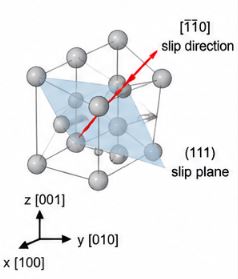
- Crystallographic Slip Systems — plastic deformation develops through slip on specific crystallographic planes and directions.
- Crystal Plasticity Hardening — evolving slip resistance controls how the active slip systems respond as deformation progresses.
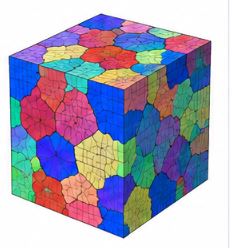
- Polycrystalline CPFEM — multiple grains with different crystallographic orientations can be modeled to investigate heterogeneous deformation and macroscopic material response.
What You Can Predict with Abaqus Crystal Plasticity UMAT
A Crystal Plasticity UMAT is particularly valuable when the mechanical response depends on crystallographic orientation and deformation mechanisms at the crystal or grain scale. The Crystal Plasticity Finite Element Method (CPFEM) can connect these local mechanisms to the overall finite element response.
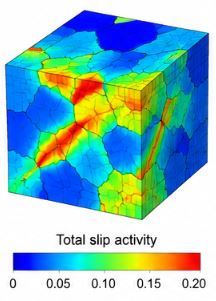
Crystallographic Slip Activity
Visualize where crystallographic slip becomes active and how accumulated slip develops across individual grains and the polycrystalline microstructure.
Resolved Shear Stress
Evaluate the resolved shear stress acting on individual crystallographic slip systems and identify the systems most likely to become active.
Orientation-Dependent Deformation
Investigate how different crystal orientations produce different deformation responses under the same macroscopic loading condition.

Anisotropic Plastic Response
Predict how the plastic response changes with crystallographic loading direction and identify orientation-dependent deformation patterns.

Macroscopic Stress–Strain Behavior
Connect crystal-scale deformation mechanisms to the overall macroscopic stress–strain response predicted by the CPFEM model.

Stress & Strain Localization
Identify localized regions of stress, strain, and plastic deformation generated by crystal orientation and microstructural interactions.

Lattice Rotation & Orientation Evolution
Study the evolution of crystal orientation and lattice rotation as deformation develops within individual grains.

Grain-to-Grain Deformation Heterogeneity
Examine how neighboring grains develop different stress, strain, and slip responses because of their orientations and interactions.

Polycrystalline CPFEM Response
Model the combined response of many grains with different crystallographic orientations within a polycrystalline CPFEM simulation.
What You Receive with This Abaqus Crystal Plasticity Tutorial
This Abaqus Crystal Plasticity UMAT Tutorial is designed as a complete learning and implementation package rather than only a finished UMAT. You receive the Abaqus models, source codes, step-by-step tutorial videos, formulation explanations, supporting files, documentation, and technical support required to understand, run, modify, and extend the CPFEM workflow.
Complete Step-by-Step Tutorial Videos
UMAT, Abaqus Models, Tutorials & Support
Package objective: the goal is not only to provide a working UMAT, but to give you a complete and reusable Abaqus Crystal Plasticity and CPFEM workflow that you can understand, verify, modify, and extend for your own material modeling, research, and engineering applications.
Choose Your Abaqus Crystal Plasticity Learning Path
Start with the fundamental Abaqus Crystal Plasticity UMAT Tutorial and progressively develop your CPFEM capabilities through hardening, nonlinear constitutive solution, numerical Jacobian implementation, polycrystalline modeling, EBSD-based realistic microstructures, Abaqus/Explicit VUMAT development, and crystal-level damage modeling. Choose an individual package or save with one of the complete learning bundles.
Part 1 — Fundamentals & CPFEM Implementation
- 🔬 Crystal plasticity fundamentals
- 💻 Complete UMAT implementation
- ⚙️ Workflow in Abaqus/Standard
£149 (Student: £129)
Part 2 — Crystal Plasticity Hardening
- ⚙️ Slip-resistance evolution
- 📈 Hardening formulation
- 🔗 Slip-system interactions
£169 (Student: £149)
Part 3 — Nonlinear Crystal Plasticity
- 🧮 Nonlinear constitutive equations
- 🎯 Local material-point solution
- 🔄 Iterative stress update
£179 (Student: £159)
Part 4 — Numerical Jacobian
- 📐 DDSDDE formulation
- 🧮 Numerical material tangent
- ⚙️ Abaqus/Standard convergence
- 💻 Practical Jacobian
£179 (Student: £159)
Part 5 — Polycrystalline CPFEM
- 🔷 Multiple crystal grains
- 🧭 Crystallographic orientations
- 🔗 Grain-to-grain interactions
£189 (Student: £169)
Part 6 — DREAM.3D, EBSD, & Real Microstructure
- 🧊 DREAM.3D microstructure
- 🔬 EBSD-based microstructures
- 🧭 Grain orientation mapping
£219 (Student: £189)
Complete Crystal Plasticity Bundle — Parts 1–6
- ✓ Complete Parts 1–6 Included
- ✓ Complete Crystal Plasticity UMAT
- ✓ Complete tutorials & supporting files
£699 (Student: £599)
Part 7 — Abaqus Explicit Crystal Plasticity VUMAT
- ⚡ Abaqus/Explicit implementation
- 💻 Crystal Plasticity VUMAT
- 🧩 Step-by-step implementation
£229 (Student: £199)
Part 8 — Crystal Plasticity Damage with VUMAT
- 💎 Diamond cutting simulation
- 🔬 Polycrystalline grain-level damage
- 💥 Damage & element deletion
£249 (Student: £219)
Complete Crystal Plasticity Suite — Parts 1–8
- ✓ Complete Parts 1–8 learning path
- ✓ Abaqus Implicit & Explicit CPFEM
- ✓ Complete tutorials & files
£949 (Student: £799)
What You Will Learn in This Abaqus Crystal Plasticity UMAT Tutorial
This Abaqus Crystal Plasticity UMAT Tutorial takes you from fundamental crystallographic deformation concepts to a practical CPFEM implementation in Abaqus. The objective is not simply to provide completed UMAT and Abaqus files, but to explain how the crystal plasticity formulation is transformed into a working constitutive model.
- 📘 Understand crystal plasticity theory — learn crystal orientations, crystallographic slip, deformation mechanisms, resolved shear stress, and the fundamental concepts required for CPFEM.
- 📐 Understand crystallographic slip systems — learn how slip planes and slip directions are defined and how crystal orientation affects the mechanical response.
- 💻 Understand the Crystal Plasticity UMAT — study the structure of the Abaqus UMAT and how the constitutive equations are implemented in Fortran.
- ⚙️ Understand crystal plasticity hardening — learn how slip resistance evolves and how interactions between slip systems influence the material response.
- 🔄 Solve the nonlinear constitutive problem — understand the numerical solution procedure required to update the crystal plasticity state at each integration point.
- 🧮 Implement the numerical Jacobian — learn how the material tangent required by Abaqus/Standard can be calculated and returned through DDSDDE.
- 🧱 Build polycrystalline CPFEM models — extend the methodology from individual crystals to multiple grains with different crystallographic orientations.
- 📊 Interpret crystal-scale results — investigate stress, strain, slip-system activity, hardening, crystal orientation effects, and grain-to-grain deformation heterogeneity.
- 🛠️ Adapt the complete CPFEM workflow — modify the supplied UMAT, Abaqus models, material parameters, orientations, and constitutive formulation for your own research or engineering application.
By the end of the complete Crystal Plasticity learning pathway, you will understand how Crystal Plasticity Finite Element Method (CPFEM) develops from crystallographic constitutive theory through Crystal Plasticity UMAT implementation, nonlinear solution, polycrystalline modeling, realistic microstructures, Abaqus/Explicit VUMAT development, and advanced damage applications.
Complete Abaqus Crystal Plasticity Workflow
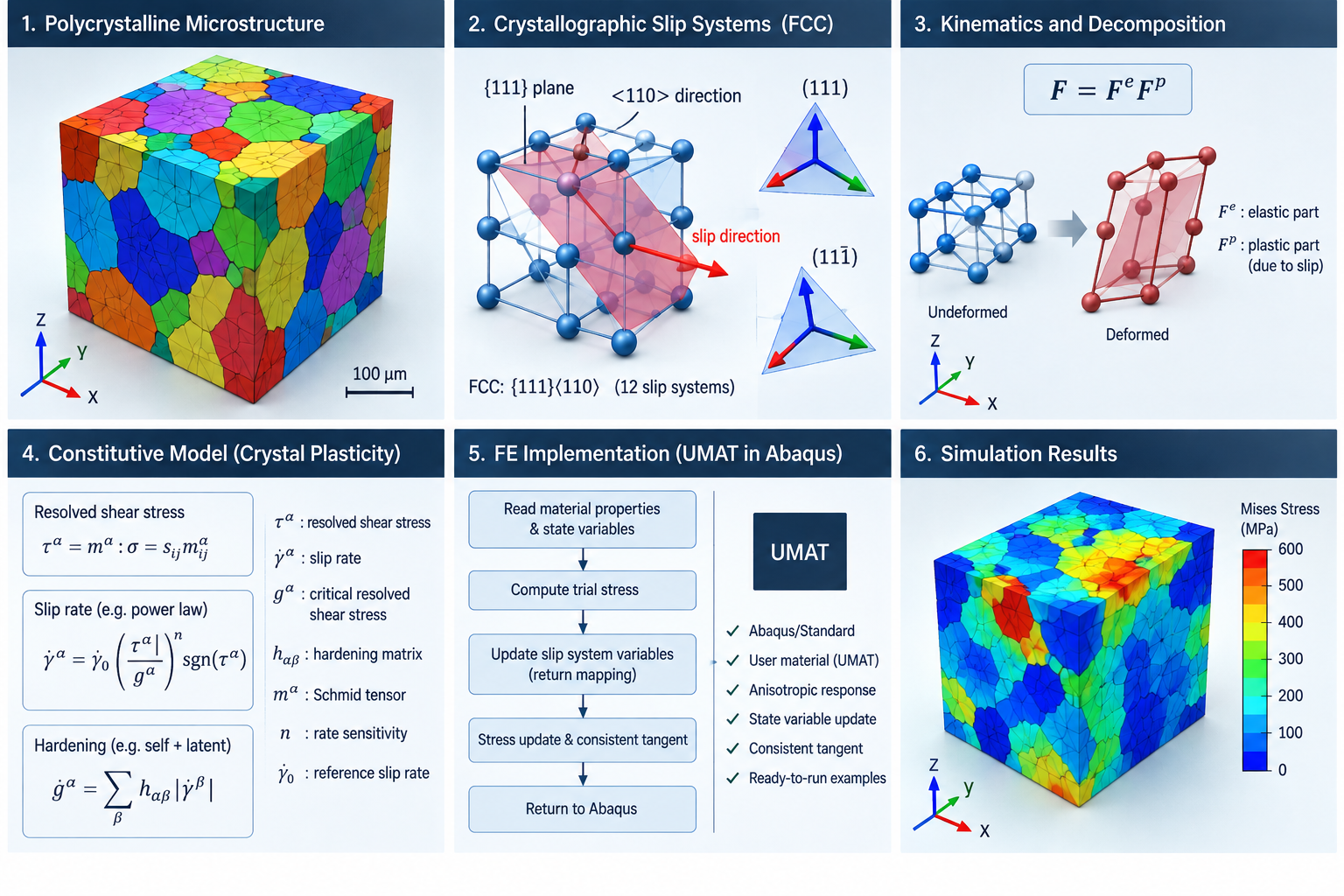
The Abaqus Crystal Plasticity UMAT Tutorial provides a complete workflow from crystal-level deformation mechanisms and constitutive equations to UMAT implementation, nonlinear solution, finite element analysis, and CPFEM result interpretation.
Crystal Structure
Orientation, slip planes & slip directions
Slip-System Response
Resolved shear stress & slip activation
Crystal Plasticity
Slip law, hardening & internal variables
UMAT Implementation
Stress update, STATEV & material response
Nonlinear Solution
Constitutive iteration & numerical Jacobian
Abaqus/Standard
Solve the complete CPFEM model
CPFEM Results
Stress, strain, slip activity, hardening & grain-scale deformation
Crystal Plasticity UMAT Implementation in Abaqus
The Crystal Plasticity UMAT is the central computational component connecting the constitutive formulation with Abaqus/Standard. During an analysis, Abaqus calls the UMAT at each relevant material integration point and provides the deformation information required to update the constitutive state.
The implementation must consistently update the stress state, crystallographic slip variables, hardening variables, crystal orientation information, and any other history-dependent quantities required by the selected formulation.
Crystal Plasticity State Variables in UMAT
The STATEV array stores the history-dependent quantities required by the crystal plasticity model. Depending on the formulation, these can include accumulated slip, slip resistance, orientation-related quantities, plastic deformation measures, and other internal variables required to continue the constitutive calculation from one increment to the next.
Material Jacobian & DDSDDE
Abaqus/Standard requires the UMAT to return a material Jacobian through DDSDDE. This tangent connects the constitutive stress update to the global Newton–Raphson equilibrium solution and therefore plays an important role in the numerical behavior of a crystal plasticity analysis.
Related Abaqus, CPFEM & Crystal Plasticity Resources
Continue your learning with related AbaqusLab tutorials and professional Abaqus consulting services, or explore authoritative external resources for Abaqus, crystal plasticity, computational mechanics, and plasticity research.
AbaqusLab Consulting & Technical Support
Related Advanced Abaqus Tutorials
Our Crystal Plasticity Research
Explore three of our peer-reviewed research papers in crystal plasticity and fatigue, including two publications in the International Journal of Plasticity and one publication in the International Journal of Fatigue, presented on our AbaqusLab About Us page.
External Crystal Plasticity & Abaqus Resources
For further study, the following external resources provide software documentation, open-source crystal plasticity frameworks, and peer-reviewed research in computational plasticity.
Need a Custom Abaqus Crystal Plasticity Model?
Crystal plasticity modeling can become challenging when the application requires a custom constitutive formulation, specialized hardening law, unusual slip-system definition, complex polycrystalline geometry, new numerical algorithm, or research-specific CPFEM implementation. If your project extends beyond the examples included in this Abaqus Crystal Plasticity UMAT Tutorial, the AbaqusLab team can help develop, debug, validate, and extend a custom crystal plasticity model for your research or engineering application.
Abaqus Crystal Plasticity UMAT Tutorial — Frequently Asked Questions
What is Abaqus Crystal Plasticity?
Abaqus Crystal Plasticity refers to implementing crystal-level constitutive equations inside the Abaqus finite element environment so that crystallographic deformation mechanisms such as slip can be represented directly in the material response.
What is CPFEM?
The Crystal Plasticity Finite Element Method (CPFEM) combines crystal plasticity constitutive equations with finite element analysis. It can represent crystallographic orientation, slip activity, hardening, and heterogeneous deformation throughout a finite element model.
What is a Crystal Plasticity UMAT?
A Crystal Plasticity UMAT is a user material subroutine that implements the crystal plasticity constitutive model in Abaqus/Standard. It calculates the material-point response and returns the updated stress, state variables, and material Jacobian to Abaqus.
Does this tutorial include the UMAT source code?
Yes. The tutorial provides the Crystal Plasticity UMAT source code together with Abaqus models, supporting files, step-by-step tutorial videos, and technical learning material.
Does the tutorial explain the crystal plasticity formulation?
Yes. The objective is to explain both the constitutive theory and its numerical implementation so that the UMAT can be understood and modified rather than treated as a black box.
Does the tutorial cover crystal plasticity hardening?
Yes. Part 2 focuses on hardening behavior and the evolution of slip resistance within the crystal plasticity framework.
Does it cover nonlinear crystal plasticity?
Yes. Part 3 focuses on the nonlinear constitutive equations and the numerical solution procedure required to update the crystal plasticity state.
Does the tutorial explain the numerical Jacobian?
Yes. Part 4 focuses on calculating and implementing the numerical material Jacobian through DDSDDE for Abaqus/Standard.
Can I model polycrystalline materials?
Yes. Part 5 extends the workflow to polycrystalline CPFEM models containing multiple grains with different crystallographic orientations.
Does the Crystal Plasticity series cover DREAM.3D, VUMAT and damage?
This page focuses on the general Parts 1–5 Abaqus Crystal Plasticity UMAT and CPFEM pathway. DREAM.3D real microstructure modeling, Crystal Plasticity VUMAT, and crystal plasticity cutting are advanced specialist topics with separate dedicated product and SEO pages.
Start the Abaqus Crystal Plasticity UMAT Tutorial
Learn how to implement Abaqus Crystal Plasticity from crystallographic deformation theory to a working Crystal Plasticity UMAT and advanced Crystal Plasticity Finite Element Method (CPFEM) simulation. The complete Parts 1–5 pathway provides the models, source code, numerical implementation, and step-by-step tutorial material required to understand and extend the methodology.
Understand the crystals. Build the UMAT. Solve the CPFEM model. Extend it to your own research.


Reviews
There are no reviews yet.