
Description
Abaqus Crystal Plasticity Damage & Cutting with VUMAT | CPFEM
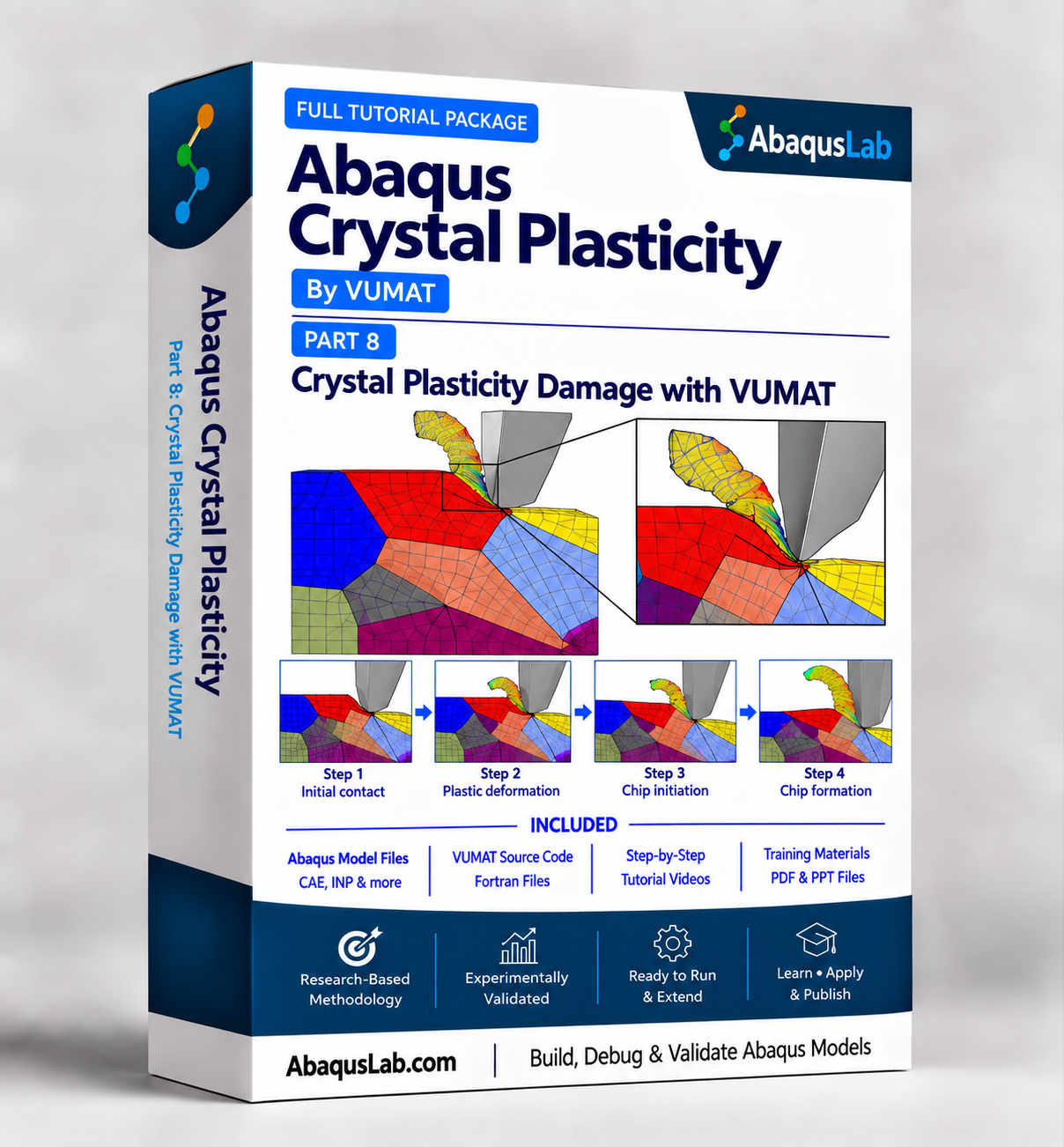
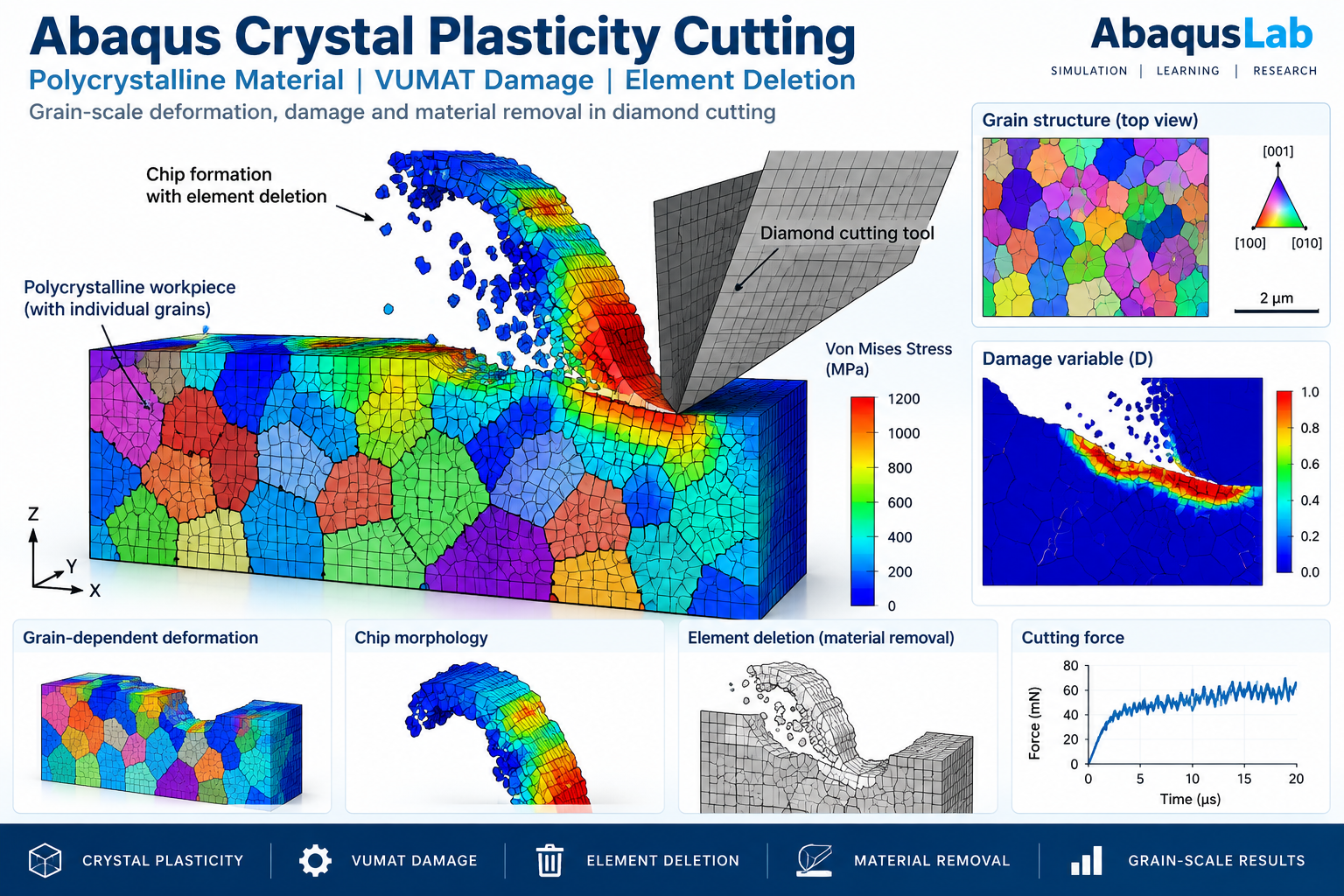
This advanced Abaqus Crystal Plasticity Damage package develops a grain-scale framework for modeling deformation, damage, and failure of crystalline materials. The Crystal Plasticity Damage VUMAT combines crystallographic slip and hardening with damage evolution in an Abaqus/Explicit material model. Abaqus Crystal Plasticity Cutting is then used to investigate the interaction between a cutting tool and individual grains with different crystallographic orientations. Grain Cutting & Damage Crystal Plasticity modeling connects grain-dependent deformation with progressive failure, material separation, and chip formation during cutting. Finally, Crystal Plasticity Element Deletion enables damaged material to be removed from the finite element model as the cutting process progresses.
What Is Abaqus Crystal Plasticity Damage Modeling?
Abaqus Crystal Plasticity Damage modeling extends conventional crystal plasticity beyond plastic deformation by introducing material degradation and failure at the grain scale. The constitutive response still accounts for crystallographic orientation, slip-system activity, resolved shear stress, and hardening, while an additional damage formulation determines when the local material response reaches a failure condition.
When implemented through VUMAT in Abaqus/Explicit, this framework can be applied to simulations involving severe deformation, contact, material separation, cutting, and progressive element deletion. This makes it possible to connect the crystallographic response of individual grains with macroscopic processes such as material removal and chip formation.
Crystal Plasticity Damage VUMAT in Abaqus/Explicit
The Crystal Plasticity Damage VUMAT evaluates the constitutive response at each material point during the explicit analysis. Crystal slip and hardening determine the anisotropic plastic response, while damage variables and failure criteria provide a route for representing progressive material degradation.
This combination is especially useful for applications where large deformation, changing contact conditions, severe localization, and material removal make a purely deformation-based crystal plasticity model insufficient.
Crystal Plasticity Cutting, Damage & Material Removal
In a crystal plasticity cutting simulation, individual grains may respond differently because each grain has its own crystallographic orientation and corresponding slip-system activity. As the cutting tool moves through the polycrystalline material, these differences can influence stress localization, plastic deformation, damage development, element deletion, chip morphology, and cutting response.
- Crystal-scale deformation — resolve orientation-dependent slip and hardening.
- Grain-level damage — connect local deformation with progressive failure.
- Element deletion — remove failed elements during the explicit analysis.
- Material removal — reproduce separation of material from the workpiece.
- Chip formation — investigate the evolving chip during cutting.
- Grain-dependent machining — study how crystallographic orientation affects cutting response.
What You Will Learn in This Crystal Plasticity Damage & Cutting Package
This package takes you from the Crystal Plasticity VUMAT framework developed in Part 7 to a complete damage and cutting application in Abaqus/Explicit. The objective is not simply to provide completed simulation files, but to explain how crystal plasticity, grain orientations, damage evolution, element deletion, contact, material removal, and cutting simulation are connected.
Understand Grain-Scale Crystal Plasticity
Understand how crystallographic orientation, slip systems, resolved shear stress, and hardening generate different mechanical responses in individual grains.
Implement Crystal Plasticity Damage
Learn how a damage formulation can be incorporated into the crystal plasticity framework to represent progressive material degradation and failure.
Implement Element Deletion
Understand how failure indicators and state variables can be used in Abaqus/Explicit to remove failed material and enable progressive material separation.
Build the Cutting Model
Create the cutting configuration with a polycrystalline workpiece, cutting tool, contact interaction, boundary conditions, grain orientations, and Abaqus/Explicit analysis procedure.
Simulate Material Removal & Chip Formation
Follow the progression from severe grain-scale deformation to damage, element deletion, material separation, and the development of the cutting chip.
Interpret Grain-Scale Cutting Results
Investigate stress, deformation, damage, deleted material, chip morphology, cutting response, and the influence of crystallographic orientation across neighboring grains.
What You Receive with This Crystal Plasticity Damage VUMAT Package
This Crystal Plasticity Damage VUMAT package is designed as a complete learning and implementation resource. You receive the Abaqus/Explicit cutting model, Crystal Plasticity VUMAT with damage and element-deletion implementation, polycrystalline model files, supporting material, tutorial videos, documentation, and technical support required to understand and adapt the workflow.
Complete Damage & Cutting Tutorial Videos
Abaqus/Explicit, VUMAT, CPFEM & Cutting Files
the goal is to give you a complete and reusable Abaqus Crystal Plasticity Damage workflow that you can understand, verify, modify, and extend for your own damage, failure, cutting, machining, and material-removal applications.
Choose Your Abaqus Crystal Plasticity Learning Path
Start with the fundamental Abaqus Crystal Plasticity UMAT implementation and progressively develop your CPFEM capabilities through hardening, nonlinear constitutive solution, numerical Jacobian implementation, polycrystalline modeling, EBSD-based realistic microstructures, Abaqus/Explicit VUMAT development, and finally crystal-level damage, element deletion, and cutting. Choose an individual package or the complete learning suite.
Part 1 — Fundamentals & CPFEM Implementation
- 🔬 Crystal plasticity fundamentals
- 💻 Complete UMAT implementation
- ⚙️ Abaqus/Standard workflow
£149 (Student: £129)
Explore Part 1 →
Part 2 — Crystal Plasticity Hardening
- ⚙️ Slip-resistance evolution
- 📈 Hardening formulation
- 🔗 Slip-system interactions
£169 (Student: £149)
Explore Part 2 →
Part 3 — Nonlinear Crystal Plasticity
- 🧮 Nonlinear constitutive equations
- 🎯 Local material-point solution
- 🔄 Iterative stress update
£179 (Student: £159)
Explore Part 3 →
Part 4 — Numerical Jacobian
- 📐 DDSDDE formulation
- 🧮 Numerical material tangent
- ⚙️ Abaqus/Standard convergence
£179 (Student: £159)
Explore Part 4 →
Part 5 — Polycrystalline CPFEM
- 🔷 Multiple crystal grains
- 🧭 Crystallographic orientations
- 🔗 Grain interactions
£189 (Student: £169)
Explore Part 5 →
Part 6 — DREAM.3D, EBSD & Real Microstructure
- 🧊 DREAM.3D microstructure
- 🔬 EBSD-based microstructures
- 🧭 Grain orientation mapping
£219 (Student: £189)
Explore Part 6 →
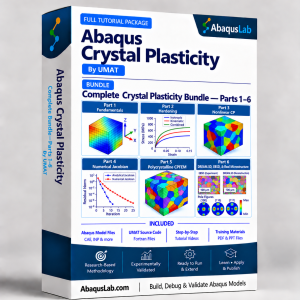
Complete Crystal Plasticity Bundle — Parts 1–6
- ✓ Complete Parts 1–6
- ✓ Crystal Plasticity UMAT
- ✓ Complete tutorials & files
£699 (Student: £599)
Get Parts 1–6 Bundle →
Part 7 — Abaqus Explicit Crystal Plasticity VUMAT
- ⚡ Abaqus/Explicit implementation
- 💻 Crystal Plasticity VUMAT
- 🧩 Explicit CPFEM workflow
£229 (Student: £199)
Explore Part 7 →
Part 8 — Crystal Plasticity Damage & Cutting with VUMAT
- 💎 Diamond cutting simulation
- 🔬 Polycrystalline grain-level damage
- 💥 Damage & element deletion
- 🌀 Material removal & chip formation
£249 (Student: £219)
Complete Crystal Plasticity Suite — Parts 1–8
- ✓ Complete Parts 1–8 learning path
- ✓ Abaqus Implicit & Explicit CPFEM
- ✓ UMAT + VUMAT + Damage
- ✓ Complete tutorials & files
£949 (Student: £799)
Get Complete Parts 1–8 Suite →
Abaqus Crystal Plasticity Cutting of Polycrystalline Materials
Abaqus Crystal Plasticity Cutting provides a microstructure-sensitive approach for studying machining processes in which the cutting scale becomes comparable to individual grains. Instead of treating the workpiece as a homogeneous isotropic material, the polycrystalline model represents grains with different crystallographic orientations.
Because differently oriented grains activate different slip systems, the local plastic response can vary as the cutting tool passes from one grain to another. This allows the CPFEM model to investigate grain-dependent deformation, stress localization, damage evolution, chip formation, and changes in cutting response.
- Polycrystalline grain structure
- Individual crystallographic orientations
- Crystal slip-system activation
- Orientation-dependent plastic deformation
- Grain-to-grain heterogeneity
- Cutting-tool interaction
- Damage localization
- Element deletion
- Material removal
- Chip morphology & cutting response
Crystal Plasticity Damage VUMAT
The Crystal Plasticity Damage VUMAT extends the constitutive model so that deformation and failure can be evaluated within the same Abaqus/Explicit material update. Crystal plasticity determines the anisotropic deformation of each grain, while the damage formulation evaluates the progressive loss of material integrity.
From Crystal Slip to Grain-Level Damage
During deformation, the resolved shear stresses on crystallographic slip systems control slip activity. Accumulated plastic deformation and the evolving stress state can then contribute to the damage calculation. This provides a pathway from crystallographic deformation to material failure at the integration-point level.
Damage State Variables in VUMAT
State variables can be used to store the evolving constitutive history required by both the crystal plasticity and damage formulations. These variables allow Abaqus/Explicit to track slip activity, hardening, accumulated deformation, damage progression, and the active or deleted status of material during the simulation.
Crystal Plasticity Element Deletion in Abaqus/Explicit
Crystal Plasticity Element Deletion provides the numerical mechanism required to convert local failure into physical material separation within the finite element model. Once the selected failure condition is satisfied, the affected material can be deactivated so that the cutting tool can progressively remove material from the workpiece.
From Damage Initiation to Material Removal
The process can be interpreted as a sequence: crystal-scale deformation develops first, damage accumulates under severe local loading, the failure condition is reached, and the corresponding material is removed through element deletion. Repetition of this process ahead of the cutting tool creates progressive material removal and enables chip formation.
Grain Cutting & Damage Crystal Plasticity
Grain Cutting & Damage Crystal Plasticity focuses on the interaction between the cutting process and the underlying polycrystalline microstructure. Individual grains do not necessarily deform or fail in the same manner because their crystallographic orientations produce different resolved shear stresses and slip-system activity.
Influence of Grain Orientation
As the tool moves through differently oriented grains, the local resistance to deformation may change. The resulting grain-dependent response can influence stress concentration, damage development, chip geometry, material flow, and cutting forces.
Influence of Grain Boundaries
Grain boundaries separate neighboring crystals with different orientations and therefore represent locations where deformation compatibility and slip activity can change significantly. A grain-resolved cutting model makes it possible to investigate how the response evolves as the tool approaches, crosses, and moves beyond a grain boundary.
Material Removal & Chip Formation with CPFEM
Material removal is one of the key differences between this Part 8 application and conventional CPFEM deformation analyses. The combination of crystal plasticity, damage, contact, and element deletion allows the workpiece to separate progressively as the cutting tool advances.
The resulting simulation can be used to investigate chip formation together with the grain-scale mechanical fields that generate it. This connects microscopic crystallographic behavior with a macroscopic machining response.
Complete Abaqus Crystal Plasticity Damage & Cutting Workflow
The complete Part 8 workflow connects polycrystalline geometry and grain orientation with Crystal Plasticity VUMAT, damage evolution, Abaqus/Explicit cutting, element deletion, material removal, and grain-scale result interpretation.
Why Use Crystal Plasticity for Cutting & Damage?
Conventional cutting simulations can reproduce macroscopic deformation and chip formation, but they do not necessarily resolve the crystallographic origin of grain-dependent material behavior. Crystal plasticity provides this additional microstructural level by explicitly representing slip systems and crystallographic orientation.
Grain-Level Anisotropy
Represent orientation-dependent deformation instead of treating every grain as mechanically identical.
Damage & Failure
Extend CPFEM beyond deformation to investigate progressive degradation and material failure.
Material Removal
Use element deletion to reproduce material separation and chip formation during cutting.
Advanced Abaqus/Explicit Application
Combine VUMAT, contact, severe deformation, damage, and element deletion within one explicit CPFEM workflow.
Who Is This Crystal Plasticity Damage & Cutting Package For?
This package is intended for researchers, graduate students, engineers, and advanced Abaqus users who want to extend crystal plasticity beyond conventional deformation analysis and investigate damage, failure, cutting, machining, and material removal at the grain scale.
- PhD and MSc researchers working with crystal plasticity and CPFEM
- Researchers studying machining and micro-cutting
- Users developing Crystal Plasticity VUMAT models
- Abaqus/Explicit users working with damage and element deletion
- Researchers investigating polycrystalline deformation and failure
- Engineers studying material removal and chip formation
- Researchers investigating crystallographic orientation and grain-boundary effects
Part 8 of the Abaqus Crystal Plasticity Learning Path
Part 8 is the advanced application stage of the AbaqusLab Crystal Plasticity learning path. It builds on the constitutive, numerical, polycrystalline, microstructure, and Abaqus/Explicit VUMAT foundations developed throughout Parts 1–7 and extends them to damage, failure, element deletion, material removal, and cutting.
Parts 1–4: Crystal Plasticity formulation → Hardening → Nonlinear solution → Numerical Jacobian
Part 5: Polycrystalline CPFEM → Multiple grains → Grain orientations → Grain interactions
Part 6: DREAM.3D → EBSD → Real microstructure → Grain orientation mapping
Part 7: Abaqus/Explicit → Crystal Plasticity VUMAT → Explicit CPFEM
Part 8: Crystal Plasticity Damage → Cutting → Element Deletion → Material Removal → Chip Formation
Need a Custom Crystal Plasticity Damage, VUMAT or Cutting Model?
Damage and cutting simulations often require project-specific constitutive formulations, VUMAT development, damage criteria, element deletion, contact definitions, polycrystalline geometry, calibration, or post-processing. AbaqusLab can help develop, debug, validate, and extend custom Crystal Plasticity VUMAT and Abaqus/Explicit models for research and engineering applications. Visit our Abaqus Consulting page to discuss your project.
Crystal Plasticity Damage, VUMAT & Cutting — Frequently Asked Questions
What is Abaqus Crystal Plasticity Damage?
Abaqus Crystal Plasticity Damage combines a crystallographic constitutive model with a damage or failure formulation so that grain-scale deformation and progressive material degradation can be studied within the same finite element framework.
What is a Crystal Plasticity Damage VUMAT?
A Crystal Plasticity Damage VUMAT is an Abaqus/Explicit user material that calculates the crystal-scale constitutive response while also tracking the variables required for damage evolution and failure.
Can Crystal Plasticity be used for cutting simulations?
Yes. Abaqus Crystal Plasticity Cutting can represent the orientation-dependent response of individual grains while the cutting tool produces severe deformation, damage, material separation, and chip formation.
What is Crystal Plasticity Element Deletion?
Crystal Plasticity Element Deletion combines the grain-scale constitutive calculation with a failure condition that allows failed material to be removed from the Abaqus/Explicit model.
Why is element deletion required for cutting?
A cutting simulation requires material to separate from the workpiece. Element deletion provides one practical numerical method for representing progressive material removal and the development of a chip as the tool advances.
Does the model represent individual grains?
Yes. The polycrystalline workpiece contains individual grains with different crystallographic orientations, allowing grain-dependent deformation and damage behavior to be investigated.
Can grain orientation influence the cutting response?
Yes. Different crystallographic orientations produce different resolved shear stresses and slip-system activity, which can alter local deformation, damage evolution, material flow, and the resulting cutting response.
Does Part 8 use Abaqus/Explicit?
Yes. Part 8 uses Abaqus/Explicit together with the Crystal Plasticity VUMAT, building directly on the explicit CPFEM framework introduced in Part 7.
Does the package include the VUMAT source code?
Yes. The package includes the Crystal Plasticity VUMAT source code together with the Abaqus/Explicit models and supporting tutorial material used in the Part 8 workflow.
Is technical support included?
Yes. Post-download technical support is included for the supplied package, including assistance with the tutorial files, implementation, model setup, troubleshooting, and interpretation of the workflow.
Related Crystal Plasticity Damage, VUMAT & Abaqus Resources
Continue your learning with related AbaqusLab tutorials and professional Abaqus consulting services, or explore authoritative external resources covering Abaqus/Explicit, user subroutines, crystal plasticity, damage, and computational material modeling.
AbaqusLab Consulting & Technical Support
Related Advanced Abaqus Tutorials
Explore other AbaqusLab packages covering advanced material modeling, fracture, damage, diffusion, and computational mechanics.
Our Crystal Plasticity Research
Explore three of our peer-reviewed research papers in
crystal plasticity and fatigue, including
two publications in the International Journal of Plasticity
and one publication in the International Journal of Fatigue.
Our research includes microstructure-sensitive crystal plasticity, material parameter identification, and fatigue applications.
External Abaqus, Crystal Plasticity & CPFEM Resources
For further study, the following external resources provide official Abaqus information, crystal plasticity frameworks, and peer-reviewed research relevant to CPFEM, material damage, and advanced computational material modeling.
AbaqusLab is an independent provider of Abaqus tutorials, simulation packages, and consulting services. External resources are provided for educational and research reference.


Reviews
There are no reviews yet.