

Description
Abaqus Peridynamics Tutorial | PDFEM & VUEL Implementation
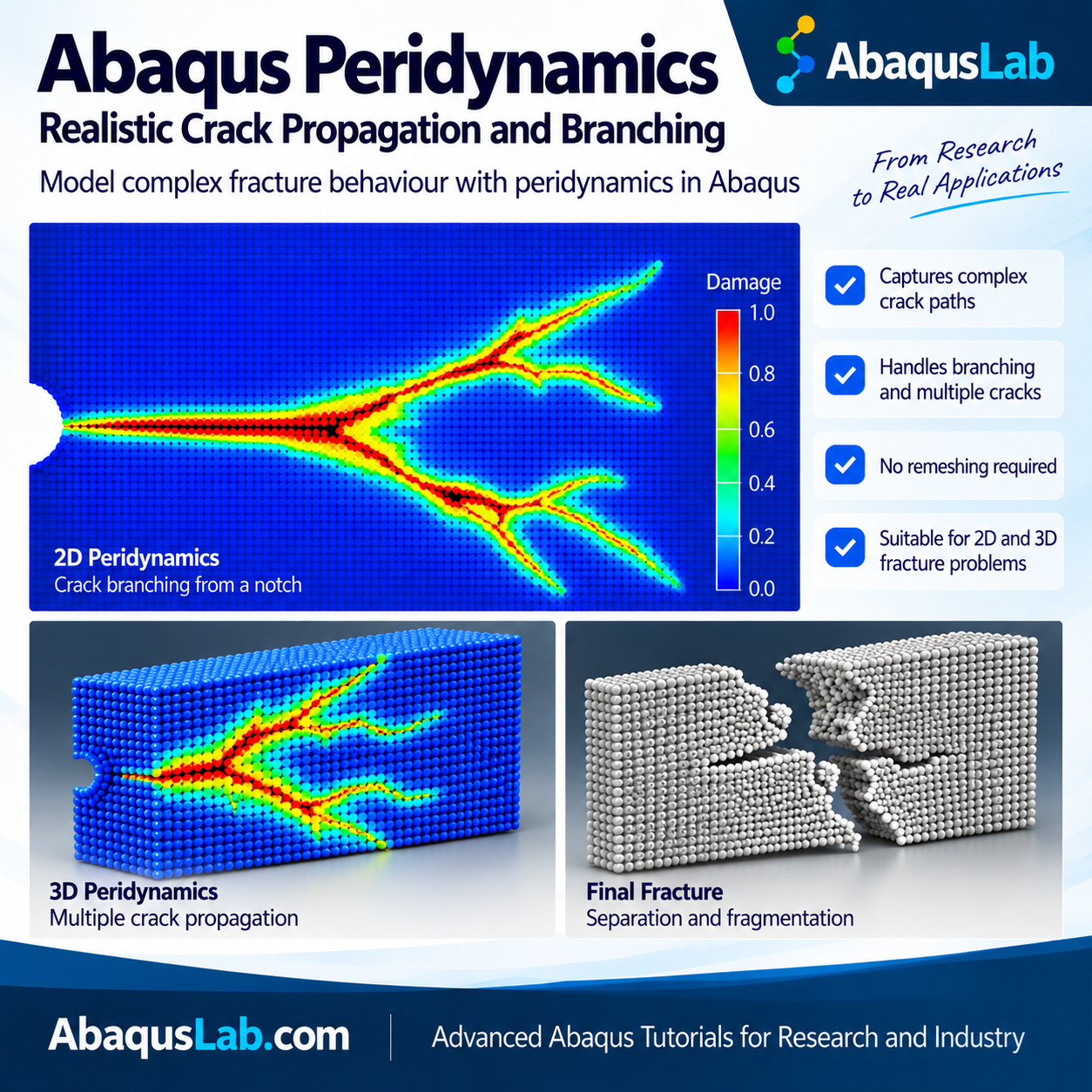
This research-based Abaqus Peridynamics Tutorial presents a practical workflow for modeling brittle fracture and complex crack evolution within Abaqus. The workflow introduces Peridynamics in Abaqus through the Peridynamic Finite Element Method (PDFEM), translating the underlying nonlocal theory into a numerical framework suitable for fracture simulation. Within this framework, a custom Abaqus Peridynamics VUEL enables the Peridynamic formulation to be implemented and solved using Abaqus/Explicit. As damage develops, cracks can initiate, propagate and branch naturally without explicitly tracking the evolving crack surface or prescribing the crack path in advance. The resulting Abaqus PDFEM VUEL workflow provides a practical route from Peridynamic theory to advanced numerical simulation of complex fracture behavior.
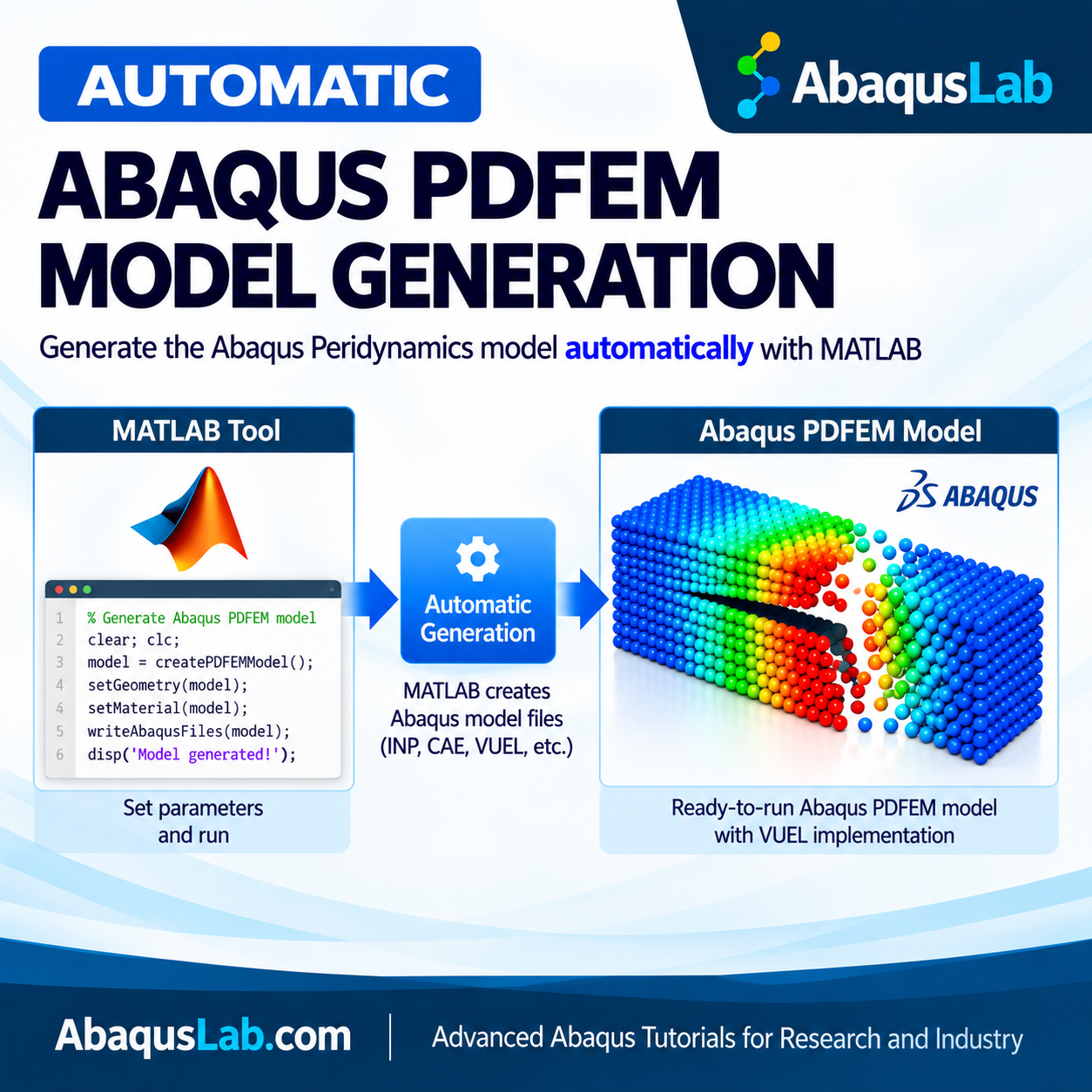
To make the workflow practical for larger models, MATLAB automation is used to generate the Abaqus PDFEM model automatically, including the required Peridynamic nodes, elements and connectivity. The generated model is then solved in Abaqus/Explicit using the custom VUEL, while VUMAT maps the Peridynamic damage information to the Abaqus model for visualization of crack initiation, propagation and branching in Abaqus/CAE. The methodology presented in this tutorial is based on the peer-reviewed study, published in the journal Computer Methods in Applied Mechanics and Engineering.
What Is Abaqus Peridynamics?
Abaqus Peridynamics is a nonlocal computational approach for fracture modeling in which material points interact with neighboring points within a finite horizon, allowing cracks and other discontinuities to develop without explicitly tracking the evolving crack surface.
Unlike conventional local continuum formulations, the governing Peridynamic equations remain applicable as discontinuities develop. This makes the method particularly suitable for simulating crack initiation, propagation, branching, fragmentation, and complex fracture paths that evolve naturally during the analysis.
AbaqusLab implements Peridynamics in Abaqus through the Peridynamic Finite Element Method (PDFEM), using a custom VUEL for Abaqus/Explicit fracture simulation.
The PDFEM framework represents Peridynamic interactions through user-defined elements within the Abaqus environment, providing a practical connection between nonlocal Peridynamic theory and finite element implementation. The methodology can be applied to two- and three-dimensional fracture problems, including static and dynamic crack propagation, crack branching, mixed-mode fracture, and impact-related failure.
Core Abaqus Peridynamics Modeling Concepts
- Abaqus Peridynamics Tutorial — the tutorial explains the workflow from Peridynamic fracture theory and PDFEM formulation to Abaqus implementation, model generation, simulation, and fracture-result interpretation.
- Abaqus Peridynamics VUEL — a custom VUEL provides the user-element implementation required to perform Peridynamic fracture simulations within Abaqus/Explicit.
- Peridynamics in Abaqus — Peridynamic interactions are introduced into the Abaqus analysis framework through user-defined elements, allowing nonlocal fracture behavior to be simulated within the Abaqus environment.
- Abaqus PDFEM VUEL — the PDFEM formulation is implemented through VUEL by assembling the Peridynamic element contributions required for an Abaqus/Explicit analysis.
- Peridynamic Finite Element Method (PDFEM) — PDFEM introduces Peridynamic nodes and elements so that the nonlocal Peridynamic formulation can be implemented within a finite element software architecture such as Abaqus.
- Abaqus Peridynamics Crack Propagation — cracks can initiate and propagate as Peridynamic interactions progressively fail, without prescribing the complete crack trajectory in advance.
- Abaqus Peridynamics Crack Branching — the nonlocal fracture formulation can reproduce evolving and branching crack paths under dynamic loading conditions.
- PDFEM–FEM Coupling — Peridynamic and conventional finite element regions can be combined so that PDFEM is concentrated in fracture-critical regions while standard FEM is retained elsewhere to improve computational efficiency.
What You Will Learn in This Abaqus Peridynamics Tutorial
This Abaqus Peridynamics Tutorial takes you from the fundamentals of nonlocal Peridynamic theory to practical Abaqus Peridynamics VUEL implementation. The objective is not simply to provide completed files, but to explain how the formulation is transformed into a working computational model.
- 📘 Understand Peridynamic theory & horizon — material points, nonlocal interactions, bonds, horizon radius, relative deformation, and the fundamental concepts required for Peridynamic analysis.
- 📐 Understand Abaqus PDFEM discretization — learn how material points and their neighboring points are organized into Peridynamic finite elements and how the nonlocal domain is discretized for Abaqus.
- 💻 Understand the Abaqus Peridynamics VUEL — study the structure of the VUEL implementation used to calculate the Peridynamic element internal-force contribution and mass terms in Abaqus/Explicit.
- ⚙️ Understand damage & bond failure — learn how failure of Peridynamic interactions produces progressive local damage and ultimately creates an evolving fracture path.
- 📈 Study crack propagation & branching — understand the numerical treatment of crack growth and dynamic branching without requiring the complete future crack trajectory to be explicitly defined.
- 🧮 Use the MATLAB tool for automatic Abaqus PDFEM model generation — learn how to automatically generate the required Peridynamic nodes, elements, neighborhoods, connectivity, and Abaqus model data instead of constructing large PDFEM models manually.
- 📊 Use VUMAT to visualize Peridynamic results in Abaqus/CAE — learn how the VUMAT workflow maps Peridynamic damage information onto the background Abaqus mesh so that crack initiation, propagation, and branching can be visualized through the Abaqus ODB.
- 🛠️ Adapt the complete Abaqus PDFEM workflow — modify the supplied models, VUEL, MATLAB generation tools, and visualization workflow for your own geometry, material, fracture problem, research project, or engineering application.
By the end of the package, you will understand how the Peridynamic Finite Element Method (PDFEM) is transformed from a nonlocal fracture formulation into a practical Abaqus PDFEM VUEL workflow, including automatic model generation with MATLAB and Peridynamic damage visualization through VUMAT and Abaqus/CAE.
Automatic Abaqus PDFEM Model Generation with MATLAB
Creating an Abaqus PDFEM model manually can be time-consuming because the Peridynamic discretization requires a large number of material points, user elements, neighboring nodes, horizon-based interactions, and connectivity definitions to be generated correctly.
To simplify this process, the package includes a dedicated MATLAB tool that automatically creates the required Abaqus PDFEM model data. Instead of manually defining thousands of nodes and Peridynamic connections, you define the model parameters and let the MATLAB tool generate the required model structure automatically.
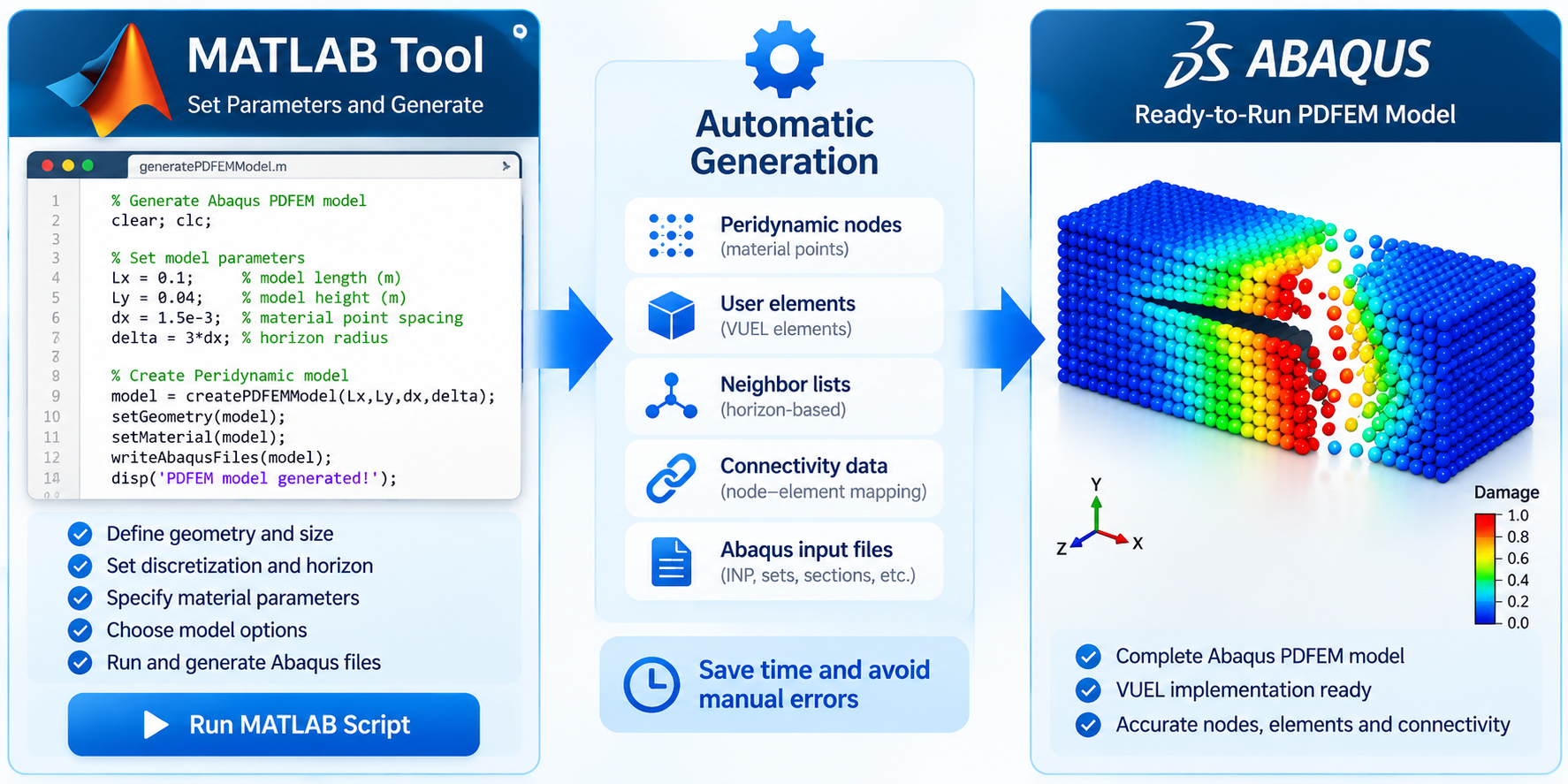
This automation makes it much easier to build larger Peridynamics in Abaqus models and reduces the risk of manual errors when preparing the connectivity required by the Abaqus Peridynamics VUEL.
What You Receive with This Abaqus Peridynamics Tutorial
This Abaqus Peridynamics Tutorial is designed as a complete learning and implementation package rather than only a finished VUEL. You receive the Abaqus models, source codes, MATLAB automation tool, tutorial videos, benchmark examples, documentation, and support required to understand, run, modify, and extend the PDFEM workflow.
Complete Step-by-Step Tutorial Videos
Models, VUEL, VUMAT, MATLAB & Support
Package objective: the goal is not only to provide working Abaqus files, but to give you a complete and reusable Abaqus Peridynamics and PDFEM workflow that you can understand, verify, modify, and extend for your own fracture mechanics research and engineering applications.
What You Can Predict with Abaqus Peridynamics VUEL
An Abaqus Peridynamics VUEL is particularly valuable when fracture initiation and the subsequent crack trajectory are part of the solution rather than completely prescribed beforehand. Depending on the formulation and model configuration, Abaqus PDFEM VUEL can be applied to static fracture, dynamic fracture, mixed-mode loading, crack branching and three-dimensional impact problems.
- Crack initiation through progressive Peridynamic damage
- Crack propagation without a predefined crack trajectory
- Dynamic crack branching under high-speed loading
- Mixed-mode fracture under combined loading conditions
- Multiple cracks and complex fracture paths
- Dynamic brittle fracture
- 3D impact fracture and complex crack development
- Contact and plate perforation
- Peridynamic damage evolution
- PDFEM–FEM coupled fracture behavior

- Research-backed capability: the underlying study demonstrates PDFEM predictions for static and dynamic crack propagation, mixed-mode fracture, dynamic crack branching, three-dimensional impact, contact and plate perforation, together with coupled PDFEM–FEM fracture simulations.
Recommended Prerequisite for Abaqus Peridynamics Modeling — Part 2
Learn Essential Abaqus VUEL Fundamentals Before Peridynamics Modeling
Part 2 builds on the Abaqus VUEL Tutorial fundamentals introduced in Part 1, including Abaqus/Explicit user-element programming, Fortran subroutine development, element connectivity, degrees of freedom, internal force calculations, and element mass matrices. These skills provide the foundation for Abaqus Peridynamics Modeling, where the VUEL subroutine is used to implement peridynamic interactions and fracture behavior, VUMAT supports results visualization, and MATLAB enables automatic peridynamic model generation. Completing Part 1 is recommended before starting the Abaqus Peridynamics Tutorial, particularly for users unfamiliar with user defined element programming in Abaqus/Explicit. Experienced users with prior VUEL knowledge can begin directly with Part 2.
Recommended learning sequence:
Abaqus Peridynamics Modeling Learning Path — Parts 1–2 and Complete Suite
The AbaqusLab Peridynamics Modeling Suite begins with Essential VUEL Fundamentals in Part 1, covering Abaqus/Explicit user-element programming, element definitions, degrees of freedom, internal forces, and element mass calculations. Part 2 progresses to Abaqus Peridynamics Modeling, including peridynamic fracture simulation, implementation via VUEL, results visualization via VUMAT, and automatic model generation with MATLAB. Recommended study order: Part 1 → Part 2.
Part 1 — Essential VUEL Fundamentals
- ⚙️ Abaqus/Explicit VUEL programming
- 💻 Fortran user-element implementation
- 📐 Element definition, nodes & DOFs
- 🔧 Internal forces & mass calculations
Part 2 — Abaqus Peridynamics Tutorial
- ⚙️ Peridynamics implementation via VUEL
- 💻 Results visualization via VUMAT
- 📐 Automatic model generation with MATLAB
- 📊 Peridynamic fracture simulation
Complete Abaqus Peridynamics Modeling Suite — Parts 1–2
- Complete Parts 1–2 learning path
- Essential Abaqus VUEL fundamentals
- Fortran user-element programming
- Element definitions and degrees of freedom
- Internal force and mass calculations
- Peridynamics implementation via VUEL
- Results visualization via VUMAT
- Automatic model generation with MATLAB
- Peridynamic fracture modeling
£899£529 Student: £399
Complete Abaqus Peridynamics Workflow
The Abaqus Peridynamics Tutorial provides a complete workflow from the underlying Peridynamic formulation to automatic PDFEM model generation, fracture simulation in Abaqus/Explicit, and final damage visualization in Abaqus/CAE.
nonlocal interactions
neighborhoods
model creation
& damage
fracture model
& branching
crack evolution in Abaqus/CAE
Abaqus Peridynamics VUEL Implementation
The Abaqus Peridynamics VUEL is one of the central components of the explicit PDFEM implementation. During an Abaqus/Explicit analysis, the user-defined element formulation evaluates the nonlocal interactions associated with each Peridynamic element and contributes the corresponding element response to the global system.
The implementation requires careful management of Peridynamic connectivity, nodal coordinates, neighborhood information, material parameters, element mass, internal forces and damage variables. These details are particularly important because a Peridynamic material point interacts with multiple neighboring points rather than only the immediately connected nodes of a conventional local finite element.
Peridynamic Element Connectivity in Abaqus
For each central Peridynamic material point, neighboring material points are identified according to the selected Peridynamic horizon. The resulting connectivity defines the user element used by the Abaqus VUEL. Correct neighborhood construction is therefore a fundamental part of implementing Peridynamics in Abaqus.
Internal Force & Mass Calculation in VUEL
For the explicit PDFEM formulation, the user element must provide the quantities required by the Abaqus/Explicit solution procedure. The underlying research derives the Peridynamic element internal-force vector and mass matrix specifically for this purpose, allowing the nonlocal formulation to operate within the Abaqus explicit finite element framework.
Peridynamic Horizon, Bonds & Nonlocal Interactions
The Peridynamic horizon defines the finite neighborhood over which a material point interacts with surrounding material points. Its size relative to the discretization spacing influences the number of interacting neighbors and is therefore an important numerical parameter in a Peridynamic model.
Within this neighborhood, the formulation evaluates the deformation and force states associated with nonlocal interactions. When the selected failure condition is reached, interactions can become irreversibly damaged. Accumulation of broken interactions produces local damage and eventually forms a macroscopic crack.
This nonlocal description is one of the reasons Abaqus Peridynamics is attractive for simulations involving complex fracture paths, multiple cracks and dynamic crack branching.
Abaqus Peridynamic Fracture, Damage & Failure
Fracture in a Peridynamic model develops through progressive failure of interactions between material points. Instead of representing a crack solely as a geometrical discontinuity that must be explicitly tracked, the evolving damage state naturally identifies regions in which the material has lost its ability to transmit the corresponding nonlocal forces.
This approach enables Abaqus crack propagation analyses in which the subsequent crack direction is determined by the evolving solution. Initial defects or pre-cracks may still be introduced when required by the physical problem or experimental benchmark, but the complete propagation trajectory does not need to be specified in advance.
For dedicated tutorials and models focused on failure, see our
Peridynamic Fracture, Damage & Failure
package.
Dynamic Crack Propagation & Crack Branching in Abaqus
One of the most important applications of Abaqus Peridynamics is dynamic brittle fracture. As loading intensity increases, a propagating crack can transition from approximately self-similar growth to branching and more complicated fracture patterns.
The research framework underlying this Abaqus Peridynamics Tutorial investigates dynamic pre-cracked plates under multiple stress levels and demonstrates the ability of PDFEM and coupled PDFEM–FEM models to reproduce crack propagation, crack speed and complex branching behavior.
For simulations specifically focused on high-speed loading and rapidly propagating fracture, explore
Peridynamic Impact & Dynamic Fracture.
PDFEM–FEM Coupling in Abaqus
Pure Peridynamic analysis can become computationally expensive because every material point interacts with multiple neighboring points inside its horizon. A PDFEM–FEM coupling strategy can reduce this computational burden by using Peridynamics primarily where nonlocal fracture behavior is required and conventional FEM elsewhere.
The research methodology uses a dual-based coupling approach between the PDFEM and FEM regions. This allows the model to benefit from the fracture capabilities of Peridynamics while retaining the computational efficiency of conventional finite elements in regions where a nonlocal description is unnecessary.
For a dedicated treatment of this methodology, see the
Peridynamic–FEM Coupling
package.
Static & Mixed-Mode Abaqus Peridynamics Validation
The published PDFEM framework is evaluated using several static fracture benchmarks. These include single-edge-notched specimens under tensile and shear loading as well as a more complex mixed-mode concrete fracture problem.
For the mixed-mode benchmark, the calculated crack trajectories are compared with experimental observations. The reported PDFEM and PDFEM–FEM predictions show agreement with the experimentally observed fracture paths, providing an important validation example for the nonlocal fracture formulation.
The peer-reviewed research basis for this methodology can be found in
Computer Methods in Applied Mechanics and Engineering.
Why Use Peridynamics in Abaqus?
Implementing Peridynamics in Abaqus combines a nonlocal fracture formulation with a mature finite element environment. Abaqus provides geometry and mesh preparation, loading and boundary-condition definition, explicit dynamic solution capabilities, contact algorithms, visualization and post-processing, while custom user subroutines provide the specialized Peridynamic formulation.
Nonlocal Fracture Modeling
Represent fracture through interactions over a finite horizon rather than relying exclusively on a local continuum description.
Complex Crack Paths
Capture evolving crack trajectories and branching without prescribing the complete future fracture path.
Abaqus/Explicit Integration
Combine a custom Peridynamic VUEL with Abaqus/Explicit capabilities for highly nonlinear transient fracture problems.
Contact & Impact
Integrate Peridynamic fracture calculations with standard Abaqus functionality for dynamic loading and contact problems.
Research Basis of the Abaqus Peridynamics Tutorial
The principal research basis of this package is the peer-reviewed paper by Y.H. Bie, Z.M. Liu, H. Yang and X.Y. Cui, “Abaqus implementation of dual peridynamics for brittle fracture”, published in Computer Methods in Applied Mechanics and Engineering, Volume 372, Article 113398.
The study develops the Peridynamic Finite Element Method (PDFEM), explicit and implicit Abaqus implementations, and a dual-based PDFEM–FEM coupling strategy. It investigates both static and dynamic fracture problems and demonstrates the methodology using two-dimensional and three-dimensional numerical examples.
Research reference:
Bie et al. — Abaqus implementation of dual peridynamics for brittle fracture
Additional Peridynamics literature can be explored through the
Peridynamics refereed-article collection.
Explore More Advanced Abaqus Modeling
The Abaqus Peridynamics Tutorial is part of the wider AbaqusLab collection of research-based simulation resources. If your work extends beyond Peridynamic fracture, explore our advanced tutorials for phase-field fracture and hydrogen-assisted damage, or work directly with our team for a customized Abaqus implementation.
Abaqus Phase Field Fracture
Explore an alternative fracture framework for predicting crack nucleation and propagation using phase-field modeling and a research-based Abaqus UMAT implementation.
Abaqus Hydrogen Modeling
Continue into coupled hydrogen–mechanics modeling, including hydrogen diffusion, trapping, fatigue, damage, and hydrogen-assisted cracking in Abaqus.
Abaqus Consulting
Need to adapt Peridynamics, PDFEM, VUEL, VUMAT, fracture, or another advanced Abaqus formulation to your own research or engineering problem?
Need a Custom Abaqus Peridynamics Model?
Peridynamic modeling can become challenging when the application requires a custom VUEL, specialized material behavior, large Peridynamic neighborhoods, PDFEM–FEM coupling, complex geometries, impact loading or research-specific fracture formulations.
If your project extends beyond the examples included in this Abaqus Peridynamics Tutorial, the AbaqusLab team can help develop and validate a custom model for your research or engineering application.
Visit our
Abaqus Consulting
page to discuss a custom Abaqus project, user subroutine or Peridynamic implementation.
Abaqus Peridynamics Tutorial — Frequently Asked Questions
What is Abaqus Peridynamics?
Abaqus Peridynamics refers to implementing a nonlocal Peridynamic formulation within the Abaqus finite element environment. In this tutorial, PDFEM user elements are used to represent interactions between material points within a finite horizon and to simulate fracture through progressive failure of those interactions.
What is Abaqus PDFEM?
Abaqus PDFEM is an implementation of the Peridynamic Finite Element Method within Abaqus. The methodology represents Peridynamic material points and their neighborhoods through user-defined finite elements, allowing the nonlocal equations to be solved using the Abaqus computational framework.
What is an Abaqus Peridynamics VUEL?
An Abaqus Peridynamics VUEL is a user-defined element subroutine used with Abaqus/Explicit to implement the Peridynamic element formulation. It provides the element-level quantities required by the explicit solver, including the Peridynamic internal-force and mass contributions.
Can Abaqus Peridynamics model crack propagation?
Yes. Peridynamic formulations are particularly suitable for problems involving discontinuities because fracture can evolve through progressive damage and failure of nonlocal interactions. The complete future crack path does not need to be prescribed before the analysis.
Can Abaqus Peridynamics predict crack branching?
Yes. Dynamic Peridynamic fracture models can capture crack branching when the loading and material response produce the conditions required for branching. The research framework underlying this tutorial includes dynamic crack-propagation and branching examples.
Can Peridynamics be coupled with conventional FEM in Abaqus?
Yes. The underlying research develops a dual-based PDFEM–FEM coupling methodology in which Peridynamic and conventional finite element regions coexist within the model. This can reduce computational cost compared with applying Peridynamics throughout the entire domain.
Does this Abaqus Peridynamics Tutorial use Abaqus/Explicit?
Yes. The tutorial focuses on an Abaqus/Explicit VUEL implementation of the Peridynamic finite element methodology for fracture analysis.
Does the research framework also support Abaqus/Standard?
Yes. The published PDFEM research develops both explicit and implicit formulations: VUEL is used for the explicit implementation and UEL for the implicit implementation. The downloadable tutorial package described on this page focuses on the VUEL-based explicit workflow unless otherwise stated in the package contents.
Is the Abaqus Peridynamics methodology research-based?
Yes. The methodology presented in this tutorial is based on peer-reviewed research published in Computer Methods in Applied Mechanics and Engineering and supported by numerical fracture benchmarks, including comparisons with experimental observations reported in the literature.
Start the Abaqus Peridynamics Tutorial
Learn how to implement Abaqus Peridynamics from the underlying nonlocal theory to a working Abaqus PDFEM fracture model. The complete package provides the Abaqus Peridynamics VUEL, supporting model files, implementation tools and step-by-step tutorial material required to understand and extend the methodology.
Build the formulation. Understand the VUEL. Simulate crack propagation with Peridynamics in Abaqus.



Reviews
There are no reviews yet.