

Description
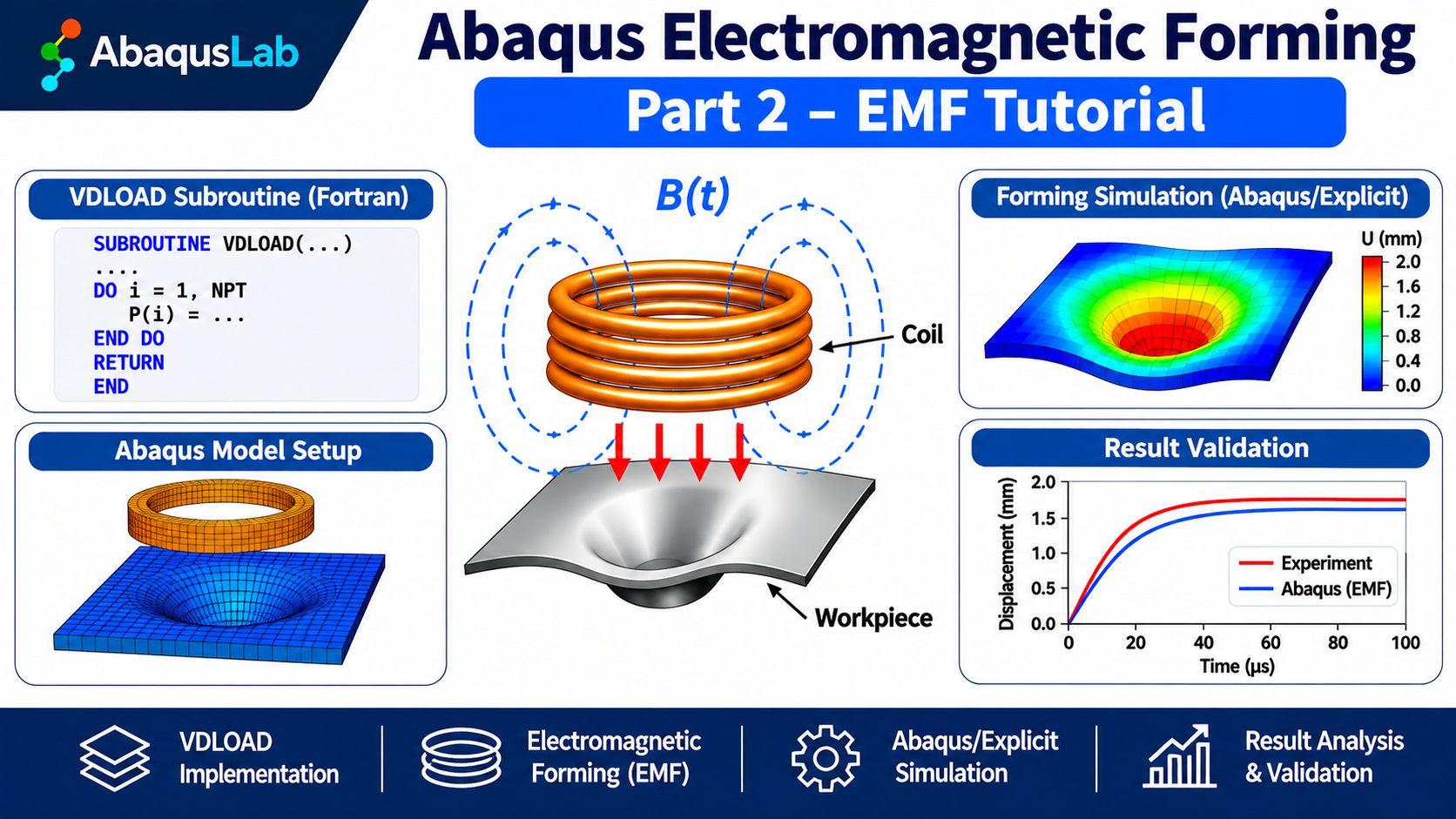
Abaqus Electromagnetic Forming Tutorial
This Abaqus Electromagnetic Tutorial explains Abaqus Electromagnetic Forming using electromagnetic-force calculations and a user-defined loading workflow in Abaqus/Explicit. You will explore Electromagnetic Forming VDLOAD implementation, build an Electromagnetic Forming Simulation, and interpret Abaqus Electromagnetic Loading during rapid metal deformation. The tutorial follows the technical progression from Maxwell’s equations and magnetic-field components B0 and B1 to mechanical loading, finite element analysis, and numerical verification.
What Is Abaqus Electromagnetic Tutorial and How Does Abaqus Electromagnetic Forming Work?
Abaqus Electromagnetic Tutorial is a practical learning resource for modeling electromagnetic metal forming with finite element analysis. In Abaqus Electromagnetic Forming, a transient electromagnetic field produces forces that accelerate and deform a conductive workpiece. An Electromagnetic Forming Simulation can represent this mechanical response in Abaqus/Explicit when an appropriate time- and position-dependent electromagnetic load has been calculated and applied. Electromagnetic Forming VDLOAD refers to implementing that distributed loading through the Abaqus/Explicit VDLOAD user subroutine. Abaqus Electromagnetic Loading must be derived or supplied from a separate electromagnetic formulation; VDLOAD itself does not solve Maxwell’s equations.
What Is Abaqus Electromagnetic Forming?
Abaqus Electromagnetic Forming is the numerical study of high-speed deformation caused by electromagnetic forces. It combines a description of transient magnetic fields with a structural model that predicts displacement, velocity, stress, strain, and final workpiece geometry. It is especially relevant when loading varies rapidly with time and position.
How Is Electromagnetic Forming VDLOAD Implemented?
Electromagnetic Forming VDLOAD uses a Fortran user subroutine to return a prescribed distributed load magnitude at locations and times requested by Abaqus/Explicit. The load may be computed from an analytical approximation or imported electromagnetic results. Correct load direction, units, spatial distribution, and time dependence are essential.
What Does an Electromagnetic Forming Simulation Predict?
An Electromagnetic Forming Simulation predicts the mechanical response of the metal to the imposed electromagnetic load. Typical results include workpiece displacement, deformation history, velocity, stress, equivalent plastic strain, and forming shape. Accuracy depends on the material law, loading data, boundary conditions, contact, mesh, and verification approach.
How Is Abaqus Electromagnetic Loading Related to Maxwell’s Equations?
Abaqus Electromagnetic Loading represents the force or pressure acting on the structure. Maxwell’s equations describe the electromagnetic field, while a force formulation connects that field to mechanical loading. The tutorial’s reference presentation addresses the EMF formulation and B0/B1 calculations; the exact pressure expression must follow the underlying model rather than being assumed universally.
Does Abaqus/Explicit VDLOAD Solve the Electromagnetic Field?
No. VDLOAD is a user-defined distributed-load interface in Abaqus/Explicit. It applies the load values supplied by the subroutine. It does not automatically calculate the coil current, induced currents, electromagnetic field, or electromagnetic–structural coupling. A separate formulation or electromagnetic solver is needed for those quantities.
Who Should Study This Abaqus Electromagnetic Tutorial?
This Abaqus Electromagnetic Tutorial is intended for Abaqus analysts, metal-forming researchers, postgraduate students, and Fortran developers who need to connect electromagnetic force calculations with explicit structural simulation. Familiarity with Abaqus/Explicit and VDLOAD is useful; Part 1 provides the recommended programming foundation.
Abaqus Electromagnetic Forming — Formulation, Equations and VDLOAD Implementation
The following expressions explain the Electromagnetic Forming Simulation workflow at a conceptual level. They are not claimed to reproduce every equation or numerical constant in the reference presentation. Use the exact electromagnetic formulation and boundary conditions of the supplied study when implementing Abaqus Electromagnetic Loading.
1. Maxwell’s Equations
The electromagnetic field is described by Maxwell’s equations. The relationships below are general differential forms, not a transcription of the specific paper.
\nabla\times\mathbf{H}=\mathbf{J}+\frac{\partial\mathbf{D}}{\partial t}
\]
\[
\nabla\times\mathbf{E}=-\frac{\partial\mathbf{B}}{\partial t}
\]
2. Magnetic-Field Components B₀ and B₁
The reference presentation includes a dedicated B₀/B₁ calculation. The following notation identifies two field contributions; their definitions and actual calculation must follow the reference.
\mathbf{B}=\mathbf{B}_{0}+\mathbf{B}_{1}
\]
3. Electromagnetic Force Density
The Lorentz-force density relates current density and magnetic flux density. Converting it into a distributed pressure requires a geometry-specific derivation.
\mathbf{f}_{\mathrm{em}}=\mathbf{J}\times\mathbf{B}
\]
4. Electromagnetic Loading History
A prescribed electromagnetic pressure may vary with position and time. This is a generic load representation, not a fitted loading law from the reference.
p_{\mathrm{em}}=p_{\mathrm{em}}(\mathbf{x},t)
\]
5. VDLOAD Fortran Implementation
VDLOAD supplies the distributed load magnitude at the locations and times requested by Abaqus/Explicit; the electromagnetic field is not solved by VDLOAD.
\mathrm{value}(k)=p_{\mathrm{em}}(\mathbf{x}_{k},t)
\]
6. Explicit Dynamic Equilibrium
Abaqus/Explicit computes the workpiece motion under applied loading. The expression below is a schematic finite-element equation of motion.
\mathbf{M}\ddot{\mathbf{u}}=\mathbf{F}_{\mathrm{ext}}-\mathbf{F}_{\mathrm{int}}
\]
7. Displacement and Plastic Deformation
Interpret displacement, velocity, equivalent plastic strain, and stress outputs to assess the forming response.
\mathbf{v}=\frac{\mathrm{d}\mathbf{u}}{\mathrm{d}t}
\]
8. Numerical Verification
Compare the computed response against available reference results and evaluate mesh, loading, material, and energy sensitivity.
\Delta u=u_{\mathrm{simulation}}-u_{\mathrm{reference}}
\]
Recommended Prerequisite — Abaqus VDLOAD Fundamentals for Electromagnetic Forming
Learn Abaqus VDLOAD Fortran Programming Before EMF Part 2
Part 2 focuses on the electromagnetic forming application. Part 1 — Abaqus VDLOAD Tutorial | Essential Fundamentals for EMF is recommended if you are new to Fortran user subroutines, distributed loading, compilation, and Abaqus/Explicit job execution. Experienced VDLOAD users may proceed directly to Part 2.
Recommended sequence:
What Does the Abaqus Electromagnetic Forming Tutorial Cover?
The Abaqus Electromagnetic Tutorial connects Abaqus Electromagnetic Forming theory, Electromagnetic Forming VDLOAD programming, and Electromagnetic Forming Simulation verification. It emphasizes how to represent Abaqus Electromagnetic Loading without confusing the electromagnetic calculation with the Abaqus structural solver.
EMF Fundamentals
Electromagnetic forming physics and high-speed deformation
Maxwell’s Equations
Electromagnetic field governing relationships
B₀ and B₁
Magnetic-field calculation concepts in the reference study
Lorentz Force
Relationship between induced current, magnetic field and force
Loading History
Time-dependent and spatially varying load description
VDLOAD Fortran
Abaqus/Explicit user-defined distributed loading
Abaqus Model Setup
Geometry, materials, mesh and boundary conditions
Explicit Dynamics
High-speed response and time-integration considerations
Output Requests
Displacement, velocity, stress and plastic strain
Verification
Comparison against available reference results
Debugging
Load magnitude, units, directions and compilation
Results Interpretation
Forming shape and mechanical response
Abaqus Electromagnetic Forming Modeling Learning Path — Parts 1–3
The AbaqusLab Electromagnetic Forming Modeling Series begins with Abaqus VDLOAD subroutine fundamentals and Fortran programming in Part 1, advances to Abaqus Electromagnetic Forming by VDLOAD implementation in Part 2, and explores electromagnetic forming of welded parts in Part 3. The VDLOAD & EMF Bundle includes Parts 1–2, while the Complete Electromagnetic & FSW Forming Suite includes Parts 1–3. Recommended study order: Part 1 → Part 2 → Part 3. Part 2 focuses on Electromagnetic Forming Simulation and Abaqus Electromagnetic Loading in Abaqus/Explicit.
Part 1 — Abaqus VDLOAD Tutorial | Essential Fundamentals for EMF
- ⚙️ VDLOAD subroutine fundamentals
- 💻 Fortran programming and Abaqus/Explicit
- 📐 User-defined distributed loading
- 🔍 Implementation, debugging and verification
£69 Student: £49
Part 2 — Abaqus Electromagnetic Forming Tutorial
- 📘 Electromagnetic forming principles and Maxwell’s equations
- ⚙️ Electromagnetic Forming VDLOAD
- 📊 Magnetic-field B0 and B1 calculations
- 📉 Abaqus Electromagnetic Loading and verification
£129 Student: £99
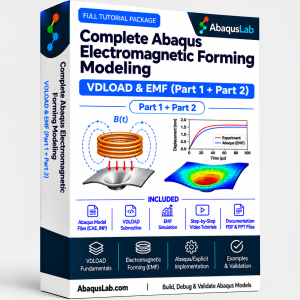
Complete Abaqus Electromagnetic Forming Modeling — Parts 1 + 2
- Part 1 — VDLOAD fundamentals
- Part 2 — Electromagnetic forming simulation
- Fortran user-defined electromagnetic loading
- Abaqus/Explicit modeling and verification
Part 3 — Abaqus Electromagnetic Forming of Welded (FSW) Parts
- 📘 Electromagnetic forming of welded components
- ⚙️ Welded-part simulation setup
- 📊 EMF loading and deformation response
- 🔍 Advanced results and numerical verification
£179 Student: £129
Complete Abaqus Electromagnetic & FSW Forming — Parts 1–3
- Complete Parts 1–3 learning path
- VDLOAD fundamentals and Fortran programming
- Electromagnetic forming principles and field
- Abaqus/Explicit electromagnetic loading
- Electromagnetic forming of welded parts
- FSW-related modeling context
- Simulation setup and verification workflow
What You Receive with This Abaqus Electromagnetic Tutorial
The learning objective is to understand and reproduce the Electromagnetic Forming Simulation workflow, from field formulation to Abaqus/Explicit results. Confirm the final downloadable package contents and video availability before publishing claims about specific files.
STEP-BY-STEP TECHNICAL LEARNING
EMF formulation; Maxwell’s equations; B0/B1 calculations; electromagnetic loading; VDLOAD implementation; Abaqus/Explicit model setup; verification.
MODEL AND SOURCE MATERIALS
Recommended deliverables: Fortran VDLOAD source, Abaqus model/input files, loading data or calculation scripts, and verification guidance. Include only items actually supplied with the final purchase.
Abaqus Electromagnetic Tutorial — Learning Sequence
Electromagnetic Forming Simulation — Abaqus/Explicit Verification Workflow
A reliable Electromagnetic Forming Simulation needs verification of both the electromagnetic load input and the structural response. The following checks are useful when implementing Abaqus Electromagnetic Loading through VDLOAD.
What You Will Learn with Abaqus Electromagnetic Forming
Understand Electromagnetic Forming
Connect transient electromagnetic effects to metal deformation
Interpret Maxwell’s Equations
Identify the field relationships relevant to EMF
Study B₀ and B₁
Follow the magnetic-field calculation stage
Apply Electromagnetic Forming VDLOAD
Translate a prescribed electromagnetic load into Abaqus/Explicit
Build an EMF Simulation
Configure mechanical geometry, materials and loads
Validate Abaqus Electromagnetic Loading
Check pressure histories, force direction and simulation results
Debug Fortran Subroutines
Review compilation, load arrays and common setup errors
Evaluate Forming Results
Assess displacement, stress, strain and deformation
Who Is This Abaqus Electromagnetic Tutorial For?
- Researchers studying electromagnetic forming and high-speed metal deformation
- Abaqus/Explicit analysts implementing user-defined distributed loads
- MSc and PhD students studying electromagnetic forming simulations
- Engineers developing or verifying VDLOAD Fortran routines
- Metal-forming specialists evaluating transient mechanical loading
- Researchers preparing advanced welded-component EMF applications
Need Custom Abaqus Electromagnetic Loading or VDLOAD Development?
Custom Abaqus Electromagnetic Loading applications may require electromagnetic field calculation, loading-data conversion, VDLOAD Fortran development, and validation against experiments or higher-fidelity coupled models. AbaqusLab consulting can help discuss the modeling scope and required verification.
Abaqus Electromagnetic Forming Tutorial — Frequently Asked Questions
What is Abaqus Electromagnetic Tutorial?
It is a tutorial on connecting electromagnetic-force calculations to an Abaqus/Explicit forming model, including VDLOAD user-defined loading and result verification.
What is Abaqus Electromagnetic Forming?
It is the simulation of rapid metal deformation driven by transient electromagnetic forces.
What does Electromagnetic Forming VDLOAD mean?
It means using the Abaqus/Explicit VDLOAD user subroutine to apply a calculated, time- and position-dependent distributed electromagnetic load.
Does VDLOAD solve Maxwell’s equations?
No. VDLOAD applies distributed loads; the electromagnetic field and force must be calculated separately or supplied as inputs.
What is included in an Electromagnetic Forming Simulation?
A typical structural model includes the workpiece, material response, explicit step, electromagnetic loading, boundary conditions, and result/energy checks.
What is Abaqus Electromagnetic Loading?
It is the force or pressure applied to the mechanical model to represent electromagnetic effects, subject to the underlying field and force formulation.
Why are B₀ and B₁ discussed?
The reference presentation includes a dedicated B₀/B₁ calculation stage. Their exact definitions must be checked in the underlying formulation.
Is Part 1 required before Part 2?
Part 1 VDLOAD fundamentals are recommended for beginners. Experienced Abaqus/Explicit and Fortran users may study Part 2 independently.
Does Part 2 include FSW welding?
No FSW implementation is assumed for Part 2. The welded-parts application belongs to the proposed Part 3 learning path.
How should I verify an EMF model?
Check the electromagnetic load calculation, units, time dependence, deformation and energy histories, mesh sensitivity, and agreement with available reference results.
Related Abaqus VDLOAD, Electromagnetic Forming and Welding Resources
Continue from the Abaqus Electromagnetic Tutorial to VDLOAD fundamentals, the advanced welded-parts application, and the complete EMF learning paths. The separate friction stir welding DFLUX tutorial is relevant background for the proposed welded-component application; DFLUX and VDLOAD have different roles.
4. SUPPORT & AUTOMATION
5. TECHNICAL REFERENCE
Consult the official Abaqus VDLOAD user-subroutine reference and the source electromagnetic-forming study when verifying interface details, force calculations and boundary conditions.

Reviews
There are no reviews yet.