Sale!

Complete Abaqus Electromagnetic & FSW Forming | VDLOAD & EMF & FSW

Original price was: £599.00.Current price is: £299.00.

🎓 Student: £219

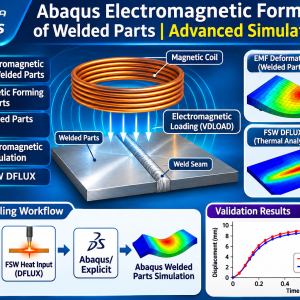
Master Abaqus Electromagnetic & FSW Forming by combining VDLOAD Fortran programming, electromagnetic forming simulations, and advanced welded-part analysis in Abaqus. This complete tutorial suite includes Part 1 — Abaqus VDLOAD Tutorial | Essential Fundamentals for EMF, Part 2 — Abaqus Electromagnetic Forming Tutorial, and Part 3 — Abaqus Electromagnetic Forming of Welded Parts | Advanced Simulation. Learn Abaqus VDLOAD Subroutine development, Abaqus Electromagnetic Forming, Electromagnetic Forming VDLOAD, Abaqus Electromagnetic Forming of Welded Parts, Abaqus Welded Parts Simulation, and Abaqus FSW DFLUX modeling concepts. Progress from user-defined loading fundamentals to electromagnetic pressure calculations, dynamic metal forming, friction stir welded components, and advanced numerical verification.

Everything you need in one package:

✓ Complete step-by-step video tutorials — from VDLOAD fundamentals to electromagnetic forming of welded parts
✓ Abaqus simulation files and supporting Fortran source code for Part 1, Part 2, and Part 3
✓ Abaqus VDLOAD fundamentals and Fortran programming
✓ User-defined distributed loading and pressure formulation
✓ VDLOAD subroutine structure, arguments, and implementation
✓ Time-dependent, spatially varying, and nonuniform loading
✓ Load magnitude calculations and amplitude functions
✓ Practical VDLOAD examples and numerical verification
✓ Electromagnetic forming principles and Maxwell’s equations
✓ Magnetic field calculations (B₀ and B₁)
✓ Electromagnetic force and pressure formulation
✓ Electromagnetic loading implementation using VDLOAD
✓ Abaqus/Explicit model setup and dynamic simulation workflow
✓ Electromagnetic forming of metal sheets and deformation analysis
✓ Friction stir welding (FSW) fundamentals and welded joint modeling
✓ Abaqus FSW DFLUX thermal loading principles and heat-input formulation
✓ Electromagnetic forming of friction stir welded parts
✓ Weld seam behavior and deformation of welded metal components
✓ Material properties, boundary conditions, and contact modeling
✓ Dynamic stress, strain, displacement, and plastic deformation analysis
✓ Weld-region deformation and forming response evaluation
✓ Fortran compilation, debugging, and troubleshooting
✓ Numerical verification and comparison with available experimental results
✓ Advanced simulation post-processing and results interpretation
✓ Complete learning path: Part 1 — VDLOAD Fundamentals → Part 2 — Electromagnetic Forming → Part 3 — Electromagnetic Forming of Welded Parts
✓ Technical documentation and supporting tutorial materials

🚀 Order Custom Project 🔬 Continue to Part 2__EMF
Categories: ,

Description

Abaqus Electromagnetic Forming Modeling Learning Path — Parts 1–3

The AbaqusLab Electromagnetic Forming Modeling Series begins with Abaqus VDLOAD subroutine fundamentals and Fortran programming in Part 1, advances to Abaqus Electromagnetic Forming by VDLOAD implementation in Part 2, and explores electromagnetic forming of welded parts in Part 3. The VDLOAD & EMF Bundle includes Parts 1–2, while the Complete Electromagnetic & FSW Forming Suite includes Parts 1–3. Recommended study order: Part 1 → Part 2 → Part 3. Part 2 focuses on Electromagnetic Forming Simulation and Abaqus Electromagnetic Loading in Abaqus/Explicit.

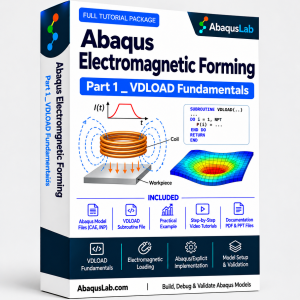
Part 1 — Abaqus VDLOAD Tutorial | Essential Fundamentals for EMF

  • ⚙️ VDLOAD subroutine fundamentals
  • 💻 Fortran programming and Abaqus/Explicit
  • 📐 User-defined distributed loading
  • 🔍 Implementation, debugging and verification

£149
£69   Student: £49

Explore Part 1 →

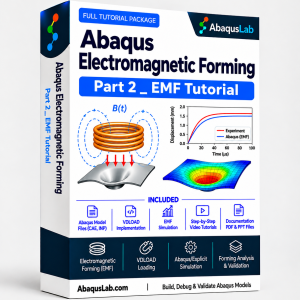
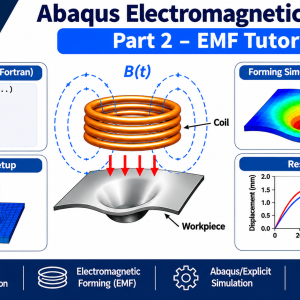
Part 2 — Abaqus Electromagnetic Forming Tutorial

  • 📘 Electromagnetic forming principles and Maxwell’s equations
  • ⚙️ Electromagnetic Forming VDLOAD
  • 📊 Magnetic-field B0 and B1 calculations
  • 📉 Abaqus Electromagnetic Loading and verification

£249
£129   Student: £99

Expore Part 2 →

VDLOAD & EMF MODELING BUNDLE

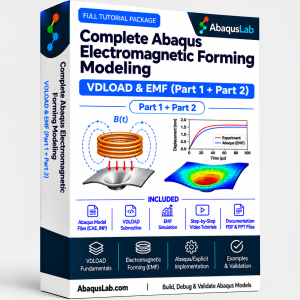
Complete Abaqus Electromagnetic Forming Modeling — Parts 1 + 2

  • Part 1 — VDLOAD fundamentals
  • Part 2 — Electromagnetic forming simulation
  • Fortran user-defined electromagnetic loading
  • Abaqus/Explicit modeling and verification

£349£169   Student: £129Explore VDLOAD & EMF Bundle →

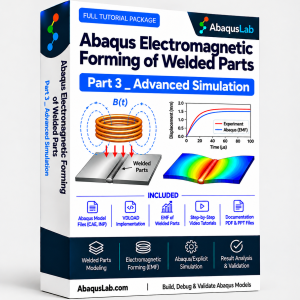
Part 3 — Abaqus Electromagnetic Forming of Welded (FSW) Parts

  • 📘 Electromagnetic forming of welded components
  • ⚙️ Welded-part simulation setup
  • 📊 EMF loading and deformation response
  • 🔍 Advanced results and numerical verification

£349
£179   Student: £129

Explore Part 3 →

COMPLETE ELECTROMAGNETIC & FSW FORMING SUITE

Complete Abaqus Electromagnetic & FSW Forming — Parts 1–3

  • Complete Parts 1–3 learning path
  • VDLOAD fundamentals and Fortran programming
  • Electromagnetic forming principles and field
  • Abaqus/Explicit electromagnetic loading
  • Electromagnetic forming of welded parts
  • FSW-related modeling context
  • Simulation setup and verification workflow
£599£299   Student: £219Explore Complete Suite →

What's Included?

This tutorial package provides a complete practical workflow for modelling and implementing the subject covered by the product in Abaqus. It includes the Abaqus model files, user-subroutine source code, step-by-step tutorial videos, and supporting training materials needed to follow and reproduce the modelling workflow.

Abaqus Model Files

Complete Abaqus model files used throughout the tutorial, including CAE and input files where applicable. The supplied models allow you to follow the examples directly and examine the modelling setup, analysis steps, material definitions, loading, boundary conditions, and output requests.

User Subroutine Files

The relevant Abaqus user-subroutine source files used in the modelling workflow, including UMAT, UMATHT, UEL, or other applicable Abaqus subroutines. The source files are provided together with the tutorial so that you can examine how the required behaviour is implemented and use the supplied implementation as a starting point for your own models.

Step-by-Step Tutorial Videos

Detailed tutorial videos explaining the modelling procedure from model setup through analysis and post-processing. The videos demonstrate how the supplied Abaqus files and user subroutines are used and explain the important modelling and implementation steps.

Training Materials

Supporting PDF and PowerPoint training materials covering the concepts, modelling approach, implementation details, and practical workflow presented in the tutorial.

Complete Practical Workflow

The different components are provided as one integrated tutorial package. You can study the modelling concepts, inspect the Abaqus files, examine the user-subroutine implementation, follow the tutorial videos, and reproduce the demonstrated simulations as you progress through the tutorial.

Important Information

Prerequisites

A basic understanding of finite element modelling and Abaqus is recommended. Users should be familiar with creating Abaqus models, defining materials, applying loads and boundary conditions, running analyses, and reviewing simulation results.

Understanding of User Subroutines

The tutorial includes the relevant user-subroutine implementations and explains their role in the modelling workflow. Basic familiarity with Abaqus user subroutines is helpful, but the supplied examples and tutorial videos are designed to guide you through the implementation used in the models.

Abaqus and Software Requirements

A compatible licensed version of Abaqus is required to run the supplied models. Where user subroutines are compiled, an appropriate Fortran compiler and compatible Abaqus development environment may also be required.

Research and Engineering Applications

The tutorial is intended for engineers, researchers, postgraduate students, and Abaqus users working on computational mechanics problems. The examples provide a practical modelling workflow that can be adapted to different geometries, materials, loading conditions, and research problems.

Model Verification and Adaptation

The supplied examples demonstrate a specific modelling and implementation workflow. For research or engineering applications, the models should be adapted to the relevant material properties, loading conditions, geometry, and experimental or literature data. Appropriate verification and validation should be performed for the intended application.

Scope of the Tutorial

This product focuses on the practical implementation of the modelling approach covered by the tutorial in Abaqus. More advanced extensions, different physical assumptions, or application-specific formulations may require additional modelling, calibration, or user-subroutine development.

Reviews

There are no reviews yet.

Be the first to review “Complete Abaqus Electromagnetic & FSW Forming | VDLOAD & EMF & FSW”

Your email address will not be published. Required fields are marked *