
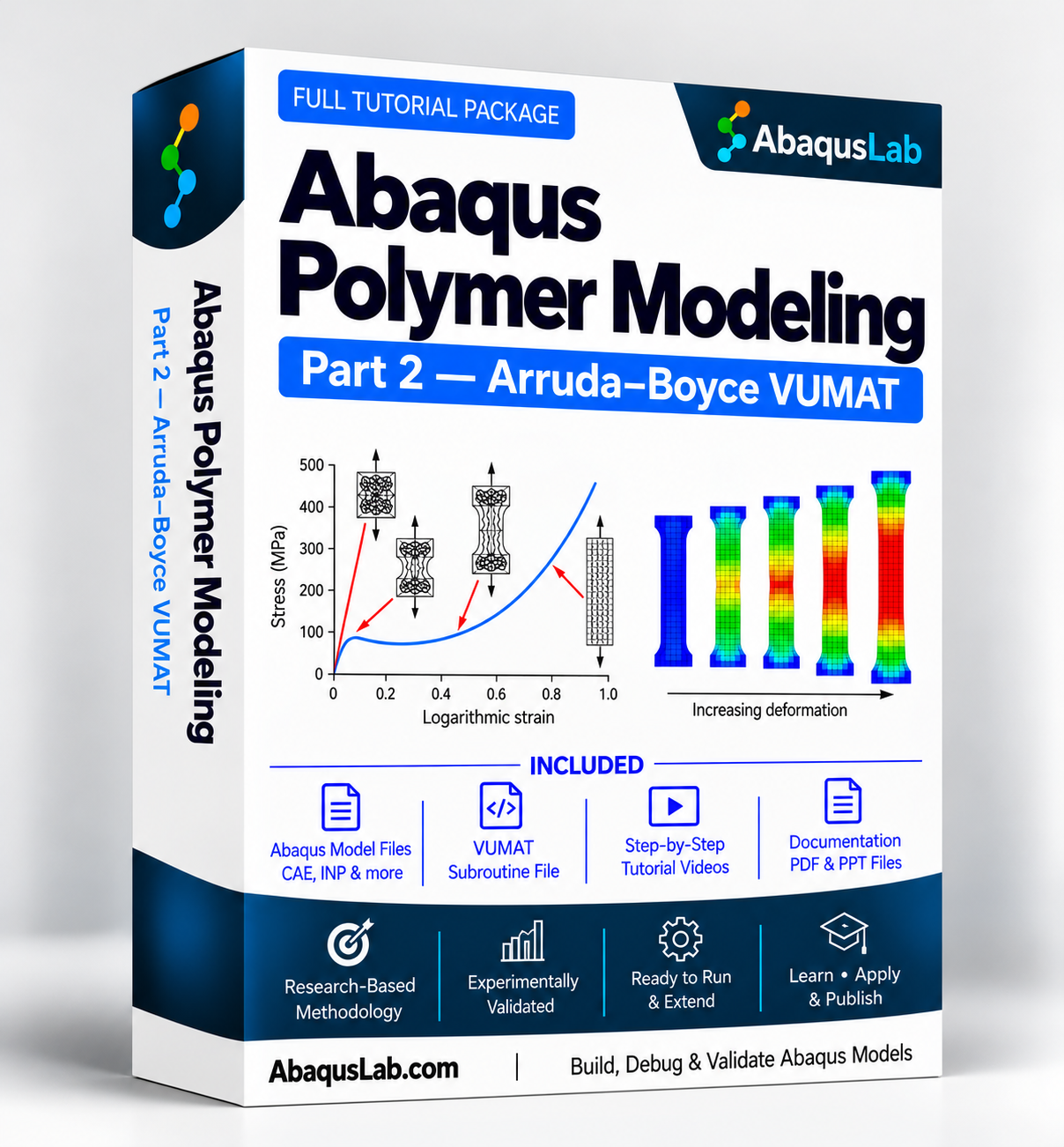


Description
Abaqus Polymer Modeling Tutorial | Arruda Boyce VUMAT
This comprehensive Abaqus polymer modeling tutorial presents Abaqus polymer VUMAT implementation and practical polymer modeling in Abaqus using the strain-rate-dependent Arruda–Boyce constitutive framework implemented in Abaqus/Explicit. The Arruda Boyce VUMAT combines large-deformation elasticity, eight-chain network hardening, and viscoplastic flow to represent yielding, strain softening, and strain hardening. Through practical viscoplastic polymer Abaqus implementation, the tutorial explains the deformation gradient, Hencky strain, internal variables, and numerical stress integration. It also examines Abaqus strain rate polymer behavior under different loading rates, helping engineers develop, execute, and evaluate nonlinear polymer material simulations.
This tutorial builds on the modeling research published by the Norwegian University of Science and Technology (NTNU, 2014), adapting its strain-rate-dependent viscoplastic formulation into a practical Abaqus/Explicit tutorial.
What Is Abaqus Polymer Modeling and How Does Arruda Boyce VUMAT Work?
Abaqus polymer modeling is the finite element simulation of polymer materials under mechanical loading, including nonlinear deformation, strain-rate sensitivity, yielding, strain softening, and strain hardening. An Abaqus polymer VUMAT enables researchers to implement custom constitutive models in Abaqus/Explicit using Fortran. This tutorial focuses on an Arruda Boyce VUMAT that combines finite-strain elasticity, viscoplastic flow, and an eight-chain molecular network to simulate rate-dependent polymer behavior.
Why Use an Arruda Boyce VUMAT for Abaqus Polymer Modeling?
The Arruda Boyce VUMAT represents nonlinear polymer deformation through finite-strain kinematics and molecular network hardening. The eight-chain model captures resistance to polymer-chain stretching, while the viscoplastic formulation accounts for yielding, strain-rate sensitivity, and strain softening. This combination is particularly useful for simulating polymers that exhibit both time-dependent inelastic deformation and significant strain hardening.
How Does Viscoplastic Polymer Modeling in Abaqus Capture Yielding and Strain Hardening?
Viscoplastic polymer Abaqus simulations use a rate-dependent constitutive flow rule to calculate inelastic deformation. The effective driving stress accounts for elastic stress and molecular network backstress. Internal state variables describe material softening and hardening, allowing the VUMAT to reproduce nonlinear stress–strain responses under different loading conditions.
How Are Strain-Rate Effects Evaluated in Abaqus Polymer Simulations?
Abaqus strain rate polymer analysis evaluates how polymer stress–strain behavior changes with loading speed. Researchers can apply different strain rates in tensile or compression simulations and compare the resulting stress, deformation, and hardening responses. The Arruda–Boyce viscoplastic formulation provides a framework for investigating rate sensitivity, hysteresis, and large-deformation polymer behavior.
Arruda Boyce VUMAT Model and Governing Equations
The Arruda Boyce model describes the finite-strain, rate-dependent behavior of polymers using a hyperelastic network and a viscoplastic flow element. The model is implemented in an Abaqus/Explicit VUMAT subroutine to simulate nonlinear polymer deformation, including yielding, strain softening, and strain hardening due to polymer-chain alignment.
1. Constitutive Model
The Arruda–Boyce model consists of a hyperelastic (Langevin) spring in parallel with a viscoplastic element. The total stress is the sum of the elastic (network) stress and the viscoplastic stress, which captures rate-dependent yielding and strain softening.
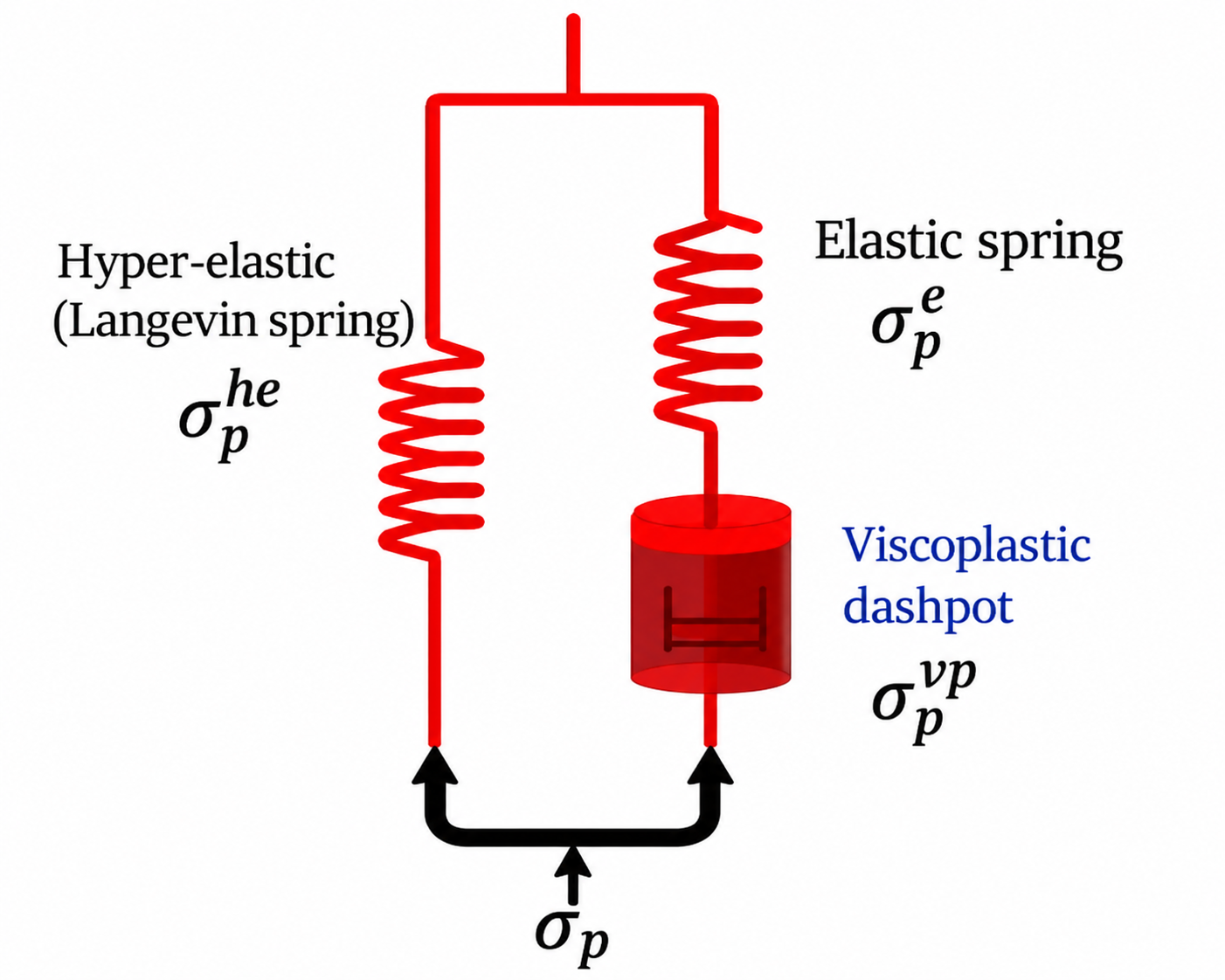
Total stress
\sigma_p
=
\sigma_p^{ve}
+
\sigma_p^{he}
\]
\sigma_p^{vp}
=
\sigma_p^e
=
\sigma_p^v
\]
- Finite-strain kinematics
- Hyper-elastic network hardening (eight-chain)
- Rate-dependent viscoplastic flow
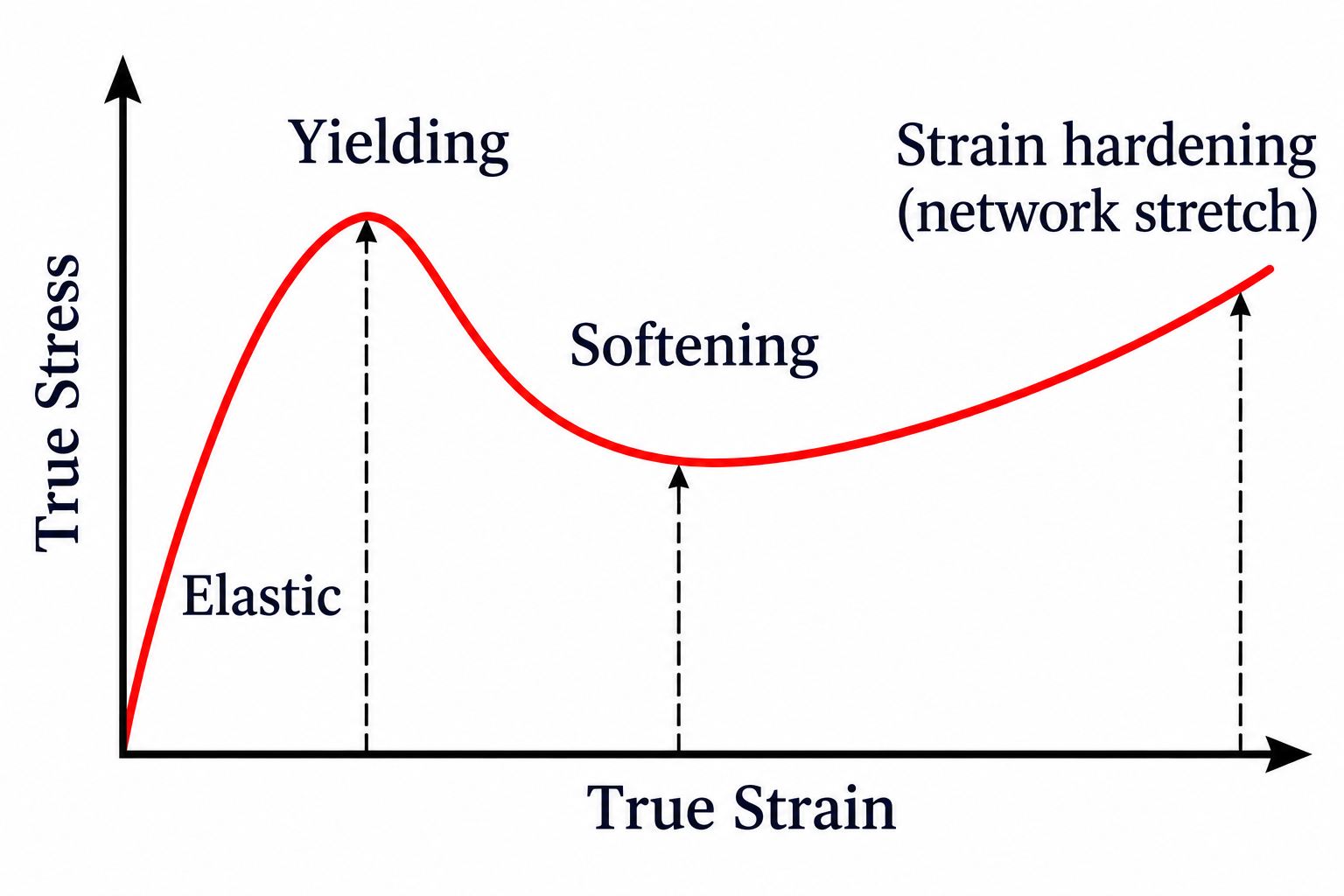
- Strain softening and strain hardening
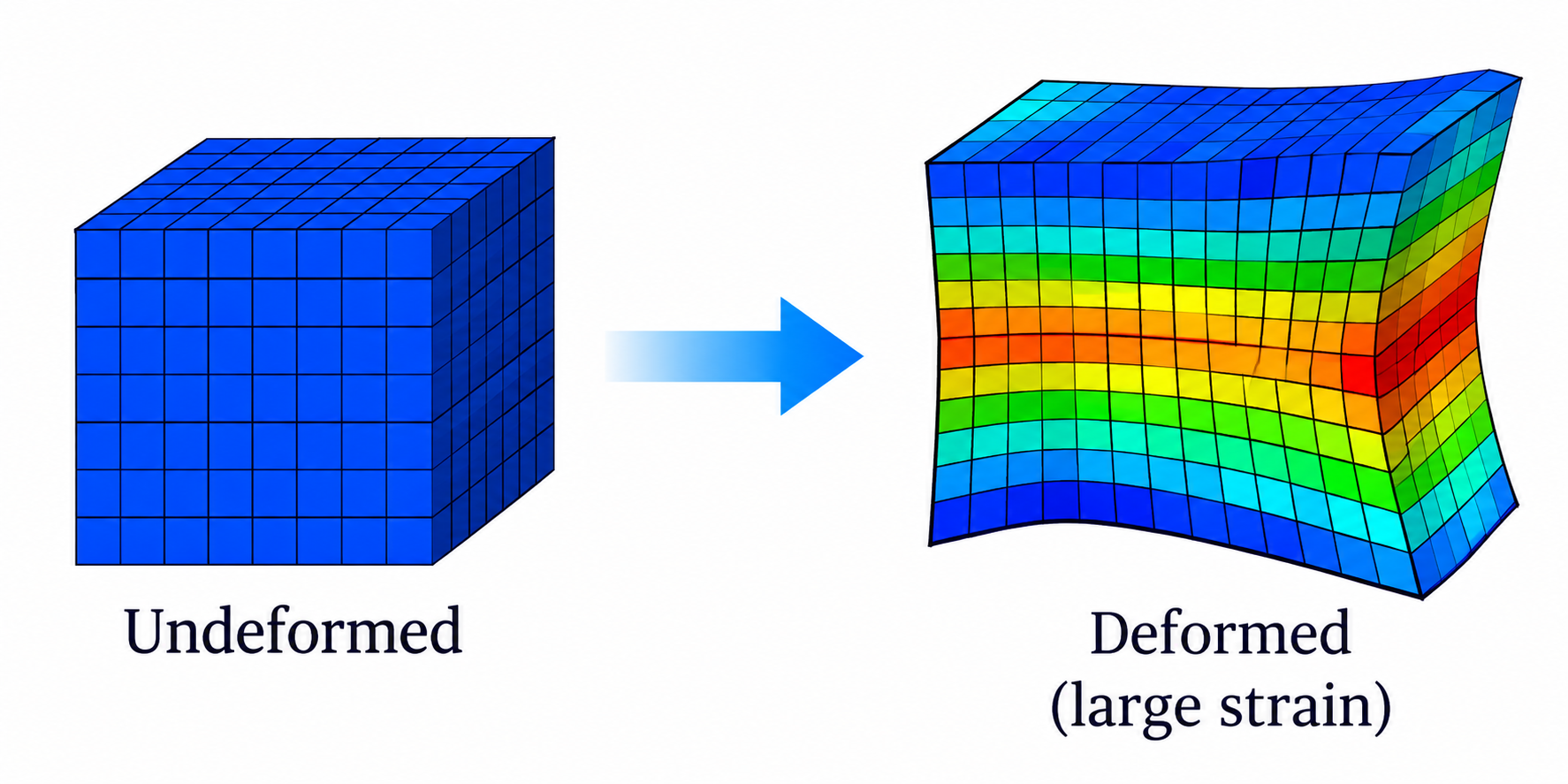
2. Finite-Strain Elastic Stress
Kirchhoff stress based on Hencky strain is used to describe the elastic response of the polymer network.
\boldsymbol{\tau}
=
\lambda\,\operatorname{tr}(\mathbf h)\mathbf I
+
2G\mathbf h
\]
\(\mathbf h\) : logarithmic (Hencky) strain tensor
\(G\) : shear modulus
\(\lambda\) : bulk modulus
\mathbf h
=
\frac{1}{2}\ln(\mathbf b)
\]
\mathbf b
=
\mathbf F\mathbf F^T
\]
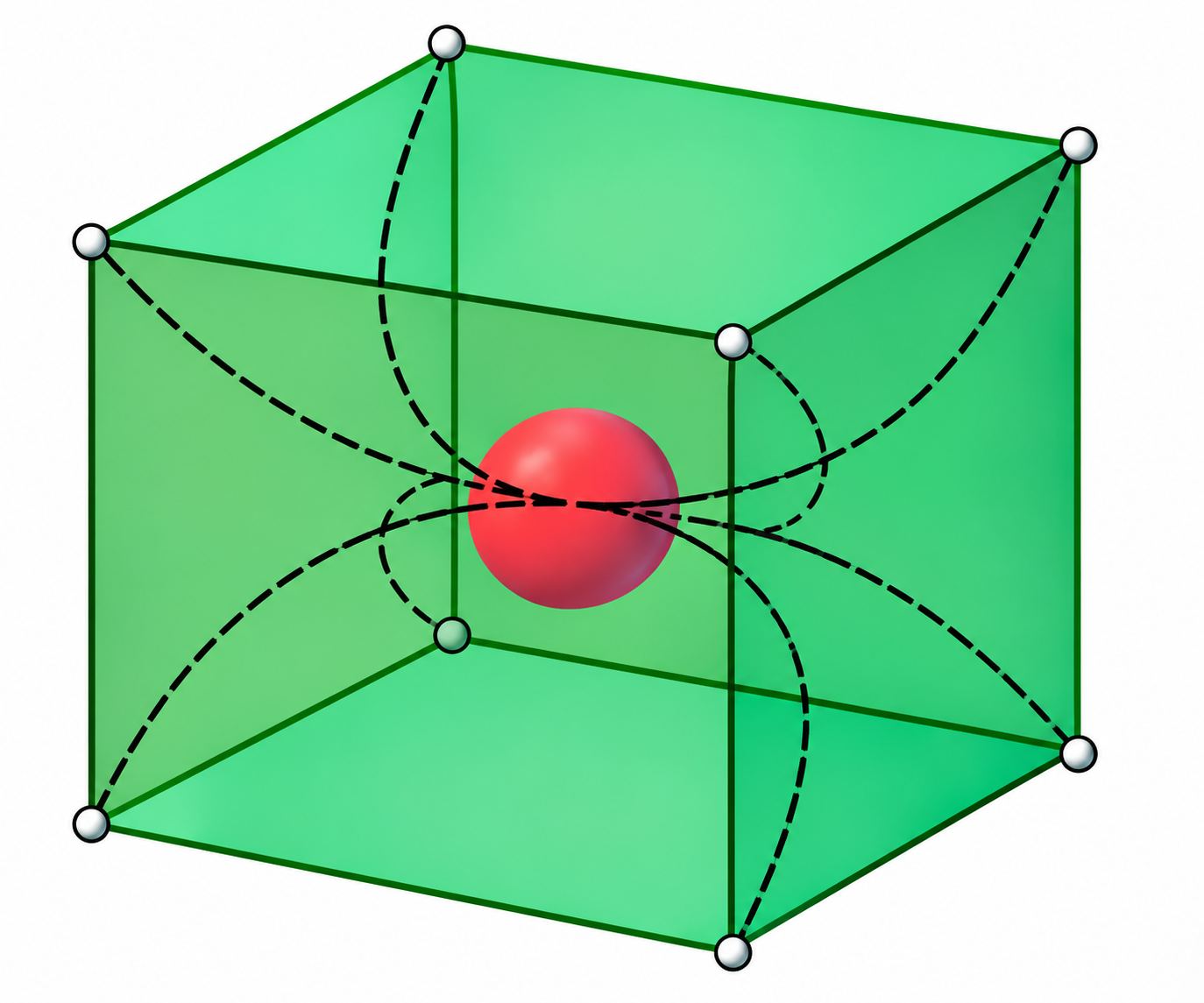
3. Eight-Chain Network Hardening
The eight-chain model represents the molecular network of polymer chains and produces a hardening backstress as the chains approach their limiting stretch.
Chain stretch
\lambda_{\mathrm{chain}}
=
\sqrt{
\frac{
\operatorname{tr}
\left(\mathbf F^i\mathbf F^{iT}\right)
}{3}
}
\]
Network backstress
\boldsymbol{\sigma}_p^{he}
=
\frac{Nk_B\theta}{J}
\beta(\lambda_{\mathrm{chain}})
\overline{\mathbf B}
\]
Langevin function
\beta(\lambda_{\mathrm{chain}})
=
\mathcal L^{-1}
\left(
\frac{\lambda_{\mathrm{chain}}}{\lambda_L}
\right)
\]
4. Viscoplastic Flow Rule
The viscoplastic element describes rate-dependent yielding based on a deviatoric driving stress and a nonlinear flow rule.
\mathbf D^i
=
\dot{\gamma}^{p}\mathbf N
\qquad
\dot{\gamma}^{p}
=
\left\langle
\left(
\frac{\Phi}{K}
\right)^{1/m}
\right\rangle
\]
\(\mathbf D^i\) : inelastic deformation rate tensor
\(\mathbf N\) : flow direction (deviatoric)
\(\dot{\gamma}^{p}\) : equivalent viscoplastic strain rate
\(m\) : rate sensitivity
\(\Phi\) : driving stress based on elastic stress minus network backstress
Driving stress
\Phi
=
\left\|
\boldsymbol{\tau}^{e}
–
\boldsymbol{\alpha}
\right\|
–
\sigma_y
\]
\(\boldsymbol{\alpha}\) : network backstress
\(\sigma_y\) : athermal shear strength
5. Strain Softening Evolution
The athermal shear strength evolves with viscoplastic deformation to represent post-yield strain softening followed by strain hardening.
\dot{\sigma}_y
=
-H
\left(
1-\frac{\sigma_y}{\sigma_{y0}}
\right)
\dot{\gamma}^{p}
\]
\(H\) : softening modulus
\(\sigma_{y0}\) : initial shear strength
\(\dot{\gamma}^{p}\) : equivalent viscoplastic strain rate
Stress–strain response
6. Deformation Gradient Decomposition
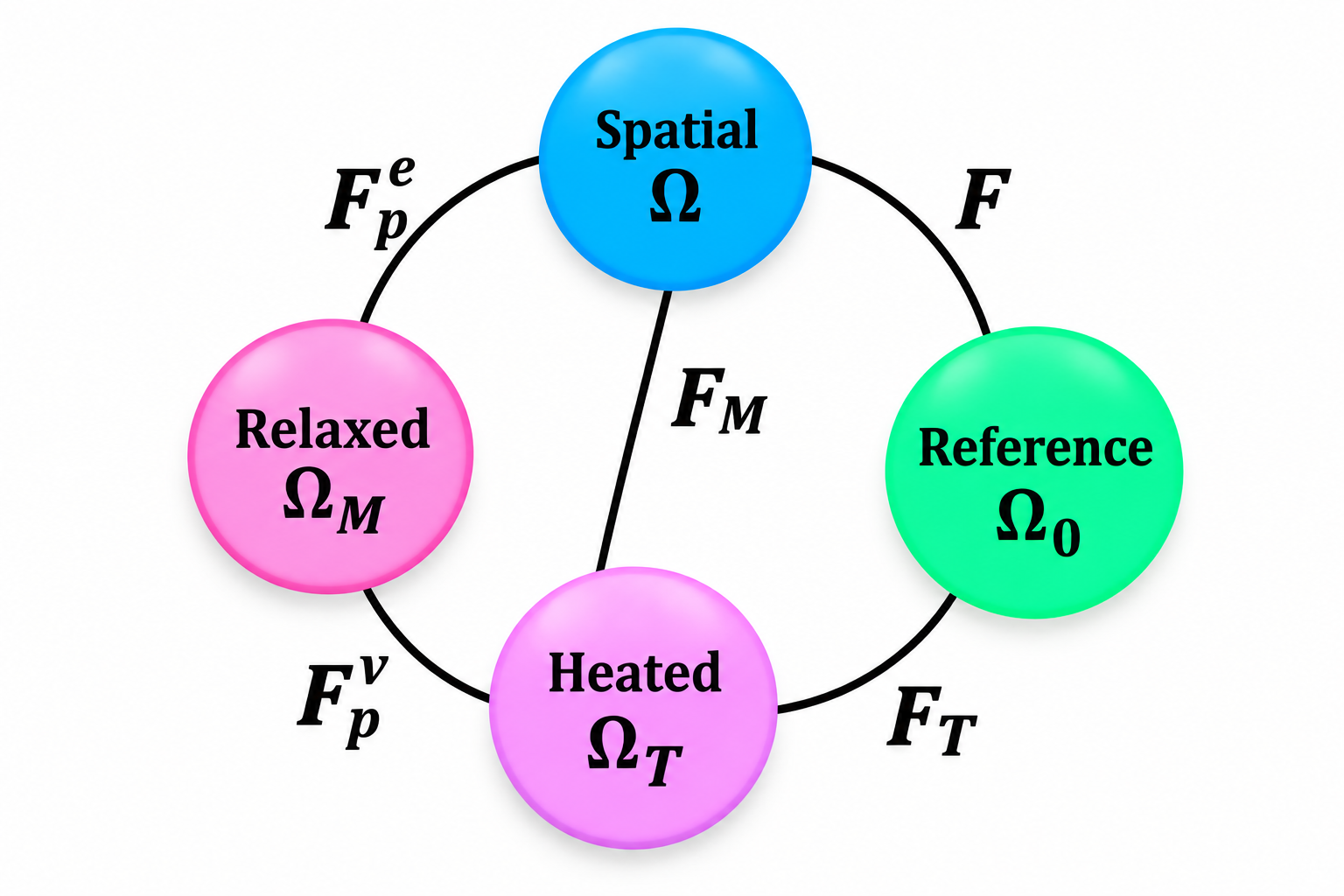
The total deformation gradient is decomposed into mechanical and thermal parts. For isotropic thermal expansion, the thermal deformation gradient is given by \(J_T^{1/3}\mathbf I\).
\mathbf F
=
\mathbf F_M\mathbf F_T
\]
\(\mathbf F\) : total deformation gradient
\(\mathbf F_M\) : mechanical deformation
\(\mathbf F_T\) : thermal deformation
J_T=\det(\mathbf F_T)
\]
\mathbf F_T
=
J_T^{1/3}\mathbf I
\]
7. VUMAT Integration Algorithm
A midpoint integration scheme is used to update stresses, network backstress, and state variables at each time increment in Abaqus/Explicit.
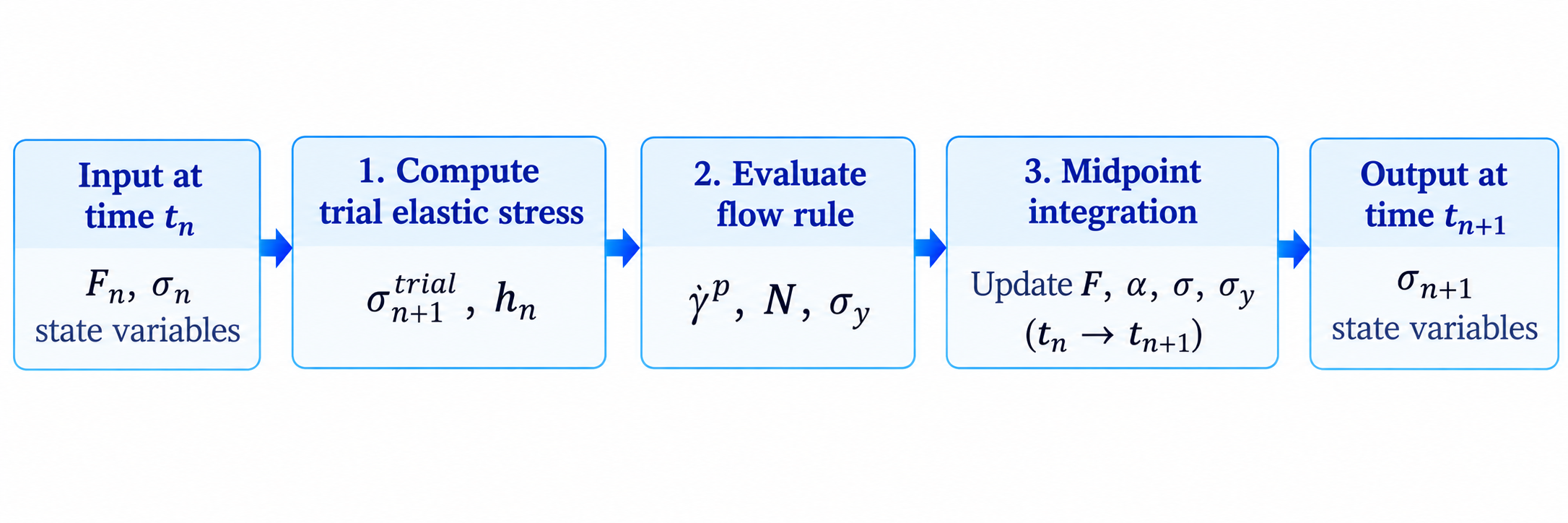
- Midpoint integration scheme for stability and accuracy
- Update deformation measures, elastic stress, network backstress and state variables
- Implemented in Abaqus/Explicit using VUMAT subroutine
8. Typical Results
The model predicts rate-dependent stress–strain behavior and nonlinear deformation of polymers using the Arruda Boyce VUMAT.

Recommended Prerequisite for Arruda Boyce VUMAT — Polymer Part 2
Learn Abaqus VUMAT Fundamentals Before Advanced Polymer Modeling
Part 2 builds on the Fortran programming, VUMAT interface, stress-update, and state-variable foundations introduced in Part 1. Completing Part 1 is recommended for newcomers to Abaqus user subroutines.
Recommended learning sequence:
What Does the Abaqus Polymer Modeling Tutorial Cover?
This polymer modeling Abaqus tutorial examines the finite-strain Arruda–Boyce framework, strain-rate-dependent viscoplasticity, network hardening, and Abaqus/Explicit implementation.
Arruda Boyce VUMAT
User-defined constitutive behavior in Abaqus/Explicit.
Large-Deformation Polymer Mechanics
Deformation gradients and finite-strain kinematics.
Hencky Strain Evaluation
Logarithmic strain and numerical approximations.
Eight-Chain Polymer Network
Langevin backstress and limiting chain stretch.
Viscoplastic Polymer Abaqus
Rate-sensitive inelastic flow and material softening.
Abaqus Strain Rate Polymer
Loading-rate effects on yield and deformation.
Midpoint Stress Integration
Incremental numerical updates and error control.
Fortran VUMAT Implementation
Stress arrays, material parameters, and state variables.
Polymer Strain Softening
Evolution of the internal shear-strength variable.
Polymer Strain Hardening
Molecular-chain alignment and network resistance.
Single-Element Verification
Parameter sensitivity and numerical consistency.
Tension and Compression
Comparison of stress–strain response and hysteresis.
Abaqus Polymer VUMAT Learning Path — Parts 1–3
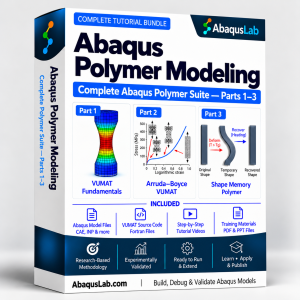
The AbaqusLab Polymer VUMAT Series begins with VUMAT programming fundamentals in Part 1, advances to Arruda–Boyce viscoplastic polymer modeling in Part 2, and extends to thermomechanical shape memory polymers in Part 3. Recommended study order: Part 1 → Part 2 → Part 3. Advanced parts may also be studied independently by experienced VUMAT users.
Part 1 — Abaqus VUMAT Fundamentals
- ⚙️ VUMAT subroutine fundamentals
- 💻 Fortran implementation
- 📐 Stress updates and state variables
- 🔍 Practical Fortran examples
£99 Student: £59
Part 2 — Arruda–Boyce Polymer VUMAT
- 📘 Finite-strain polymer mechanics
- ⚙️ Eight-chain Arruda–Boyce model
- 📊 Strain-rate and softening effects
- 📉 Polymer hardening and backstress
£179 Student: £119
Part 3 — Shape Memory Polymer VUMAT
- 💻 Shape memory VUMAT formulation
- ⚙️ Thermomechanical material response
- 📊 Programming and recovery behavior
- 🔄 Shape fixing and recovery
£229 Student: £149
Complete Abaqus Polymer VUMAT Modeling Suite — Parts 1–3
- Complete Parts 1–3 learning path
- VUMAT Fortran programming
- Polymer constitutive equations and integration
- Arruda–Boyce eight-chain network
- Rate-dependent viscoplastic response
- Shape memory polymer formulation
- Thermomechanical shape recovery
- Progressive polymer modeling tutorials
What You Receive with This Abaqus Polymer Modeling Tutorial
This Abaqus Polymer Modeling Tutorial is designed as a complete learning and implementation package rather than only a finished VUMAT. You receive the Abaqus models, Arruda Boyce VUMAT source code, step-by-step tutorial videos, constitutive formulation explanations, supporting files, documentation, and technical support required to understand, run, modify, and extend the viscoplastic polymer Abaqus workflow, including Abaqus polymer VUMAT implementation and Abaqus strain rate polymer analysis.
Complete Step-by-Step Tutorial Videos
▶ Complete Abaqus Arruda–Boyce VUMAT video training
VUMAT, Abaqus Models, Tutorials & Support
Package objective:
The goal is not only to provide a working Arruda Boyce VUMAT, but to give you a complete and reusable Abaqus polymer modeling and viscoplastic polymer simulation workflow that you can understand, verify, modify, and extend for your own material modeling, research, and engineering applications.
Abaqus Polymer Modeling Tutorial — Arruda Boyce VUMAT Learning Sequence
From Polymer Constitutive Theory to VUMAT Implementation
The learning sequence progresses from finite-strain polymer mechanics to the Arruda Boyce VUMAT formulation, Fortran implementation, and stress–strain verification.
Abaqus Polymer Simulation and VUMAT Subroutine Workflow
A practical Abaqus polymer modeling workflow combines finite-strain constitutive equations, Fortran VUMAT implementation, parameter studies, and independent numerical verification.
What You Will Learn with the Abaqus Polymer Modeling Tutorial
Understand Abaqus Polymer Modeling
Explain nonlinear polymer deformation, rate dependence, and chain hardening.
Build an Abaqus Polymer Simulation
Connect material parameters, loading rates, and stress–strain response.
Develop a VUMAT Polymer Subroutine
Implement elastic stress, viscoplastic flow, and network backstress.
Predict Polymer Deformation Abaqus
Evaluate large deformation and nonlinear stress–strain behavior.
Model Strain-Rate-Dependent Polymer Response
Relate flow parameters to yielding, strain softening, and hardening.
Explore Arruda–Boyce Material Parameters
Examine rubber modulus, limiting chain stretch, and flow parameters.
Interpret Eight-Chain Network Hardening
Study chain stretch, backstress, and large-strain strengthening.
Validate Polymer Finite Element Results
Assess deformation and density against measurements.
Who Is This Abaqus Polymer Modeling Tutorial For?
- Researchers studying nonlinear and rate-dependent polymer behavior
- Engineers investigating polymer yielding, softening, and hardening
- Finite element analysts developing custom VUMAT models
- Researchers implementing Arruda–Boyce constitutive equations
- PhD and MSc students in computational polymer mechanics
- Fortran developers implementing finite-strain VUMAT routines
- Engineers assessing strain-rate effects in polymer deformation
- Abaqus/Explicit users progressing beyond conventional polymer models
Need Custom Abaqus Polymer Modeling or VUMAT Development?
Custom Abaqus polymer modeling can require experimental calibration of viscoplastic flow parameters, network hardening, strain softening, and finite-strain stress integration. AbaqusLab provides consulting for advanced Abaqus/Explicit modeling, user subroutines, and numerical verification.
Arruda Boyce VUMAT — Frequently Asked Questions
What is the Abaqus polymer VUMAT?
A Fortran user-material subroutine that computes polymer stress and state-variable updates in Abaqus/Explicit.
Is this Arruda–Boyce formulation strain-rate dependent?
Yes. The attached thesis develops a viscoplastic Arruda–Boyce-type framework with rate-dependent flow, strain softening, and eight-chain hardening. This differs from a purely hyperelastic Arruda–Boyce formulation.
Does the model include polymer strain hardening?
Yes. A Langevin eight-chain network supplies the hardening backstress associated with polymer-chain alignment.
What numerical integration method is discussed?
The thesis describes a midpoint integration scheme, flow-rule iteration, error checks, and stress updates.
Why is Hencky strain important?
Logarithmic strain supports the large-deformation elastic response. Its accurate numerical evaluation is an important implementation issue.
Can Abaqus strain rate polymer response be studied?
Yes. The thesis examines how loading rate and viscoplastic parameters influence stress–strain behavior.
Is Part 1 required?
Part 1 is recommended for users new to Fortran or VUMAT programming; experienced users may begin with Part 2.
Are complex large-deformation geometries fully validated?
No. The reference thesis reports an unresolved limitation in its void-growth study and recommends further development for complex large-deformation geometries.
Related Abaqus Polymer VUMAT, Material Modeling & Advanced Simulation Resources
Continue studying Abaqus polymer VUMAT, Abaqus VUMAT subroutine development, nonlinear polymer mechanics, and advanced finite element simulation through related AbaqusLab tutorials and research resources. These learning paths connect polymer constitutive modeling with composite damage, impact, cutting, soil deformation, wear simulation, fracture mechanics, hydrogen transport, and microstructure-sensitive material modeling.
1
RELATED COMPOSITES TUTORIALS
Study progressive damage, composite failure, impact and machining using VUMAT in Abaqus/Explicit.
Composite Impact & Progressive Damage VUMAT
- Laminate impact simulation
- Progressive composite damage
- VUMAT implementation
CFRP Cutting & Damage VUMAT
- CFRP cutting simulation
- Fiber orientation effects
- Material removal and damage
2
RELATED SOIL MODELING TUTORIALS
Explore large deformation, penetration and rate-dependent soil behavior using CEL and VUMAT.
Abaqus CEL Soil Modeling
- Coupled Eulerian–Lagrangian (CEL)
- Large deformation analysis
- Soil material behavior
Rate-Dependent Soil VUMAT
- Strain-rate-dependent soil model
- Penetration and soft clay analysis
- VUMAT implementation
3
RELATED WEAR MODELING TUTORIALS
Model surface degradation, material removal and adaptive meshing using UMESHMOTION in Abaqus/Standard.
UMESHMOTION Wear Simulation
- Archard wear model
- UMESHMOTION subroutine
- Adaptive meshing and material loss
Hip Joint Wear with UMESHMOTION
- Hip joint wear simulation
- Contact and wear evolution
- UMESHMOTION implementation
4
OTHER ADVANCED MATERIAL MODELING TUTORIALS
Expand your knowledge with additional AbaqusLab tutorials.
5
CONSULTING & SUPPORT
Custom modeling, subroutine development and technical support.
6
EXTERNAL RESOURCES & RESEARCH JOURNALS
Explore official Abaqus documentation and peer-reviewed research on polymer constitutive mechanics and computational materials.

Reviews
There are no reviews yet.