

Description
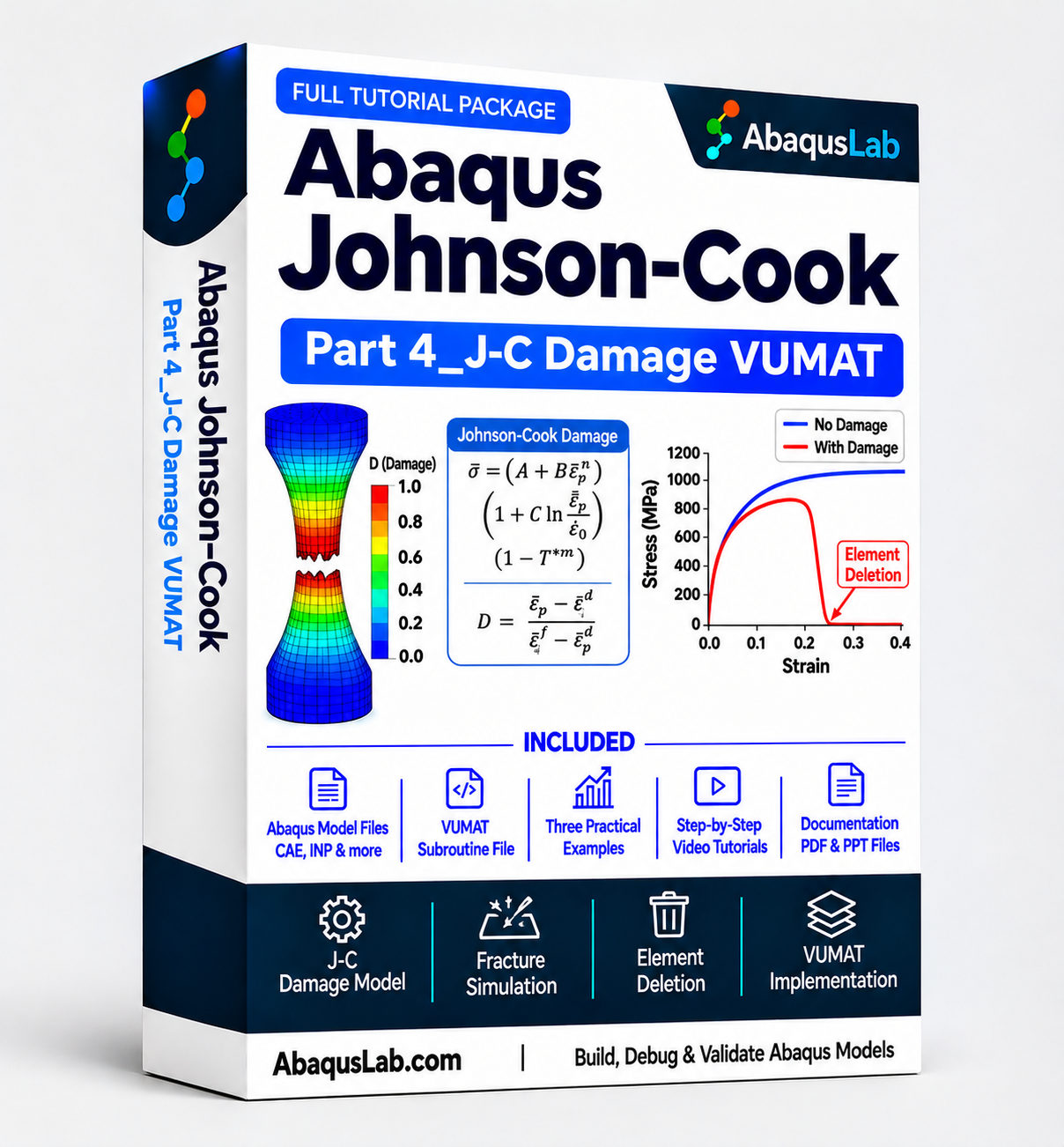
Abaqus Johnson-Cook Damage VUMAT | Fracture Simulation
This Abaqus Johnson Cook Damage VUMAT tutorial introduces the Johnson–Cook failure-strain criterion and its implementation with Fortran in Abaqus/Explicit. The Johnson Cook Damage VUMAT Tutorial explains Abaqus Explicit Damage Modeling, the Johnson Cook Fracture Model, and Abaqus VUMAT Failure Simulation through constitutive equations, damage accumulation, material-point updates, and verification. Learn how plasticity and damage interact in dynamic simulations, while distinguishing damage initiation from stiffness degradation and element deletion.
What Is Abaqus Johnson Cook Damage VUMAT and How Does Explicit Damage Modeling Work?
Abaqus Johnson Cook Damage VUMAT is a user-defined Fortran material routine for implementing a Johnson–Cook failure-strain and damage-accumulation model in Abaqus/Explicit. The Johnson Cook Fracture Model links failure strain to stress state, strain rate, and temperature. Abaqus Explicit Damage Modeling with VUMAT enables custom history-variable updates and controlled study of failure initiation, while post-initiation material degradation must be explicitly defined.
What Is the Johnson Cook Fracture Model?
The Johnson Cook Fracture Model describes the equivalent plastic strain at failure using stress triaxiality, plastic strain rate, and homologous temperature. Its classical five parameters D1–D5 require calibration to suitable failure tests. The failure-strain criterion is separate from the Johnson–Cook plastic flow-stress law.
What Does a Johnson Cook Damage VUMAT Tutorial Teach?
A Johnson Cook Damage VUMAT Tutorial explains the failure-strain equation, damage increment calculation, VUMAT arguments, stress updates, and state-variable storage. A reliable learning workflow checks a material point first, then examines specimen response and sensitivity to mesh, loading rate, and constitutive assumptions.
How Does Abaqus Explicit Damage Modeling Accumulate Damage?
In Abaqus Explicit Damage Modeling, a common Johnson–Cook approach accumulates damage as increments of equivalent plastic strain divided by the current failure strain. Damage reaches an initiation threshold when its accumulated value reaches unity. The subsequent loss of stiffness, stress reduction, or deletion requires a separate defined evolution rule.
How Is Abaqus VUMAT Failure Simulation Different from Plasticity VUMAT?
Abaqus VUMAT Failure Simulation extends a plasticity update by tracking a failure measure and defining the material response after the damage criterion is reached. Part 3 focuses on Johnson–Cook plasticity in Abaqus/Explicit; Part 4 focuses on the damage and fracture formulation. Element deletion is not automatically implied by damage initiation.
Why Use VUMAT Instead of UMAT for Dynamic Fracture?
VUMAT is the user-material interface for Abaqus/Explicit, where central-difference time integration is well suited to many short-duration dynamic and contact problems. UMAT belongs to Abaqus/Standard and uses a different interface. Solver selection still depends on the application and verification requirements.
How Are Johnson–Cook Damage Parameters Calibrated?
The classical damage parameters D1–D5 are fitted using failure data covering different stress triaxialities, and—when the full model is active—strain rates and temperatures. The plasticity parameters must also be identified consistently. A single uniaxial test generally cannot uniquely identify the full failure law.
Can Johnson–Cook VUMAT Model Crack Growth and Element Deletion?
A Johnson–Cook criterion can signal local material failure, but crack propagation and element removal depend on the chosen post-initiation damage evolution, failure flag, mesh, and solver settings. Confirm that the delivered VUMAT implements deletion before advertising that capability.
Johnson Cook Fracture Model — VUMAT Damage Equations and Explicit Failure Formulation
These equations describe the classical Johnson–Cook damage framework for technical learning. They do not verify which thermal, rate, softening, or element-removal options are implemented in the supplied VUMAT; confirm the actual source and examples before publication.
1. Johnson–Cook Failure-Strain Criterion
The classical fracture strain depends on triaxiality, normalized plastic strain rate, and temperature.
- D1–D3: stress-state dependence
- D4: strain-rate dependence
- D5: temperature dependence
2. Stress Triaxiality
The hydrostatic stress relative to von Mises equivalent stress influences ductile failure.
- Hydrostatic mean stress
- Equivalent von Mises stress
- Check sign conventions
3. Damage Accumulation
Damage increases with equivalent plastic strain increments relative to the local failure strain.
- History-variable tracking
- Incremental plastic strain
- Damage initiation at D ≥ 1
4. Normalized Strain Rate and Temperature
The classical model uses dimensionless rate and homologous temperature variables.
- Reference strain rate
- Reference and melting temperatures
- Check valid ranges and regularization
5. Johnson–Cook Plastic Flow Stress
The damage criterion is often coupled to a Johnson–Cook plasticity model.
- Plasticity constants A, B, n, C, m
- Plastic strain history
- Check implementation and coupling
6. VUMAT Stress and State Updates
The Abaqus/Explicit material interface updates stresses and state variables by material-point block.
- Block-oriented VUMAT interface
- Damage stored in stateNew
- No UMAT DDSDDE tangent
7. Damage Initiation Versus Failure Evolution
A damage threshold signals initiation; post-initiation response is a distinct modeling choice.
- Damage threshold
- Post-initiation law must be defined
- Element deletion requires verification
8. Explicit Verification and Energy Checks
Check material response and damage progression against controlled references.
- Single-element verification
- Failure strain and stress history
- Energy balance and mesh sensitivity
What Does the Johnson Cook Damage VUMAT Tutorial Cover?
This Abaqus Johnson Cook Damage VUMAT learning path connects the Johnson Cook Fracture Model to Abaqus Explicit Damage Modeling, Fortran VUMAT development, damage accumulation, and verification of Abaqus VUMAT Failure Simulation.
Johnson–Cook Failure Criterion
Classical failure strain and the D1–D5 parameters.
Stress Triaxiality
Mean stress, equivalent stress, and failure sensitivity.
Fortran VUMAT Structure
Block-based user-material interface in Abaqus/Explicit.
Abaqus/Explicit Setup
Link the user material and initialize damage history.
Damage Initiation
Interpret the threshold for local failure onset.
Damage Accumulation
Update damage from equivalent plastic strain increments.
State Variables
Track plastic strain and damage with stateNew.
Post-Initiation Response
Distinguish damage initiation from degradation and deletion.
Strain-Rate Effects
Understand the classical rate-dependent failure term.
Temperature Effects
Interpret homologous temperature dependence.
Single-Element Verification
Check damage accumulation and failure strain.
Failure Simulation Results
Review damage, stress, and strain histories.
Abaqus Johnson–Cook Modeling Learning Path — Parts 1–4
The AbaqusLab Johnson–Cook Modeling Series includes two Abaqus/Standard UMAT tutorials and two Abaqus/Explicit VUMAT tutorials. Part 1 introduces Johnson–Cook plasticity in UMAT; Part 2 extends the Standard path to damage; Part 3 introduces plasticity in VUMAT; and Part 4 focuses on damage and failure in VUMAT. The Complete Suite contains all four.
Part 1 — Johnson–Cook UMAT Plasticity
- ✓ Abaqus/Standard plasticity
- ✓ Johnson–Cook flow stress
- ✓ Fortran UMAT implementation
- ✓ Stress integration and verification
Part 2 — Johnson–Cook Damage UMAT
- ✓ Abaqus/Standard damage
- ✓ Failure criterion concepts
- ✓ UMAT damage workflow
- ✓ Damage-model verification
Part 3 — Johnson–Cook VUMAT Plasticity
- ✓ Abaqus/Explicit plasticity
- ✓ Johnson–Cook material response
- ✓ Fortran VUMAT workflow
- ✓ Dynamic simulation checks
Part 4 — Johnson–Cook Damage VUMAT
- ✓ Abaqus/Explicit damage
- ✓ Failure and fracture modeling
- ✓ VUMAT implementation
- ✓ Explicit results interpretation
COMPLETE JOHNSON-COOK SUITE
Abaqus Johnson-Cook Modeling — Complete UMAT & VUMAT Suite
- Complete Parts 1–4 learning path
- Johnson–Cook plasticity UMAT & VUMAT
- Johnson–Cook damage UMAT & VUMAT
- Abaqus/Standard & Abaqus/Explicit
- Plasticity, strain-rate & failure modeling
- Fortran source, tutorials & simulation files
What You Receive with This Johnson Cook Damage VUMAT Tutorial
The Part 4 learning package is designed around the Johnson–Cook failure criterion, Fortran VUMAT development, and Abaqus/Explicit damage-model verification. Confirm exact videos, source files, and implemented damage-evolution options against the final downloadable package.
Johnson–Cook Damage VUMAT Tutorial Videos
Johnson–Cook VUMAT Source Code, Abaqus Models & Materials
Johnson Cook Damage VUMAT Tutorial — Learning Sequence
Abaqus Explicit Damage Modeling — VUMAT Simulation and Verification Workflow
What You Will Learn with the Abaqus Johnson Cook Damage VUMAT Tutorial
Understand Johnson–Cook Damage
Interpret failure strain, triaxiality and accumulation.
Implement a Fortran VUMAT
Work with stressNew and stateNew in Abaqus/Explicit.
Identify Failure Parameters
Interpret D1–D5 and reference conditions.
Build Explicit Failure Models
Configure and run user-defined damage simulations.
Study Damage Initiation
Relate equivalent plastic strain to local failure onset.
Review Damage Integration
Check incremental updates and numerical stability.
Interpret VUMAT Variables
Track stress, plastic strain, and damage history.
Verify Failure Predictions
Compare material-point and specimen-level results.
Who Is This Johnson Cook Damage VUMAT Tutorial For?
- Researchers developing ductile damage and failure models
- Abaqus/Explicit VUMAT users and Fortran developers
- Engineers studying rate-sensitive material failure
- MSc and PhD students studying fracture criteria
- FEA analysts validating explicit damage simulations
- Engineers extending Part 3 plasticity to Part 4 damage
Need Custom Abaqus Johnson Cook Damage VUMAT or Plasticity Development?
A custom Abaqus Johnson Cook Damage VUMAT may require parameter calibration, numerical integration checks, experimental comparison, or adaptation to a specific material. AbaqusLab consulting can support Abaqus Johnson Cook Plasticity implementation and verification for research and engineering workflows.
Abaqus Johnson Cook Damage VUMAT — Frequently Asked Questions
What is Abaqus Johnson Cook Damage VUMAT?
It is a Fortran user-material implementation of a Johnson–Cook failure criterion and damage history update for Abaqus/Explicit.
What is the Johnson Cook Fracture Model?
It is a phenomenological failure-strain relation that depends on stress triaxiality, plastic strain rate, and temperature.
What is covered in the Johnson Cook Damage VUMAT Tutorial?
The learning framework includes failure strain, damage accumulation, VUMAT implementation, explicit simulation setup, and numerical verification.
What is Abaqus Explicit Damage Modeling?
It is the modeling of damage initiation and potentially subsequent material degradation in Abaqus/Explicit; the evolution law must be specified.
How does Abaqus VUMAT Failure Simulation work?
VUMAT updates stresses and history variables at material points and can track a damage criterion during explicit time integration.
Does Part 4 include element deletion?
Element deletion is not established by the supplied product outline. Verify the source code and model settings before claiming it.
What do the D1–D5 parameters mean?
They control the classical failure-strain dependence on triaxiality, strain rate, and temperature.
Is Part 3 required before Part 4?
Part 3 provides a recommended Abaqus/Explicit plasticity foundation; a formal prerequisite has not been confirmed.
How is a damage VUMAT verified?
Begin with controlled material-point tests, compare damage and failure strain, then assess specimen response and mesh sensitivity.
How does VUMAT differ from UMAT?
VUMAT is used in Abaqus/Explicit and UMAT in Abaqus/Standard; their interfaces and stress update conventions differ.
Related Abaqus UMAT, VUMAT, Plasticity, Damage & Advanced Material Modeling Resources
Explore Johnson–Cook plasticity, damage UMAT, VUMAT, fracture modeling, and advanced AbaqusLab tutorials. These resources connect the Abaqus Johnson Cook Damage VUMAT learning path with related material modeling and simulation workflows.


Reviews
There are no reviews yet.