


Description
Abaqus Johnson-Cook VVUMAT Tutorial | Plasticity Modeling
This Abaqus Johnson Cook VUMAT tutorial explains Abaqus Explicit Plasticity through the Johnson–Cook metal plasticity law and user-defined Fortran material programming. The Johnson Cook VVUMAT Tutorial introduces the Johnson Cook Constitutive Model, plastic strain hardening, strain-rate dependence, thermal softening, and stress integration in Abaqus/Explicit. Learn how the VUMAT interface supports Abaqus Dynamic Simulation and how to verify computed stress–strain behavior against reference data.
What Is Abaqus Johnson Cook VUMAT? Johnson Cook VVUMAT Tutorial for Abaqus Explicit Plasticity
The Abaqus Johnson Cook VUMAT is a Fortran material subroutine used to model metal plasticity in Abaqus/Explicit. This Johnson Cook VVUMAT Tutorial connects the Johnson Cook Constitutive Model with Abaqus Explicit Plasticity and practical Abaqus Dynamic Simulation. It focuses on material equations, user-material implementation, numerical checks, and interpretation of simulation results.
What Is Abaqus Johnson Cook VUMAT and How Does It Work in Abaqus/Explicit?
Abaqus Johnson Cook VUMAT is a Fortran user-defined material implementation of the Johnson–Cook metal plasticity law for Abaqus/Explicit. It updates stress and material history at integration points during an explicit analysis. This approach supports custom constitutive calculations and verification of rate-sensitive material behavior.
What Does a Johnson Cook VVUMAT Tutorial Teach?
A Johnson Cook VVUMAT Tutorial explains the VUMAT argument arrays, material constants, block-wise material-point updates, stress and state-variable outputs, and model verification. Unlike the Abaqus/Standard UMAT interface, VUMAT does not return stressNew; the explicit solver advances without a global Newton material tangent.
How Does Abaqus Explicit Plasticity Represent Metal Deformation?
Abaqus Explicit Plasticity uses incremental stress updates to model permanent deformation. A Johnson–Cook implementation can represent isotropic hardening and, when coded and enabled, strain-rate sensitivity and thermal softening. Accurate predictions require suitable parameter calibration and stable explicit time increments.
What Is the Johnson Cook Constitutive Model?
The Johnson Cook Constitutive Model describes metal flow stress using a strain-hardening factor, a logarithmic plastic strain-rate factor, and a normalized-temperature softening factor. The classical constants A, B, n, C, and m require experimental calibration. The terms actually implemented in the downloadable VUMAT must be checked against its source code.
Why Use VUMAT for Abaqus Dynamic Simulation?
Abaqus Dynamic Simulation with VUMAT is useful when a custom constitutive law is needed for explicit transient analyses involving rapid loading, contact, or large deformation. The solver choice and material model must suit the physical time scale and mesh. A VUMAT alone does not guarantee impact accuracy.
What Is the Difference Between Johnson–Cook UMAT and VUMAT?
UMAT runs in Abaqus/Standard and commonly provides a material Jacobian (stressNew). VUMAT runs in Abaqus/Explicit and updates blocks of material points, typically using a corotational stress measure. Part 1 covers the Standard UMAT path; Part 3 focuses on the Explicit VUMAT path.
How Are Strain-Rate and Temperature Effects Evaluated?
The classical model includes a logarithmic rate multiplier and a thermal-softening factor. Verification compares responses at controlled plastic strain rates and temperatures. Thermal coupling, temperature updates, and rate regularization depend on the actual code and analysis setup.
How Is an Abaqus Johnson Cook VUMAT Verified?
Start with a single-element uniaxial test and check elastic response, yield onset, plastic strain history, and stress–strain curves. Compare with an analytical or independently validated reference, then test specimen-level responses and mesh sensitivity. Damage and element deletion belong to the separate Part 4 learning path unless explicitly included.
Johnson Cook Constitutive Model — VUMAT Constitutive Equations and Plasticity Formulation
The following are standard illustrative Johnson–Cook relationships, not a line-by-line description of the unverified source code. Check the implemented strain-rate law, temperature coupling, hardening update, stress integration algorithm, and material Jacobian before treating all terms as active tutorial features.
1. Johnson–Cook Flow-Stress Equation
The classical flow stress multiplies strain hardening, strain-rate sensitivity, and thermal softening.
\bar{\sigma}=(A+B(\bar{\varepsilon}^{p})^{n})\left[1+C\ln\left(\frac{\dot{\bar{\varepsilon}}^{p}}{\dot{\varepsilon}_{0}}\right)\right]\left[1-(T^{*})^{m}\right]
\]
- A: reference yield stress
- B and n: strain hardening
- C and m: rate and thermal terms
2. Equivalent Plastic Strain and Hardening
Plastic flow depends on accumulated equivalent plastic strain; at reference conditions the law reduces to a hardening relation.
\bar{\sigma}=A+B(\bar{\varepsilon}^{p})^{n}
\]
- Equivalent plastic strain
- Reference-condition stress–strain response
- Material parameter calibration
3. Strain-Rate Sensitivity
When included, the rate factor depends on the ratio of plastic strain rate to a reference rate.
R=1+C\ln\left(\frac{\dot{\bar{\varepsilon}}^{p}}{\dot{\varepsilon}_{0}}\right)
\]
- Reference plastic strain rate ε̇₀
- Logarithmic rate term
- Regularization and domain checks
4. Homologous Temperature and Softening
Thermal softening is expressed using a normalized temperature in the classical formulation.
T^{*}=\frac{T-T_{r}}{T_{m}-T_{r}}
\]
- Reference temperature Tᵣ
- Melting temperature Tₘ
- Thermal coupling requires verification
5. Elastic Predictor and Plastic Correction
A numerical material update can begin with an elastic trial state and correct stress when plastic yielding occurs.
\boldsymbol{\sigma}_{n+1}=\boldsymbol{\sigma}_{\mathrm{trial}}-\mathbb{C}^{e}:\Delta\boldsymbol{\varepsilon}^{p}
\]
- Trial stress
- Plastic increment
- Constitutive integration checks
6. VUMAT Stress and State Updates
Abaqus/Explicit receives updated stresses and internal state variables for each material point in a VUMAT block.
\mathrm{stressNew},\quad\mathrm{stateNew},\quad\mathrm{strainInc}
\]
- History-variable bookkeeping
- Explicit stress updates
- Stability and debugging
7. Material Parameter Identification
Parameter estimation requires mechanical tests spanning the conditions the model is intended to predict.
A,\ B,\ n,\ C,\ m,\ \dot{\varepsilon}_{0},\ T_{r},\ T_{m}
\]
- Reference tensile data
- Rate-dependent experiments
- Temperature-dependent experiments
8. Abaqus Simulation and Verification
Compare material-point responses and specimen results to known behavior and experimental data when available.
\sigma\text{–}\varepsilon,\quad\bar{\varepsilon}^{p},\quad\mathrm{stateNew}
\]
- Single-element checks
- Stress–strain and equivalent plastic strain outputs
- Increment and convergence checks
What Does the Abaqus Johnson Cook VVUMAT Tutorial Cover?
This Abaqus Johnson Cook VUMAT learning path connects the Johnson Cook Constitutive Model to Abaqus Explicit Plasticity, Fortran programming, stress integration, and numerical verification in Abaqus/Standard.
Johnson–Cook Plasticity Law
Strain hardening and the classical rate and temperature factors.
Johnson–Cook Material Parameters
Interpret A, B, n, C, m and reference conditions.
Fortran VUMAT Structure
Understand the user-material interface and arguments.
Abaqus/Standard Setup
Link the UMAT to an Abaqus material definition.
Plastic Yielding
Identify elastic and plastic constitutive responses.
Stress Integration
Understand trial stress and plastic correction.
State Variables
Track plastic history with stateNew.
VUMAT Stress Updates
Review stress updates and stable time increments.
Strain-Rate Effects
Interpret the classical rate factor and its applicability.
Thermal Softening
Understand the normalized temperature term.
Single-Element Verification
Check controlled material response.
Simulation Results
Interpret stress, plastic strain and stress–strain curves.
Abaqus Johnson–Cook Modeling Learning Path — Parts 1–4
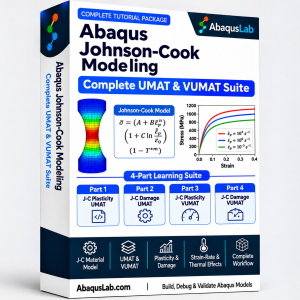
The AbaqusLab Johnson–Cook Modeling Series includes two Abaqus/Standard VUMAT tutorials and two Abaqus/Explicit VVUMAT tutorials. Part 1 introduces Johnson–Cook plasticity in UMAT; Part 2 extends the Standard path to damage; Part 3 introduces plasticity in VUMAT; and Part 4 focuses on damage and failure in VUMAT. The Complete Suite contains all four.
Part 1 — Johnson–Cook UMAT Plasticity
- ✓ Abaqus/Standard plasticity
- ✓ Johnson–Cook flow stress
- ✓ Fortran VVUMAT implementation
- ✓ Stress integration and verification
Part 2 — Johnson–Cook Damage UMAT
- ✓ Abaqus/Standard damage
- ✓ Failure criterion concepts
- ✓ UMAT damage workflow
- ✓ Damage-model verification
Part 3 — Johnson–Cook VVUMAT Plasticity
- ✓ Abaqus/Explicit plasticity
- ✓ Johnson–Cook material response
- ✓ Fortran VUMAT workflow
- ✓ Dynamic simulation checks
Part 4 — Johnson–Cook Damage VUMAT
- ✓ Abaqus/Explicit damage
- ✓ Failure and fracture modeling
- ✓ VVUMAT implementation
- ✓ Explicit results interpretation
COMPLETE JOHNSON-COOK SUITE
Abaqus Johnson-Cook Modeling — Complete UMAT & VUMAT Suite
- Complete Parts 1–4 learning path
- Johnson–Cook plasticity UMAT & VUMAT
- Johnson–Cook damage UMAT & VUMAT
- Abaqus/Standard & Abaqus/Explicit
- Plasticity, strain-rate & failure modeling
- Fortran source, tutorials & simulation files
What You Receive with This Abaqus Johnson Cook VVUMAT Tutorial
The Part 3 package is intended to support hands-on learning of the Johnson Cook Constitutive Model and Abaqus Dynamic Simulation with a Fortran VUMAT. Confirm the exact file extensions, videos, and implemented physics against the final downloadable package before publication.
Johnson–Cook VUMAT Plasticity Tutorial Videos
Johnson–Cook UMAT Source Code, Abaqus Models & Materials
Abaqus Johnson Cook VVUMAT Tutorial — Learning Sequence
Abaqus Explicit Plasticity — UMAT Simulation and Verification Workflow
What You Will Learn with the Abaqus Johnson Cook VVUMAT Tutorial
Understand Johnson–Cook Plasticity
Interpret strain hardening and classical rate/temperature terms.
Implement a Fortran VUMAT
Work with user-material inputs and stress updates.
Identify Material Parameters
Interpret A, B, n, C, m and reference conditions.
Build Abaqus/Explicit Models
Set up and run user-defined material simulations.
Study Plastic Flow
Relate flow stress to accumulated plastic strain.
Review Stress Integration
Understand trial stress and plastic correction.
Interpret VUMAT Variables
Examine stressNew, stateNew and strainInc.
Verify Abaqus Results
Check stress–strain, PEEQ and convergence.
Who Is This Abaqus Johnson Cook VVUMAT Tutorial For?
- Researchers implementing metal plasticity constitutive models
- Abaqus/Standard UMAT users and Fortran developers
- Engineers investigating strain hardening and rate-sensitive metals
- MSc and PhD students studying constitutive integration
- FEA analysts verifying user-material simulations
- Engineers preparing to study Johnson–Cook damage UMAT or VUMAT
Need Custom Abaqus Johnson Cook VUMAT or Plasticity Development?
A custom Abaqus Johnson Cook VUMAT may require parameter calibration, numerical integration checks, experimental comparison, or adaptation to a specific material. AbaqusLab consulting can support Abaqus Explicit Plasticity implementation and verification for research and engineering workflows.
Abaqus Johnson Cook VUMAT — Frequently Asked Questions
What is Abaqus Johnson Cook VUMAT?
It is a Fortran user-material implementation of the Johnson–Cook constitutive law for Abaqus/Standard.
What does Abaqus Explicit Plasticity model?
The classical model describes plastic flow stress using strain hardening, strain-rate sensitivity, and thermal softening.
What is the Johnson Cook Constitutive Model equation?
The classical form multiplies a strain-hardening term, a logarithmic strain-rate term, and a homologous-temperature softening term.
Which Johnson–Cook parameters are used?
The classical constants are A, B, n, C, and m, with reference strain rate and temperature definitions.
Is this Johnson Cook VVUMAT Tutorial for Abaqus/Standard or Abaqus/Explicit?
Part 3 is for Abaqus/Explicit VUMAT. Part 1 covers Abaqus/Standard UMAT.
Does Part 1 include Johnson–Cook damage or element deletion?
Part 3 is the VUMAT plasticity learning path. Damage is addressed separately in Part 2; do not assume element deletion is included.
How do I verify an Abaqus Dynamic Simulation UMAT?
Start with single-element tests, compare stress–strain and plastic strain history, and check convergence and the material tangent.
Is Part 3 required before Part 4?
Part 3 is a recommended foundation for Part 4, but a formal prerequisite has not been verified.
Are strain-rate and thermal effects implemented in the downloadable UMAT?
They are part of the classical Johnson–Cook formulation; the activated features must be checked in the supplied source code.
What is the difference between UMAT and VUMAT?
UMAT is used with Abaqus/Standard, whereas VUMAT is used with Abaqus/Explicit and has a different interface.
Related Abaqus UMAT, VUMAT, Plasticity, Damage & Advanced Material Modeling Resources
Continue from Abaqus Johnson Cook VUMAT to Johnson–Cook damage, Abaqus/Explicit VUMAT, UMAT fundamentals, material calibration, and other advanced AbaqusLab learning paths. These resources connect Abaqus Dynamic Simulation with constitutive development and numerical simulation.
Reviews
There are no reviews yet.