

Description
Abaqus Hashin 3D UMAT — 3D Composite Damage & Failure
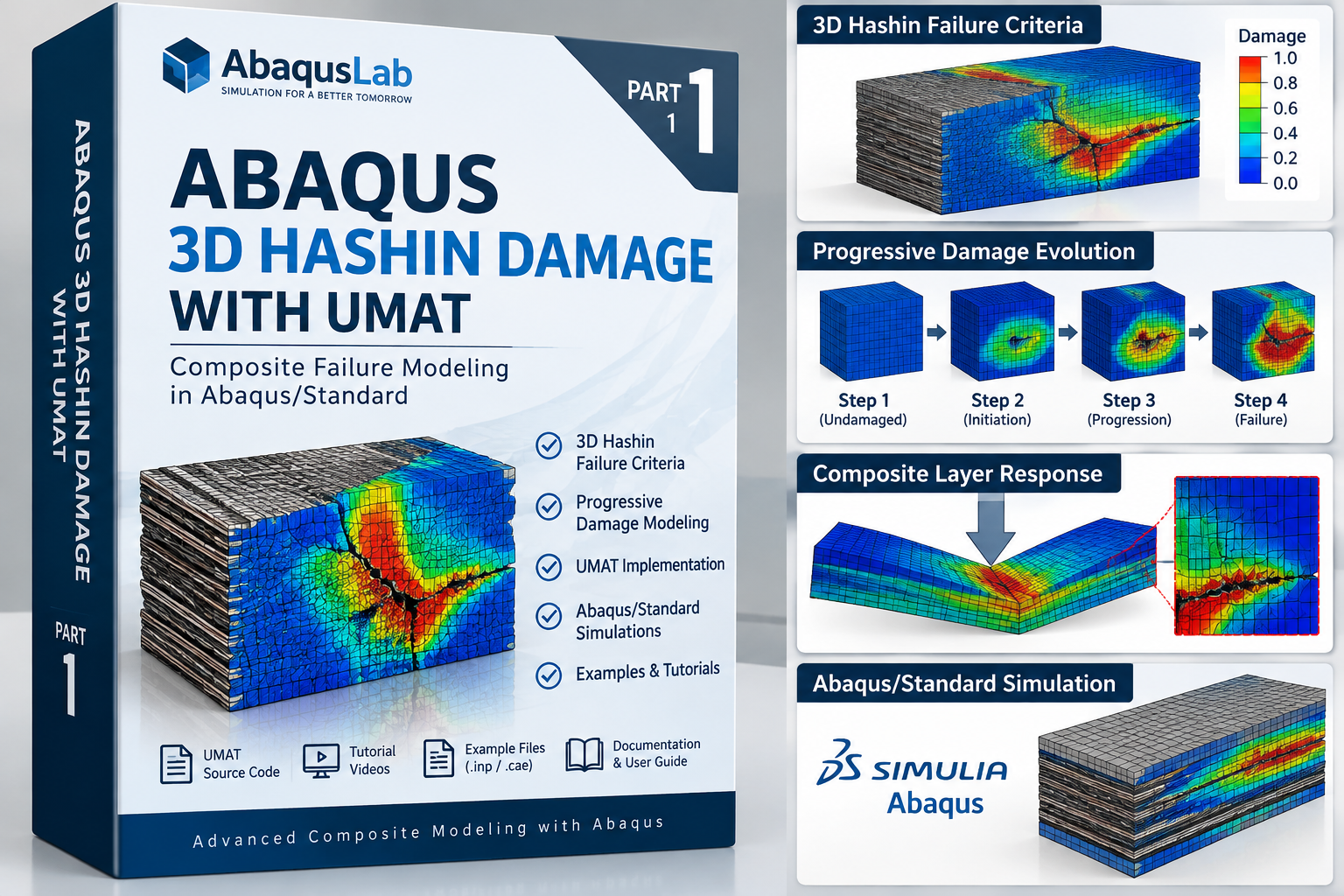
This Abaqus Hashin 3D UMAT package provides a practical framework for modeling damage and failure in 3D composite materials using Abaqus/Standard. The 3D Hashin UMAT identifies different fiber and matrix failure modes and uses an Abaqus Composite UMAT to simulate their effect on the material response. The resulting Composite Damage UMAT can model progressive damage and stiffness degradation in CFRP and other composite materials.
3D Hashin failure criterion → orthotropic composite elasticity → failure-mode identification → damage variables → stiffness degradation → UMAT implementation → Abaqus/Standard composite failure simulation.
What Is Abaqus Hashin 3D UMAT?
Abaqus Hashin 3D UMAT is a user-defined material implementation for modeling three-dimensional damage and progressive failure in fiber-reinforced composite materials using Abaqus/Standard. AbaqusLab implements Abaqus 3D Hashin modeling through an Abaqus composite UMAT for progressive composite damage and failure analysis.
Core Abaqus Hashin 3D UMAT Concepts
- Abaqus Hashin 3D UMAT — implements three-dimensional composite constitutive behavior, Hashin failure criteria, and progressive damage in Abaqus/Standard.
- 3D Hashin UMAT — evaluates the complete three-dimensional composite stress state and determines the active fiber or matrix failure mechanism.
- Abaqus Composite UMAT — implements the composite constitutive equations and damage calculations directly at the material-point level in Abaqus/Standard.
- Composite Damage UMAT — connects damage initiation with stiffness degradation to represent progressive composite damage as loading continues.
3D Hashin Failure Criteria & Composite Damage Modes
The 3D Hashin failure criteria distinguish different failure mechanisms in a composite material rather than representing failure with a single damage index. In the Abaqus Hashin 3D UMAT, the three-dimensional stress state is evaluated to identify four primary damage modes: fiber tension, fiber compression, matrix tension, and matrix compression. Each failure mode is evaluated separately and can subsequently be used in the progressive composite damage calculation.
Material Coordinate System
For the 3D Hashin formulation, the 1-direction represents the longitudinal fiber direction, while the 2- and 3-directions represent the transverse material directions. The complete three-dimensional stress state therefore contains six stress components.
Normal Stresses
\sigma_{11},\quad \sigma_{22},\quad \sigma_{33}
\]
Shear Stresses
\sigma_{12},\quad \sigma_{13},\quad \sigma_{23}
\]
All stresses used in the failure criteria are expressed in the local composite material coordinate system.
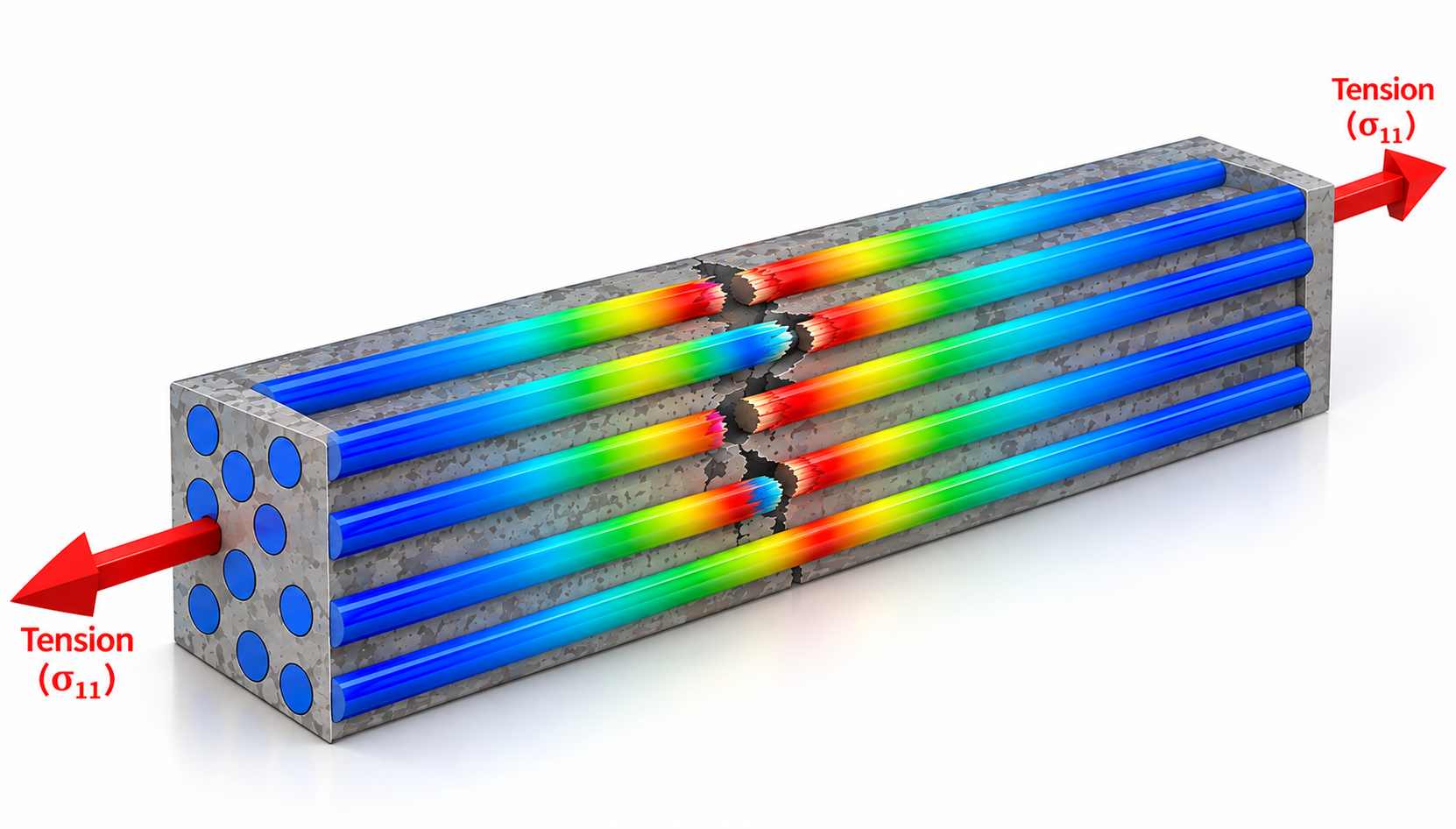
1. Fiber Tensile Failure
Fiber tensile failure is evaluated when the longitudinal stress along the principal fiber direction is tensile.
\sigma_{11} \geq 0
\qquad\qquad
F_{ft}
=
\left(\frac{\sigma_{11}}{X_T}\right)^2
+
\left(\frac{\sigma_{12}}{S_{12}}\right)^2
+
\left(\frac{\sigma_{13}}{S_{13}}\right)^2
\]
The criterion combines longitudinal fiber tension with shear stresses acting on planes containing the fiber direction.
2. Fiber Compressive Failure
Fiber compressive failure is evaluated when the longitudinal stress along the principal fiber direction becomes compressive.
\sigma_{11} < 0
\qquad\qquad
F_{fc}
=
\left(\frac{\sigma_{11}}{X_C}\right)^2
\]
The longitudinal compressive stress is compared with the corresponding fiber-direction compressive strength.

3. Matrix Tensile Failure
Matrix tensile failure is evaluated when the combined transverse normal stress is tensile.
\sigma_{22}+\sigma_{33} \geq 0
\]
F_{mt} =
\left(\frac{\sigma_{22}+\sigma_{33}}{Y_T}\right)^2
+
\frac{\sigma_{23}^{2}-\sigma_{22}\sigma_{33}}{S_{23}^{2}}
+
\left(\frac{\sigma_{12}}{S_{12}}\right)^2
+
\left(\frac{\sigma_{13}}{S_{13}}\right)^2
\]
The 3D matrix criterion includes transverse normal, through-thickness, and shear stress components associated with matrix cracking.

4. Matrix Compressive Failure
Matrix compressive failure is evaluated when the combined transverse normal stress becomes compressive.
\sigma_{22}+\sigma_{33} < 0
\]
F_{mc} =
\frac{1}{Y_C}
\left[
\left(\frac{Y_C}{2S_{23}}\right)^2 – 1
\right]
(\sigma_{22}+\sigma_{33})
+
\frac{(\sigma_{22}+\sigma_{33})^2}{4S_{23}^{2}}
+
\frac{\sigma_{23}^{2}-\sigma_{22}\sigma_{33}}{S_{23}^{2}}
+
\left(\frac{\sigma_{12}}{S_{12}}\right)^2
+
\left(\frac{\sigma_{13}}{S_{13}}\right)^2
\]
The criterion accounts for the interaction between transverse compression and the three-dimensional shear stress state.

What You Will Learn with Abaqus Hashin 3D UMAT
Abaqus Hashin 3D UMAT tutorial package is designed to explain not only how to run a completed composite model, but how the complete 3D Hashin UMAT workflow is constructed. You will connect composite constitutive theory, three-dimensional failure criteria, material history variables, stiffness degradation, UMAT programming, Abaqus/Standard model setup, and result interpretation.
Understand Composite Material Axes
Understand longitudinal, transverse, and through-thickness material directions and their role in three-dimensional orthotropic composite behavior.
Build the 3D Constitutive Model
Learn how engineering constants are assembled into the three-dimensional orthotropic constitutive response required by the UMAT.
Implement 3D Hashin Failure
Understand how fiber tension, fiber compression, matrix tension, and matrix compression are evaluated from the material stress state.
Implement Damage & Stiffness Degradation
Follow the transition from failure initiation to the modified constitutive stiffness used for the damaged composite response.
Understand the UMAT Code
Learn how stresses, strains, material properties, state variables, constitutive calculations, and damage logic are organized within the Abaqus UMAT.
Interpret Composite Failure Results
Post-process stresses, failure indicators, damage variables, and the resulting structural response to understand where and how composite failure develops.
Abaqus Composites Learning Path — Parts 1–6
The AbaqusLab Composites Series is organized from fundamental user-material implementations to advanced composite applications. Parts 1 and 2 establish the UMAT and VUMAT composite-damage foundations required for the advanced applications developed in the following Parts. The recommended learning order is Part 1 → Part 2 → Part 3 → Part 4 → Part 5 → Part 6.
Part 1 — 3D Hashin Damage with UMAT
- 🧩 3D Hashin failure criteria
- 💻 Composite UMAT
- ⚙️ Abaqus/Standard
£149 (Student: £129)
Part 2 — 3D Hashin Damage with VUMAT
- ⚡ 3D composite failure
- 💻 Composite VUMAT
- 💥 Abaqus/Explicit
£149 (Student: £129)
Explore Part 2 →
Part 3 — Composite Laminate Impact & Progressive Damage
- 💥 Low-velocity impact
- 🧩 Progressive damage VUMAT
- 🔗 Cohesive modeling
£169 (Student: £139)
Explore Part 3 →
Part 4 — CFRP Cutting & Progressive Damage
- 💎 CFRP cutting
- 🧭 Fiber-orientation effects
- 🌀 Damage & material removal
£199 (Student: £169)
Explore Part 4 →
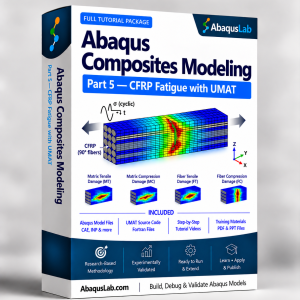
Part 5 — CFRP Fatigue Modeling with UMAT
- 🔄 Composite fatigue
- 📉 Progressive fatigue damage
- 💻 Fatigue UMAT
£129 (Student: £99)
Explore Part 5 →
Part 6 — Composite Pipe Stress & Failure Analysis
- ⭕ Filament-wound pipes
- 📊 Stress through thickness
- 💥 Composite pipe failure
£129 (Student: £99)
Explore Part 6 →
Complete Abaqus Composites Suite — Parts 1–6
- ✓ Complete Parts 1–6 learning path
- ✓ UMAT + VUMAT composite modeling
- ✓ Hashin + damage + impact + cutting
- ✓ CFRP fatigue + composite pipe analysis
- ✓ Complete tutorials & simulation files
£924£499Student: £419
What You Receive with the Abaqus Hashin 3D UMAT Package
This package is designed as a complete learning and implementation resource for Abaqus 3D Hashin composite damage with UMAT. The objective is to provide the material implementation, Abaqus models, tutorial material, and technical explanation needed to understand the workflow and adapt it to composite research and engineering applications.
Complete 3D Hashin UMAT Tutorial
UMAT, Abaqus Models & Technical Files
Complete Abaqus Hashin 3D UMAT Workflow
The complete workflow connects composite material properties with three-dimensional constitutive modeling, Hashin failure evaluation, damage-state variables, stiffness degradation, UMAT implementation, Abaqus/Standard analysis, and composite failure post-processing.
STEP 01: Define 3D orthotropic composite properties
STEP 02: Calculate the three-dimensional constitutive response
STEP 03: Evaluate fiber and matrix stress states
STEP 04: Check 3D Hashin failure criteria
STEP 05: Update failure and damage variables
STEP 06: Degrade the appropriate material stiffness
STEP 07: Return stress and material response through UMAT
RESULTS: Evaluate composite stresses, failure modes, damage evolution, and structural response
What Does the Abaqus Hashin 3D UMAT Model Contain?
The Part 1 model combines the three-dimensional constitutive response of an orthotropic composite with failure initiation and material degradation. Instead of using a purely elastic orthotropic material, the UMAT evaluates the evolving material state and determines whether the local stress condition has reached a fiber- or matrix-dominated failure condition.
3D Orthotropic Elasticity
Represent the directional elastic response of a fiber-reinforced composite using longitudinal, transverse, and through-thickness material properties.
3D Hashin Failure
Evaluate composite failure using three-dimensional stress components rather than restricting the material formulation to a simple in-plane stress state.
Fiber & Matrix Failure
Separate fiber-dominated failure from matrix-dominated failure and distinguish tensile and compressive mechanisms.
Damage Variables
Track the evolving failure state through material history variables within the UMAT framework.
Stiffness Degradation
Modify the constitutive stiffness after failure initiation so that damage influences the subsequent stress response.
Abaqus/Standard UMAT
Connect the complete material formulation to Abaqus/Standard through a user-defined material subroutine.
From Undamaged Composite to Progressive Failure
At the beginning of the analysis, the composite responds according to its orthotropic elastic properties. As loading develops, the UMAT calculates the material stress state and evaluates the three-dimensional Hashin failure functions. When a failure condition is reached, the corresponding damage state is activated and the material stiffness is modified according to the implemented degradation logic.
This creates a computational path from orthotropic deformation → failure initiation → damage development → stiffness degradation → damaged composite response.
Why Implement 3D Hashin Damage with UMAT?
A user-defined material provides direct control over the composite constitutive formulation. This is particularly valuable when the required failure criterion, damage evolution, degradation rules, material variables, or research formulation extends beyond a predefined material model.
Control the Failure Formulation
Implement and modify the composite failure equations directly within the material model.
Track Custom State Variables
Store failure indicators, damage variables, and constitutive history required by the model.
Modify Damage Evolution
Extend the UMAT for alternative stiffness-degradation laws and project-specific composite formulations.
Build Advanced Composite Models
Use the Part 1 foundation as a basis for more advanced UMAT-based composite applications, including fatigue modeling.
Who Is This Abaqus Hashin 3D UMAT Package For?
This package is intended for researchers, graduate students, engineers, and advanced Abaqus users who need to understand or implement three-dimensional composite failure through a user-defined material.
- PhD and MSc researchers working with CFRP and composite failure
- Engineers modeling fiber-reinforced composite structures
- Users developing Abaqus UMAT material models
- Researchers studying progressive composite damage
- Users who need 3D fiber and matrix failure criteria
- Abaqus/Standard users developing custom composite constitutive models
- Researchers preparing for advanced composite fatigue UMAT development
Need a Custom Composite UMAT, Hashin Damage Model or Abaqus Project?
Composite simulations often require project-specific material properties, custom failure criteria, damage evolution, UMAT development, convergence improvements, calibration, validation, or post-processing. AbaqusLab can help develop, debug, validate, and extend custom composite UMAT models for research and industrial applications.
Abaqus Hashin 3D UMAT — Frequently Asked Questions
What is Abaqus 3D Hashin damage modeling?
Abaqus 3D Hashin damage modeling evaluates different fiber- and matrix-dominated failure mechanisms using the three-dimensional material stress state and applies the resulting failure information to the composite constitutive response.
What is an Abaqus Hashin 3D UMAT?
An Abaqus Hashin 3D UMAT is a user-defined material for Abaqus/Standard that combines a three-dimensional composite constitutive formulation with Hashin-type fiber and matrix failure criteria and material damage calculations.
Which failure modes are included?
The formulation distinguishes fiber tension, fiber compression, matrix tension, and matrix compression, allowing different composite failure mechanisms to be evaluated separately.
Why use a 3D Hashin formulation?
Three-dimensional composite models can develop longitudinal, transverse, through-thickness, and shear stresses. A 3D formulation allows these stress components to be considered within the material failure calculation.
Does Part 1 use UMAT or VUMAT?
Part 1 uses UMAT with Abaqus/Standard. Part 2 develops the corresponding composite-damage foundation for VUMAT and Abaqus/Explicit.
What is the difference between Part 1 and Part 2?
Part 1 focuses on the UMAT implementation for Abaqus/Standard, while Part 2 focuses on VUMAT and Abaqus/Explicit. Together they establish the implicit and explicit composite-damage foundations used throughout the Abaqus Composites learning series.
Can the UMAT be modified for another composite material?
Yes. The package is intended to help users understand the constitutive and failure implementation so that material properties and, where appropriate, model components can be adapted for other composite applications.
Is Part 1 relevant to CFRP fatigue modeling?
Yes. Part 1 establishes the UMAT-based composite constitutive and failure framework that provides an important foundation for the CFRP fatigue modeling developed later in Part 5.
Does the package include UMAT source code?
Yes. The package includes the UMAT source code together with Abaqus/Standard model files and supporting tutorial material for the Part 1 workflow.
Is technical support included?
Yes. Post-download technical support is included for the supplied package, including assistance with the tutorial files, implementation, model setup, troubleshooting, and understanding the workflow.
Related Abaqus Hashin 3D UMAT, Composite Damage & Advanced Modeling Resources
Continue your learning with related AbaqusLab tutorials and professional Abaqus consulting services, or explore authoritative external resources covering Abaqus, user materials, composite mechanics, damage, fracture, and computational material modeling.
AbaqusLab Consulting & Technical Support
Related Advanced Abaqus Tutorials
Explore other AbaqusLab learning paths covering custom material models, fracture, diffusion, nonlocal mechanics, microstructure-sensitive modeling, and advanced finite element implementation.
External Abaqus & Composite Modeling Resources
For further study, official software documentation and peer-reviewed composite-mechanics resources can be used alongside the AbaqusLab implementation tutorials to explore user materials, composite failure, damage mechanics, and finite element modeling in greater depth.



Reviews
There are no reviews yet.