


Description
Abaqus Composite Pipe Stress & Failure Analysis
This tutorial package provides a practical framework for performing Abaqus composite pipe analysis for thick-walled, multilayered, filament-wound composite pipes subjected to pressure loading. The composite pipe stress analysis workflow focuses on the relationship between composite lay-up, winding angle, material orientation, through-thickness stress distribution, and composite pipe failure prediction. The filament wound pipe Abaqus model provides a structured approach for investigating radial, hoop, axial, and shear stresses together with failure coefficients in a composite pressure pipe under applied pressure.
Composite pipe geometry → multilayer lay-up → filament winding orientation → external pressure → through-thickness stress analysis → stress transformation → Tsai-Hill failure assessment → winding-angle comparison → composite pipe failure analysis.
What Is Abaqus Composite Pipe Analysis?
Abaqus composite pipe analysis is used to investigate the mechanical response of composite tubular structures in which material properties, fiber directions, layer arrangement, pipe geometry, and pressure loading interact to produce a strongly anisotropic stress state. In a filament-wound pipe, each composite layer can have a different fiber orientation, meaning that the radial, hoop, axial, and shear response depends directly on the selected winding angles and stacking sequence.
This composite pressure pipe tutorial focuses on a thick-walled multilayer composite pipe subjected to external pressure. The workflow connects pipe geometry, orthotropic composite properties, filament-winding orientation, pressure loading, through-thickness stress distributions, stress transformation into the material directions, and composite failure prediction within a complete engineering analysis.
Composite Pipe Stress & Failure Analysis
The mechanical response of a multilayer filament-wound composite pipe differs significantly from that of an isotropic metallic pipe. Each composite layer has directional stiffness and strength, and the orientation of the fibers relative to the pipe axis determines how the layer carries axial, circumferential, radial, and shear loading. The Abaqus composite pipe analysis therefore requires careful definition of the pipe coordinate system, local material orientations, composite lay-up, pressure loading, and failure variables.
Cylindrical & Local Material Coordinates in Composite Pipes
The composite pipe is described using the radial (r), hoop (θ), and axial (z) directions. Each filament-wound composite layer also has its own principal material coordinate system, with the 1-direction aligned with the fibers and the transverse directions perpendicular to the fibers. Correct transformation between the cylindrical pipe coordinates and local material directions is essential for both stress interpretation and composite failure analysis.
Pipe Normal Stresses
Material-Direction Stresses
The stress state calculated in the pipe coordinate system is interpreted relative to the filament orientation so that the composite pipe failure assessment can be performed using the stresses acting in the principal composite material directions.
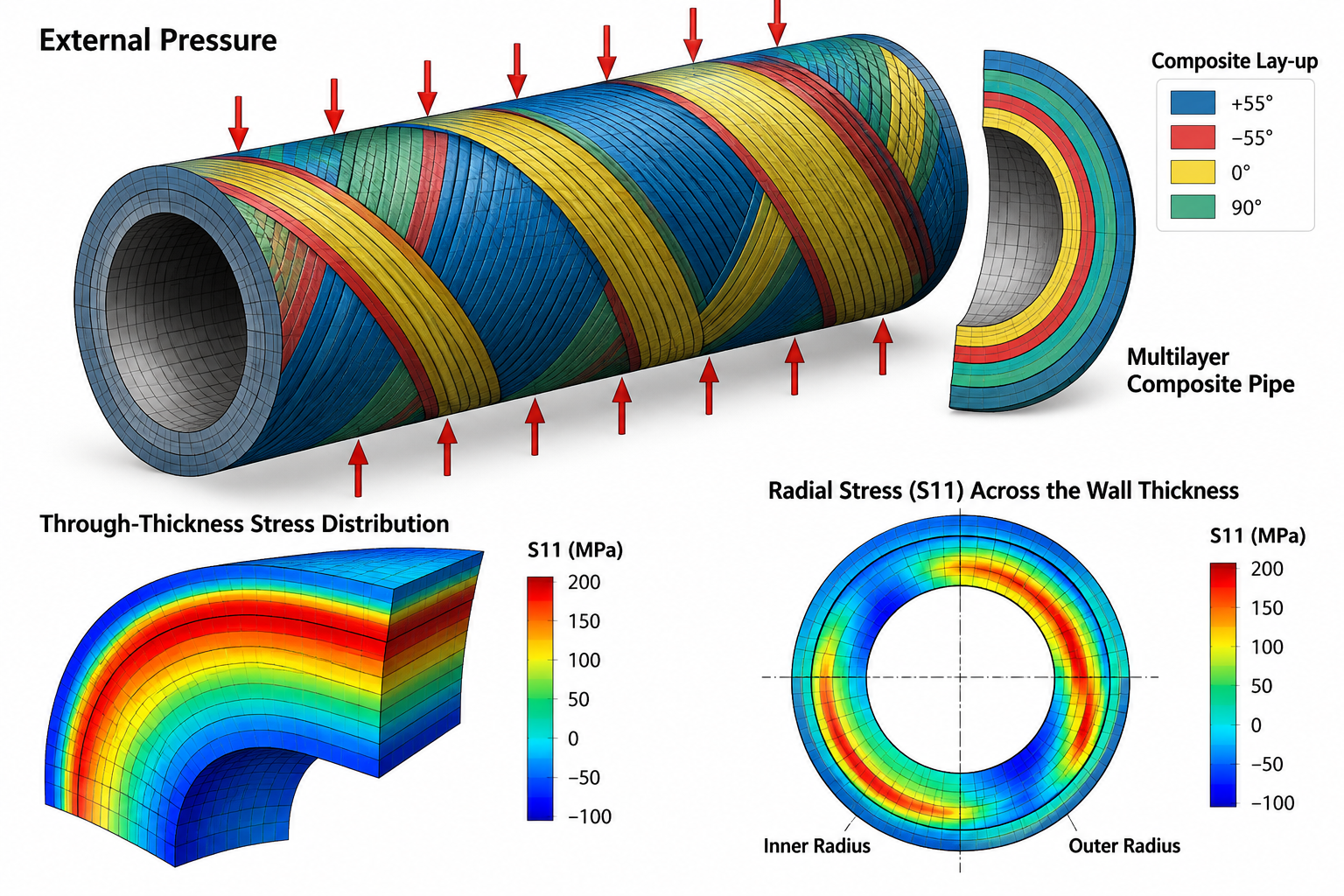
1. Composite Pipe under External Pressure
The analysis begins with a thick-walled multilayer composite pipe subjected to external pressure. The applied pressure produces a three-dimensional stress state through the pipe wall, and the magnitude and distribution of these stresses depend on pipe geometry, composite properties, layer thicknesses, stacking sequence, and filament-winding angles.
Unlike a thin isotropic pressure vessel, a thick filament-wound composite pipe can exhibit significant variation in stress from the inner radius to the outer radius. This through-thickness behavior is an important part of the composite pipe stress analysis.
2. Through-Thickness Stress Distribution
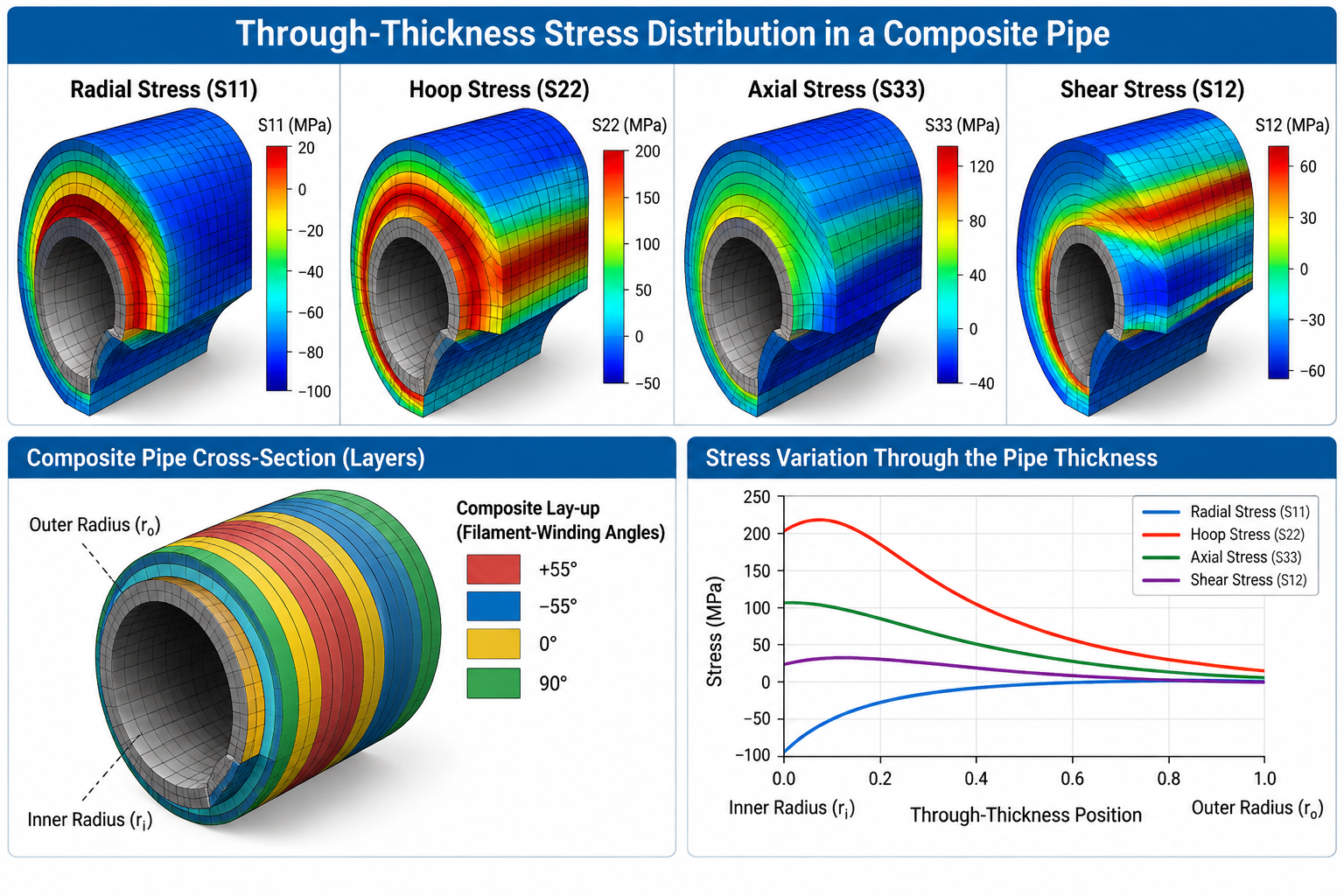
The Abaqus composite pipe analysis evaluates how radial, hoop, axial, and shear stresses vary across the wall of the multilayer pipe. Because neighboring layers may have different filament orientations, stress distributions can change significantly at the interfaces between composite layers.
Comparing these stress components through the pipe thickness helps identify highly loaded regions and reveals how the stacking sequence redistributes pressure-induced loads between differently oriented composite layers.
3. Filament Winding Angle & Lay-Up Effects
The mechanical response of a filament wound pipe Abaqus model is strongly influenced by the orientation of the fibers. Changing the winding angle modifies the relationship between axial and circumferential reinforcement and therefore changes the stress carried by individual layers.
Different stacking sequences can therefore produce substantially different through-thickness stress distributions even when the pipe geometry, composite material, and applied pressure remain unchanged. Comparing winding angles and lay-ups provides a direct way to investigate composite pipe design sensitivity.

4. Composite Pipe Failure Prediction
For composite failure assessment, the stresses are evaluated in the principal material directions of each filament-wound layer. The tutorial investigates composite pipe failure using the Tsai-Hill failure framework and examines how the calculated failure coefficient changes with pressure, winding angle, layer position, and stacking sequence.
The failure coefficient provides a convenient measure for comparing different pipe designs. A value below the failure threshold indicates that the evaluated material state remains below the criterion, while reaching the threshold identifies the onset of predicted failure according to the selected formulation.

Abaqus Composite Damage & Composite Modeling Learning Path — Parts 1–6
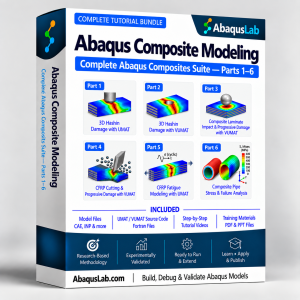
The AbaqusLab Composites Series progresses from user-defined composite material models to advanced engineering applications. Parts 1–5 cover UMAT, VUMAT, progressive composite damage, impact, cutting, and fatigue, while Part 6 applies composite mechanics to filament-wound pressure pipes with emphasis on lay-up definition, winding angle, through-thickness stresses, pressure loading, and failure assessment.
Part 1 — 3D Hashin Damage with UMAT
- 🧩 3D Hashin failure criteria
- 💻 Composite UMAT
- ⚙️ Abaqus/Standard
£149 (Student: £129)
Part 2 — 3D Hashin Damage with VUMAT
- 🧩 3D Hashin failure criteria
- 💻 Composite VUMAT
- 💥 Abaqus/Explicit
£149 (Student: £129)
Part 3 — Composite Laminate Impact & Progressive Damage
- 💥 Composite laminate impact
- 🧩 3D Hashin VUMAT
- 📉 Intralaminar damage
- 🔗 Delamination & cohesive modeling
£169 (Student: £139)
Part 4 — Composite Cutting & Progressive Damage
- 💎 Composite cutting
- 🔬 Macro & micro simulation
- 🧭 Fiber-orientation effects
- 🌀 Damage & material removal
£199 (Student: £169)
Part 5 — Composite Fatigue Modeling with UMAT
- 🔄 Composite fatigue
- 📉 Progressive fatigue damage
- 💻 Fatigue UMAT
£129 (Student: £99)
Part 6 — Composite Pipe Stress & Failure Analysis
- ⭕ Filament-wound pipes
- 📊 Stress through thickness
- 🧭 Winding-angle effects
- 💥 Composite pipe failure
£129 (Student: £99)
Complete Abaqus Composites Suite — Parts 1–6
- ✓ Complete Parts 1–6 learning path
- ✓ UMAT + VUMAT composite modeling
- ✓ Hashin + damage + impact + cutting
- ✓ CFRP fatigue + composite pipe analysis
- ✓ Complete tutorials & simulation files
£924£499Student: £419
What Does the Abaqus Composite Pipe Analysis Model Contain?
The Abaqus composite pipe analysis tutorial combines thick-walled pipe geometry, multilayer composite definition, filament-winding orientations, pressure loading, through-thickness stress evaluation, material-coordinate stress interpretation, winding-angle comparison, and composite failure assessment. Together, these components provide a complete framework for studying the structural response of a composite pressure pipe.
Thick-Walled Composite Pipe
Create and analyze a multilayer composite tubular structure representative of filament-wound pressure-pipe applications.
Filament-Wound Composite Layers
Define individual composite layers with directional material properties and selected winding orientations.
External Pressure Loading
Apply external pressure and evaluate the resulting mechanical response across the composite pipe wall.
Through-Thickness Stress Analysis
Evaluate radial, hoop, axial, and shear stress distributions from the inner radius to the outer pipe surface.
Winding Angle & Lay-Up Effects
Compare different filament orientations and stacking sequences to understand their influence on pipe behavior.
Composite Pipe Failure
Evaluate composite failure coefficients and identify how pressure, winding angle, and layer arrangement influence predicted failure.
Filament-Wound Composite Pipe Framework
Each layer of the pipe represents a directional fiber-reinforced composite. The local material orientation is related to the filament-winding angle, allowing the structural response of the pipe to change as the winding direction and stacking sequence are modified.
Composite Pipe Stress Analysis
The pressure-loaded pipe develops radial, hoop, axial, and shear stresses that vary across the wall thickness. Evaluating these quantities layer by layer provides the mechanical information required to compare pipe designs and perform the subsequent failure assessment.
What Is Included with the Abaqus Composite Pipe Analysis Package?
The package combines step-by-step video instruction, Abaqus model files, composite pipe modeling guidance, pressure-loading analysis, stress evaluation, failure assessment, and supporting technical files so that the complete composite pipe stress analysis workflow can be studied from model creation through post-processing.
Abaqus Composite Pipe Analysis Training
Composite Pipe Abaqus Model & Tutorial Files
Through-Thickness Stress Distribution in Composite Pipes
A key objective of the composite pipe stress analysis is to determine how the stress state changes through the thick multilayer wall. Radial, hoop, axial, and shear stresses are influenced by both the pressure loading and the directional stiffness of the individual filament-wound layers.
Layer interfaces are particularly important because a change in fiber orientation changes the local composite stiffness. As a result, axial, hoop, and shear stresses can show substantial changes between neighboring layers. Examining these variations helps explain why two pipes with identical dimensions and material systems can respond differently when their lay-ups are changed.
Composite pipe stress-analysis sequence:
External pressure → pipe deformation → layer-dependent response → radial stress → hoop stress → axial stress → shear stress → interface stress changes → failure evaluation
Filament Winding Angle & Composite Pipe Lay-Up Effects
The winding angle is one of the most important design variables in a filament wound pipe Abaqus model. Fibers oriented closer to the pipe axis and fibers oriented closer to the circumferential direction contribute differently to the axial and hoop stiffness of the structure. Changing the winding angle therefore modifies both the through-thickness stress distribution and the resulting failure coefficient.
The tutorial uses different multilayer arrangements to demonstrate how layer sequence and filament orientation influence the structural response of a composite pressure pipe. Rather than evaluating only a single stress contour, the analysis compares the response across the pipe wall and examines how the failure measure changes with the composite design.
0° Layers
Study layers whose fibers are aligned with the pipe axis and examine their contribution to the axial response.
±α Filament Layers
Evaluate pairs of oppositely wound composite layers and their contribution to the pressure-loaded pipe response.
90° Layers
Investigate circumferentially oriented reinforcement and its effect on the composite pipe response.
Stacking Sequence
Compare different arrangements of axial and angled layers through the pipe thickness.
Stress Redistribution
Observe how changes in layer orientation alter radial, hoop, axial, and shear stresses.
Failure Coefficient
Compare how winding angle, lay-up, and pressure influence the predicted composite failure state.
Complete Abaqus Composite Pipe Analysis Workflow
The complete Abaqus composite pipe analysis workflow connects pipe geometry, composite material properties, multilayer definition, filament orientation, pressure loading, stress evaluation, material-direction stress interpretation, failure assessment, and post-processing within a single structural analysis.
STEP 01: Define the thick-walled composite pipe geometry
STEP 02: Define the orthotropic composite material properties
STEP 03: Create the multilayer composite pipe lay-up
STEP 04: Define the filament-winding angle and local material orientations
STEP 05: Apply the appropriate boundary conditions and external pressure
STEP 06: Run the composite pressure-pipe analysis
STEP 07: Evaluate radial, hoop, axial, and shear stresses
STEP 08: Examine stress variation through the pipe wall and across layer interfaces
STEP 09: Evaluate stresses relative to the local composite material directions
STEP 10: Calculate and interpret the composite failure coefficient
RESULTS: Compare through-thickness stresses, winding-angle effects, lay-up response, pressure sensitivity, and composite pipe failure
What You Will Learn with Abaqus Composite Pipe Analysis
The tutorial shows how a filament wound pipe Abaqus model is assembled into a complete structural analysis and how composite material orientation, pipe geometry, pressure loading, through-thickness stresses, and failure criteria can be combined to evaluate multilayer composite pressure pipes.
Build an Abaqus Composite Pipe Model
Create the thick-walled pipe geometry, composite materials, multilayer structure, boundary conditions, and pressure loading.
Define Filament-Winding Angles
Assign directional composite properties and understand how fiber orientation is related to the pipe coordinate system.
Create Composite Pipe Lay-Ups
Build multilayer stacking sequences using axial, circumferential, and angled filament orientations.
Evaluate Through-Thickness Stresses
Interpret radial, hoop, axial, and shear stress distributions across the thick composite pipe wall.
Assess Composite Pipe Failure
Use the calculated material-direction stresses to evaluate the composite failure coefficient.
Compare Composite Pipe Designs
Investigate how pressure, winding angle, layer position, and stacking sequence influence structural performance.
Why Use Abaqus for Composite Pipe Stress & Failure Analysis?
Abaqus composite pipe analysis provides a practical numerical framework for studying structures in which geometry, pressure loading, orthotropic material behavior, local fiber directions, and multilayer lay-ups interact. This is particularly useful for thick-walled filament-wound pipes, where the stress state can vary substantially through the wall and between differently oriented composite layers.
Using Abaqus also makes it possible to visualize the complete three-dimensional structural response rather than examining only individual analytical stress curves. Stress contours, layer-dependent results, local material orientations, pressure-induced deformation, and composite failure measures can be evaluated together to understand how the pipe design responds to loading.
Who Is This Abaqus Composite Pipe Analysis Tutorial For?
This Abaqus composite pipe analysis package is intended for engineers, researchers, postgraduate students, and advanced Abaqus users working with composite pipes, filament-wound structures, pressure vessels, offshore structures, oil-and-gas applications, composite stress analysis, and failure assessment.
- PhD and MSc researchers studying composite pipes and pressure vessels
- Engineers modeling filament-wound composite structures
- Users performing composite pipe stress analysis
- Researchers studying winding-angle and lay-up effects
- Engineers working with composite pressure pipe structures
- Researchers studying thick-walled multilayer composite cylinders
- Abaqus users evaluating composite failure criteria
- Engineers working on offshore, subsea, pipeline, riser, and oil-and-gas composite applications
Need a Custom Abaqus Composite Pipe or Pressure-Vessel Model?
Composite pipe simulations often require project-specific pipe geometries, composite materials, winding angles, stacking sequences, pressure conditions, failure criteria, optimization, validation, troubleshooting, or specialized post-processing. AbaqusLab can help develop and extend custom composite pipe analysis models for research and engineering applications.
Abaqus Composite Pipe Analysis — Frequently Asked Questions
What is Abaqus composite pipe analysis?
Abaqus composite pipe analysis uses finite element modeling to evaluate the structural response of composite tubular structures. In this tutorial, the analysis focuses on a thick-walled multilayer filament-wound pipe subjected to pressure loading, with particular attention to through-thickness stresses, winding-angle effects, lay-up design, and composite failure.
What type of composite pipe is modeled?
The tutorial focuses on a thick-walled multilayer filament-wound composite pipe. Individual layers can have different fiber orientations, allowing the influence of winding angle and stacking sequence on pipe stresses and failure to be investigated.
Does the tutorial include pressure loading?
Yes. The composite pipe is analyzed under external pressure so that the pressure-induced radial, hoop, axial, and shear response can be evaluated through the multilayer pipe wall.
Does the tutorial evaluate through-thickness stresses?
Yes. A central part of the composite pipe stress analysis is the evaluation of stress variation from the inner radius to the outer radius, including changes that occur between layers with different filament orientations.
Does winding angle affect composite pipe performance?
Yes. Winding angle strongly influences the directional stiffness of individual composite layers and therefore affects the distribution of axial, hoop, radial, and shear stresses as well as the calculated failure coefficient.
Are different composite pipe lay-ups compared?
Yes. The tutorial investigates multilayer arrangements so that the effects of layer position, fiber orientation, and stacking sequence on the pressure-loaded pipe response can be compared.
Does the tutorial include Tsai-Hill failure analysis?
Yes. Composite failure is evaluated using the Tsai-Hill failure framework, allowing the relationship between material-direction stresses, composite strengths, pressure loading, winding angle, and predicted failure to be studied.
What does a failure coefficient of 1 mean?
Within the selected failure formulation, a failure coefficient below 1 indicates that the evaluated stress state remains below the criterion, while a failure coefficient reaching or exceeding 1 indicates predicted failure according to that criterion.
Is Part 6 dependent on the UMAT or VUMAT tutorials?
No. Part 6 focuses on structural composite pipe analysis rather than UMAT or VUMAT development. Previous experience with composite materials, local material orientations, stresses, lay-ups, and failure criteria is useful, but Parts 1–5 are not required prerequisites.
Are the Abaqus model files included?
Yes. The package includes the associated Abaqus composite pipe model files together with the tutorial videos and supporting technical material required to follow the analysis workflow.
Is technical support included?
Yes. Post-download technical support is included for questions related to the supplied tutorial, Abaqus model files, composite pipe setup, pressure loading, material orientation, stress analysis, failure assessment, and post-processing workflow.
Related Abaqus Composite Pipe, Pressure Vessel & Advanced Modeling Resources
Continue studying Abaqus composite pipe analysis, composite structural mechanics, pressure loading, composite failure, material orientation, and advanced computational mechanics through related AbaqusLab tutorials and engineering resources. These learning paths connect filament-wound pipe analysis with three-dimensional composite damage, fracture, user-defined materials, and advanced structural simulation.
Related Advanced Abaqus Composite & Structural Tutorials
Explore additional AbaqusLab tutorials for researchers and engineers working with composite failure, custom material models, fracture mechanics, nonlocal methods, coupled problems, and advanced structural analysis. These topics complement the composite pipe stress analysis workflow by extending finite element modeling to other classes of structural and material failure.
AbaqusLab Consulting & Composite Structural Analysis
For custom composite pipe models, pressure-vessel analysis, filament-wound structures, composite lay-up development, failure analysis, debugging, validation, optimization, or research support, explore the related AbaqusLab consulting services.
External Resources for Composite Pipe & Abaqus Modeling
For additional background on composite structures, filament-wound pipes, pressure loading, material orientations, failure criteria, and finite element analysis, authoritative Abaqus documentation and peer-reviewed composite-pipe research can complement the AbaqusLab tutorial.

Reviews
There are no reviews yet.