
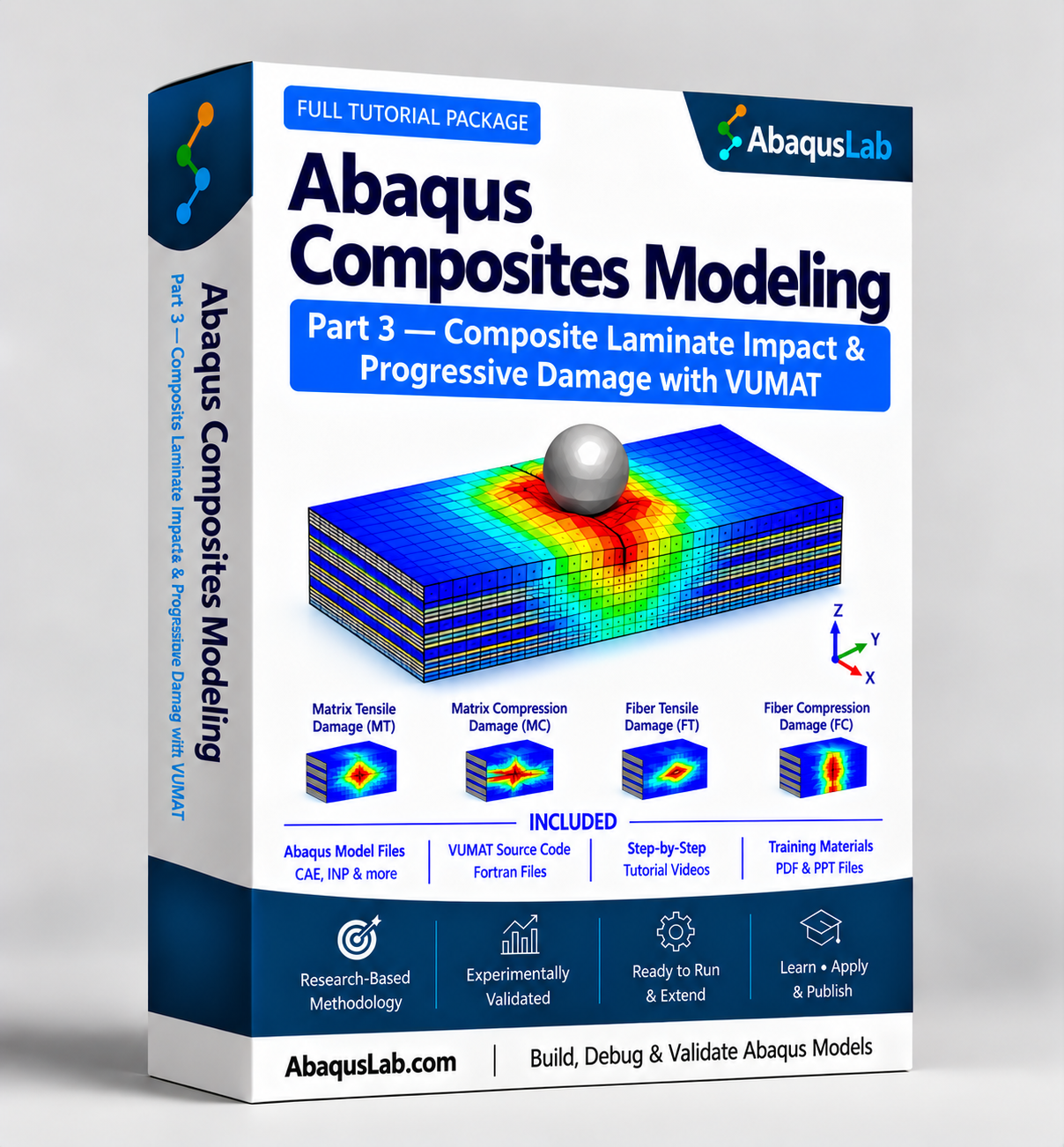

Description
Abaqus Composite Laminate Impact & Progressive Damage with VUMAT
This tutorial package provides a practical framework for simulating impact-induced damage and failure in laminated composite structures using Abaqus composite laminate impact VUMAT. During the impact event, the evolving material response inside individual plies is evaluated through a composite laminate damage VUMAT. By combining three-dimensional composite failure criteria with material degradation, the Abaqus composite laminate damage framework can represent the development of fiber- and matrix-dominated failure. In addition to damage within the plies, separation between adjacent laminate layers is captured through cohesive interfaces for composite delamination Abaqus modeling. Together, these intralaminar and interlaminar mechanisms create a composite laminate Hashin 3D workflow for studying how impact damage initiates, evolves, and influences the overall laminate response.
3D Hashin VUMAT → composite laminate construction → impact loading → intralaminar damage → damage evolution → stiffness degradation → cohesive interface damage → delamination → Abaqus/Explicit impact simulation.
This tutorial builds on a peer-reviewed composite impact study published in Fibers and Polymers (2020), adapting its laminate impact framework into a practical Abaqus/Explicit tutorial.
What Is Abaqus Composite Laminate Impact VUMAT Modeling?
Abaqus composite laminate impact VUMAT modeling combines Abaqus/Explicit impact analysis with a user-defined composite material model to simulate damage and failure in laminated structures. During impact, the composite laminate damage VUMAT evaluates the three-dimensional material response within each ply, identifies active fiber- and matrix-dominated failure modes, and updates the material response as damage develops.
In this tutorial, intralaminar Abaqus composite laminate damage is evaluated using the composite laminate Hashin 3D formulation introduced in Part 2. Damage between neighboring plies is treated separately through cohesive interfaces for composite delamination Abaqus modeling, allowing ply damage and interlaminar separation to be investigated together during the impact event.
Composite Laminate Hashin 3D Failure under Impact Loading
Part 3 applies the composite laminate Hashin 3D formulation introduced in Part 2 to evaluate intralaminar damage during impact. Instead of treating composite failure with a single damage index, the composite laminate damage VUMAT distinguishes four damage modes: fiber tension, fiber compression, matrix tension, and matrix compression. During the Abaqus/Explicit impact analysis, these criteria are evaluated from the evolving three-dimensional stress state within each composite ply.
Local Material Coordinates in the Composite Laminate
The Hashin criteria are evaluated in the local material coordinate system of each ply. The 1-direction follows the longitudinal fiber direction, while the 2- and 3-directions represent the transverse and through-thickness material directions. Because the laminate experiences a complex three-dimensional stress state during impact, all six stress components can contribute to the failure evaluation.
Normal Stresses\[
\sigma_{11},\quad \sigma_{22},\quad \sigma_{33}
\]
Shear Stresses\[
\sigma_{12},\quad \sigma_{13},\quad \sigma_{23}
\]
The stress components supplied to the composite laminate Hashin 3D criteria are expressed in the local material orientation of each composite ply.
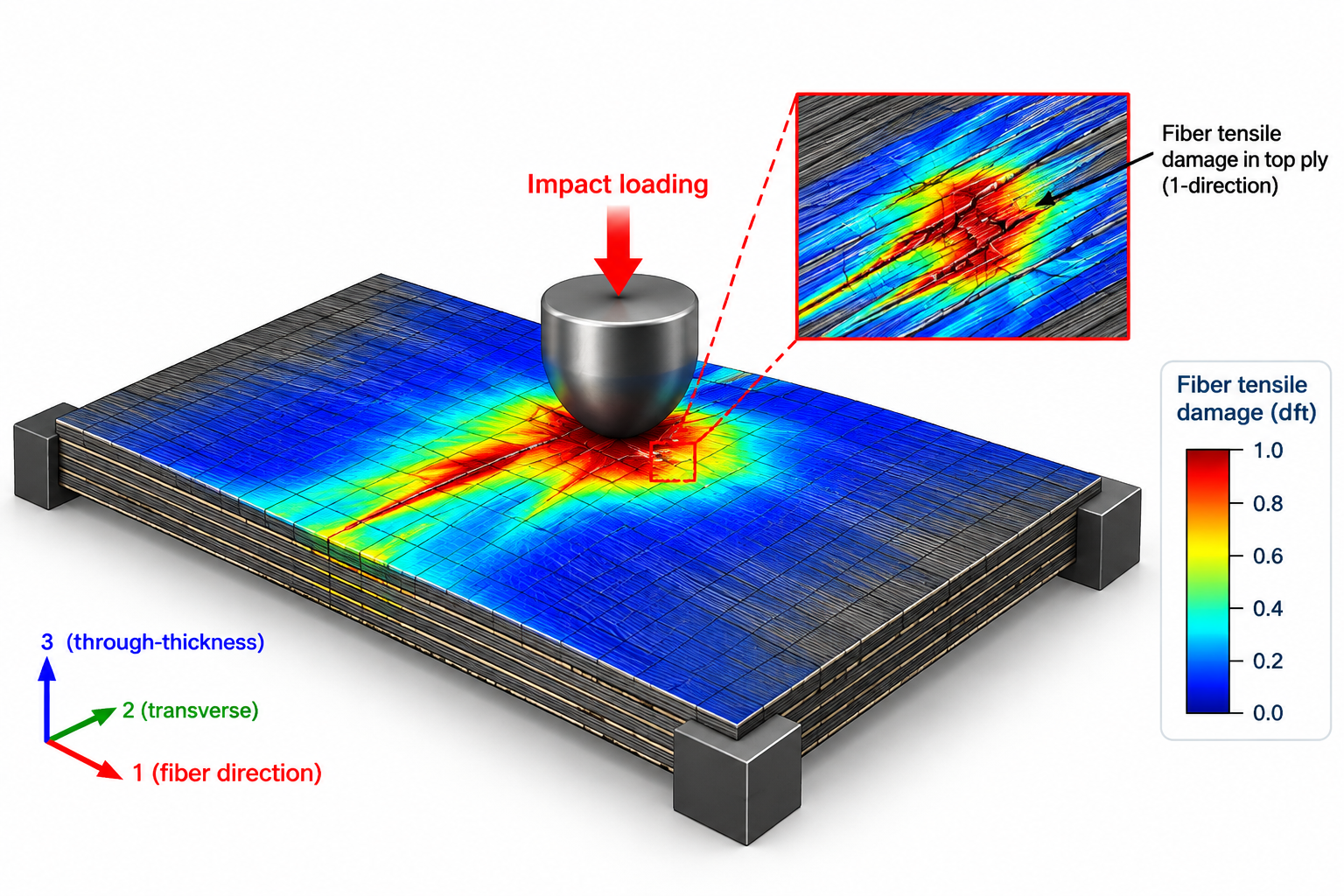
1. Fiber Tensile Damage during Laminate Impact
Fiber tensile damage is evaluated when impact-induced deformation produces tensile stress along the principal fiber direction of a composite ply. The 3D Hashin criterion also includes the shear stresses acting on planes containing the fiber direction.
\sigma_{11} \geq 0
\qquad\qquad
F_{ft}
=
\left(\frac{\sigma_{11}}{X_T}\right)^2
+
\left(\frac{\sigma_{12}}{S_{12}}\right)^2
+
\left(\frac{\sigma_{13}}{S_{13}}\right)^2
\]
During impact, this criterion allows the VUMAT to identify tensile fiber-dominated damage developing within individual laminate plies.
2. Fiber Compressive Damage during Laminate Impact
Fiber compressive damage is evaluated when the impact response produces compressive stress along the principal fiber direction. This mode is associated with longitudinal compression within the affected composite ply.
\sigma_{11} < 0
\qquad\qquad
F_{fc}
=
\left(\frac{\sigma_{11}}{X_C}\right)^2
\]
The criterion compares the longitudinal compressive stress with the corresponding fiber-direction compressive strength and identifies the onset of fiber-dominated compressive damage.

3. Matrix Tensile Damage during Laminate Impact
Matrix tensile damage is evaluated when the combined transverse normal stress becomes tensile. This mode is particularly important for representing matrix-dominated cracking generated by the complex transverse and shear stress field surrounding the impact region.
\sigma_{22}+\sigma_{33} \geq 0
\]
F_{mt} =
\left(\frac{\sigma_{22}+\sigma_{33}}{Y_T}\right)^2
+
\frac{\sigma_{23}^{2}-\sigma_{22}\sigma_{33}}{S_{23}^{2}}
+
\left(\frac{\sigma_{12}}{S_{12}}\right)^2
+
\left(\frac{\sigma_{13}}{S_{13}}\right)^2
\]
The criterion combines transverse normal, through-thickness, and shear stresses so that matrix-dominated tensile damage can be tracked within the Abaqus composite laminate damage model.

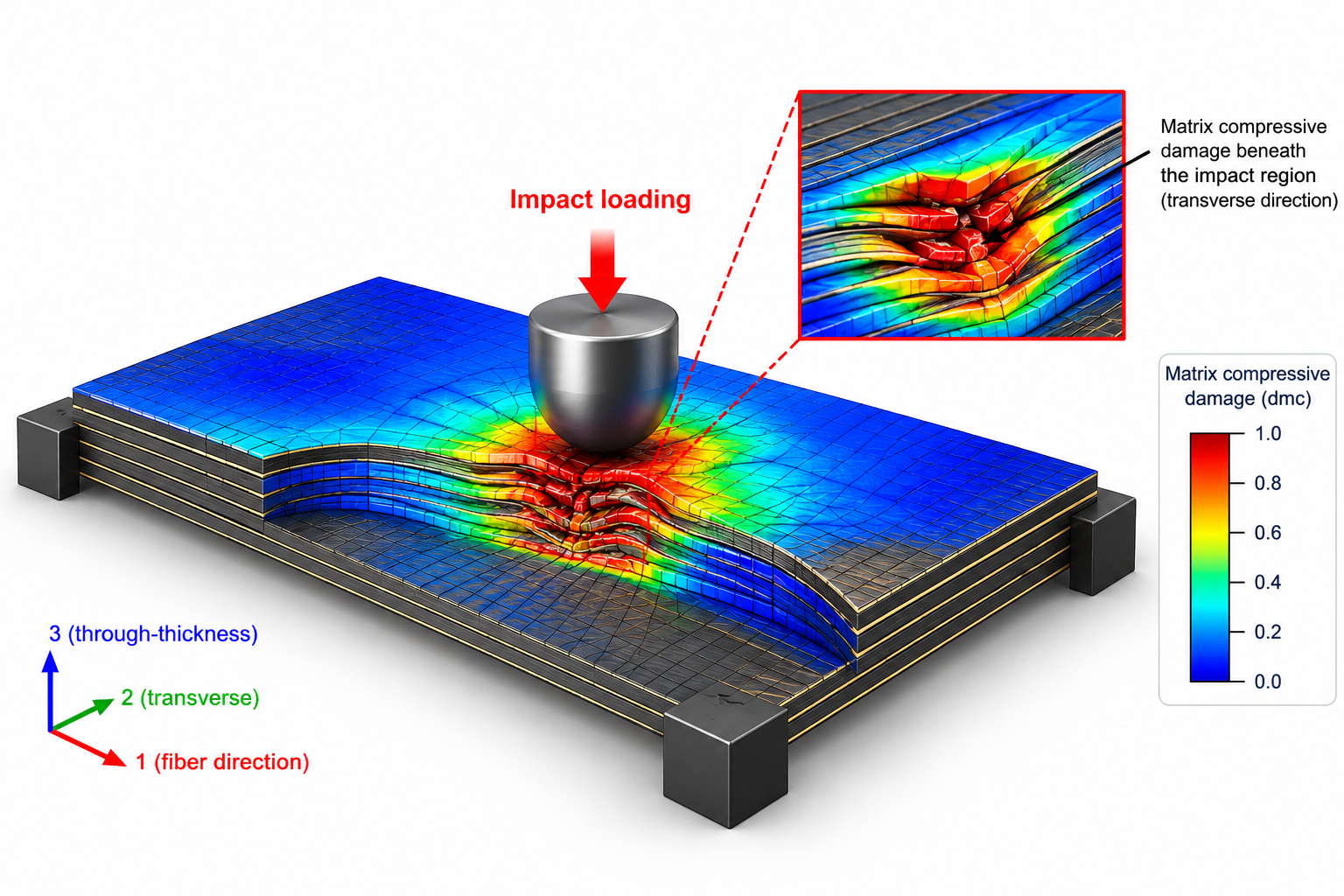
4. Matrix Compressive Damage during Laminate Impact
Matrix compressive damage is evaluated where the combined transverse normal stress becomes compressive. Beneath and around the impact zone, this mode captures matrix-dominated failure associated with transverse compression and the accompanying three-dimensional shear stress state.
\sigma_{22}+\sigma_{33} < 0
\]
F_{mc} =
\frac{1}{Y_C}
\left[
\left(\frac{Y_C}{2S_{23}}\right)^2 – 1
\right]
(\sigma_{22}+\sigma_{33})
+
\frac{(\sigma_{22}+\sigma_{33})^2}{4S_{23}^{2}}
+
\frac{\sigma_{23}^{2}-\sigma_{22}\sigma_{33}}{S_{23}^{2}}
+
\left(\frac{\sigma_{12}}{S_{12}}\right)^2
+
\left(\frac{\sigma_{13}}{S_{13}}\right)^2
\]
The criterion accounts for the interaction of transverse compression and shear, allowing the composite laminate damage VUMAT to distinguish matrix compressive damage from the other Hashin failure modes.
Recommended Prerequisite for Composite Laminate Hashin 3D — Part 2
Build the Composite Laminate Damage VUMAT Foundation First
Part 3 applies the 3D Hashin damage criterion and VUMAT framework introduced in Part 2 to an advanced Abaqus composite laminate impact VUMAT application. The detailed derivation of the failure criteria, three-dimensional composite constitutive formulation, state variables, damage logic, and fundamental VUMAT implementation is therefore not repeated at the same depth in Part 3.
If you are new to composite laminate Hashin 3D modeling or VUMAT implementation in Abaqus/Explicit, completing Part 2 first is strongly recommended. Users who already understand an equivalent 3D Hashin formulation and its VUMAT implementation can proceed directly to Part 3.
Part 2: 3D Hashin criterion → composite constitutive model → damage initiation → damage variables → stiffness degradation → VUMAT implementation
↓
Part 3: 3D Hashin VUMAT → laminate impact → intralaminar damage → cohesive interfaces → delamination → impact results
Abaqus Composite Laminate Damage Learning Path — Parts 1–6
The AbaqusLab Composites Series progresses from fundamental user-defined composite material models to advanced engineering applications. The recommended sequence provides a structured route through UMAT, VUMAT, Abaqus composite laminate damage, impact, cutting, fatigue, and composite structural analysis. For Part 3 specifically, Part 2 provides the recommended foundation because the composite laminate Hashin 3D formulation used in the impact model builds on the 3D Hashin VUMAT implementation introduced there.
Part 1 — 3D Hashin Damage with UMAT
- 🧩 3D Hashin failure criteria
- 💻 Composite UMAT
- ⚙️ Abaqus/Standard
£149 (Student: £129)
Explore Part 1 →
Part 2 — 3D Hashin Damage with VUMAT
- 🧩 3D Hashin failure criteria
- 💻 Composite VUMAT
- 💥 Abaqus/Explicit
£149 (Student: £129)
Explore Part 2 →
Part 3 — Composite Laminate Impact & Progressive Damage
- 💥 Composite laminate impact
- 🧩 3D Hashin VUMAT
- 📉 Intralaminar damage
- 🔗 Delamination & cohesive modeling
£169 (Student: £139)
Part 4 — CFRP Cutting & Progressive Damage
- 💎 CFRP cutting
- 🧭 Fiber-orientation effects
- 🌀 Damage & material removal
£199 (Student: £169)
Part 5 — CFRP Fatigue Modeling with UMAT
- 🔄 Composite fatigue
- 📉 Progressive fatigue damage
- 💻 Fatigue UMAT
£129 (Student: £99)
Part 6 — Composite Pipe Stress & Failure Analysis
- ⭕ Filament-wound pipes
- 📊 Stress through thickness
- 💥 Composite pipe failure
£129 (Student: £99)
Complete Abaqus Composites Suite — Parts 1–6
- ✓ Complete Parts 1–6 learning path
- ✓ UMAT + VUMAT composite modeling
- ✓ Hashin + damage + impact + cutting
- ✓ CFRP fatigue + composite pipe analysis
- ✓ Complete tutorials & simulation files
£924£499Student: £419
What Does the Abaqus Composite Laminate Damage Model Contain?
The Abaqus composite laminate damage model combines orthotropic composite elasticity, a composite laminate Hashin 3D failure formulation, damage evolution, Abaqus/Explicit impact loading, and cohesive interface behavior. This allows the simulation to evaluate both intralaminar damage inside the plies and interlaminar separation between neighboring laminate layers.
Composite Laminate Hashin 3D Failure
Evaluate three-dimensional fiber tensile, fiber compressive, matrix tensile, and matrix compressive failure mechanisms.
Composite Laminate Damage VUMAT
Implement the composite constitutive equations, damage checks, material state variables, and degraded stiffness inside Abaqus/Explicit.
Abaqus Composite Laminate Impact VUMAT
Apply the user-defined composite material model within a dynamic impact simulation involving contact and rapidly changing structural response.
Abaqus Composite Laminate Damage Evolution
Follow the transition from undamaged orthotropic behavior to a progressively degraded composite material state.
Composite Delamination Abaqus Interfaces
Introduce cohesive interfaces between neighboring plies to represent interlaminar damage and separation.
Impact Results & Damage Interpretation
Evaluate structural response together with intralaminar failure, interface damage, and the resulting laminate damage pattern.
Intralaminar Composite Laminate Hashin 3D Damage
Inside each ply, the composite laminate Hashin 3D formulation evaluates the three-dimensional material stress state and distinguishes fiber- and matrix-dominated failure mechanisms. These calculations are performed within the VUMAT and provide the damage-initiation framework for the intralaminar material model.
Interlaminar Composite Delamination Abaqus Damage
Between neighboring plies, composite delamination Abaqus modeling is performed with cohesive interfaces. This separates interface failure from the intralaminar damage calculated by the VUMAT and makes it possible to investigate how material damage and delamination interact during impact.
What Is Included with the Composite Laminate Damage VUMAT Package?
The package combines video instruction, source code, Abaqus/Explicit models, and technical files so that the complete composite laminate damage VUMAT workflow can be studied from material formulation through impact simulation and post-processing.
Abaqus Composite Laminate Impact VUMAT Training
Composite Laminate Damage VUMAT & Model Files
Abaqus Composite Laminate Damage Evolution & Stiffness Degradation
Damage initiation identifies when a failure condition has been reached, while the subsequent Abaqus composite laminate damage process determines how the material response changes after initiation. Damage variables are updated and used to reduce the corresponding material stiffness as failure develops.
Within the composite laminate damage VUMAT, this evolving state allows a material point to transition from its original undamaged orthotropic response toward a damaged state. The resulting stress redistribution can then influence damage development in neighboring material points and laminate layers.
Undamaged orthotropic response → composite laminate Hashin 3D initiation → evolving damage variables → stiffness degradation → stress redistribution → damaged laminate response
Composite Delamination Abaqus Modeling with Cohesive Interfaces
Composite delamination Abaqus modeling represents failure between neighboring composite plies rather than damage occurring inside the material itself. Cohesive interfaces are introduced between laminate layers to transfer normal and shear tractions and to represent interface degradation when the interlaminar damage conditions are reached.
This cohesive formulation complements the composite laminate Hashin 3D material model. Hashin-based intralaminar failure is calculated inside the composite plies, while cohesive-zone behavior represents interlaminar separation between them.
Traction–Separation for Composite Delamination Abaqus
Represent the mechanical relationship between interface tractions and relative separation of neighboring laminate layers.
Interface Damage Initiation
Evaluate the combined interface loading state to determine when cohesive damage begins.
Mixed-Mode Interface Damage
Represent the combined influence of normal and shear separation during cohesive damage evolution.
Abaqus Composite Laminate Damage & Delamination
Study the interaction between intralaminar composite damage and interlaminar interface failure during impact.
Complete Abaqus Composite Laminate Impact VUMAT Workflow
The complete Abaqus composite laminate impact VUMAT workflow connects composite material definition, laminate construction, impact loading, composite laminate Hashin 3D failure, material degradation, cohesive interface damage, delamination, and post-processing within a single Abaqus/Explicit simulation framework.
STEP 01: Define the orthotropic composite material
STEP 02: Construct the laminate and define material orientations
STEP 03: Create the impactor, contact, constraints, and impact conditions
STEP 04: Calculate the composite constitutive response with the VUMAT
STEP 05: Evaluate composite laminate Hashin 3D failure modes
STEP 06: Update material damage and degrade the corresponding stiffness
STEP 07: Evaluate cohesive interface damage and delamination
STEP 08: Advance the dynamic impact event in Abaqus/Explicit
RESULTS: Evaluate impact response, intralaminar damage, stiffness degradation, interface failure, and delamination
What You Will Learn with Abaqus Composite Laminate Impact VUMAT
The tutorial shows how the Abaqus composite laminate impact VUMAT framework is assembled into a complete engineering simulation rather than treating the material subroutine independently from the structural model.
Build an Abaqus Composite Laminate Impact VUMAT Model
Create the laminate, impactor, contact, constraints, and Abaqus/Explicit impact-analysis setup.
Apply Composite Laminate Hashin 3D
Use the Part 2 three-dimensional Hashin VUMAT framework inside a laminate impact application.
Understand Composite Laminate Damage VUMAT Logic
Follow the material response from constitutive calculations through failure initiation and evolving material damage.
Interpret Abaqus Composite Laminate Damage
Understand how fiber and matrix damage influence the evolving structural response during impact.
Build Composite Delamination Abaqus Interfaces
Introduce cohesive behavior between neighboring plies and evaluate interlaminar damage.
Interpret Impact & Failure Results
Evaluate structural response together with material damage, interface degradation, and final laminate failure patterns.
Why Use a Composite Laminate Damage VUMAT for Impact?
A composite laminate damage VUMAT provides direct control over the constitutive equations, failure calculations, state variables, and damaged material response used during an Abaqus/Explicit analysis. This is particularly useful for dynamic composite problems where contact, rapidly changing loads, intralaminar damage, and delamination can occur during the same event.
Combining the VUMAT with a composite laminate Hashin 3D formulation also makes the underlying failure logic accessible for study and modification. Instead of treating the material model as a black box, the user can understand how stresses are evaluated, how failure modes are identified, and how the damaged material response is updated.
Who Is This Abaqus Composite Laminate Damage Tutorial For?
This Abaqus composite laminate damage package is intended for engineers, researchers, postgraduate students, and advanced Abaqus users working with composite structures, impact mechanics, VUMAT development, cohesive interfaces, and delamination.
- PhD and MSc researchers studying composite impact
- Engineers modeling CFRP and laminated composite structures
- Users developing a composite laminate damage VUMAT
- Researchers implementing composite laminate Hashin 3D criteria
- Researchers studying fiber and matrix failure
- Users performing composite delamination Abaqus analysis
- Abaqus/Explicit users developing custom composite material models
- Researchers investigating impact-induced laminate damage
Need a Custom Abaqus Composite Laminate Damage or VUMAT Model?
Composite impact simulations often require project-specific material properties, VUMAT development, composite laminate Hashin 3D implementation, damage calibration, cohesive-interface modeling, contact setup, validation, troubleshooting, or specialized post-processing. AbaqusLab can help develop and extend custom composite material and impact models for research and engineering applications.
Abaqus Composite Laminate Impact VUMAT — Frequently Asked Questions
What is an Abaqus composite laminate impact VUMAT?
An Abaqus composite laminate impact VUMAT is a user-defined material implementation used with Abaqus/Explicit to calculate the constitutive response and evolving intralaminar damage of composite plies during a dynamic impact simulation.
Does Part 3 use composite laminate Hashin 3D failure criteria?
Yes. Part 3 applies the composite laminate Hashin 3D framework introduced in Part 2 to the laminate impact application. Part 2 explains the fundamental 3D Hashin formulation and VUMAT implementation in greater detail.
Is the paper’s damage criterion also Hashin 3D?
No. The research paper on which the impact application is based uses a maximum-stress approach for fiber failure and Hou-type criteria for matrix failure. The AbaqusLab Part 3 tutorial instead applies the 3D Hashin VUMAT framework introduced in Part 2. The paper therefore provides the research basis for the laminate impact application, while the tutorial uses a different intralaminar damage-initiation formulation.
Do I need Part 2 before studying the composite laminate damage VUMAT?
Part 2 is strongly recommended for users who are new to the composite laminate damage VUMAT framework, 3D Hashin failure criteria, or VUMAT implementation. Users who already have equivalent knowledge can proceed directly to Part 3.
Do I need Part 1 before Part 3?
No. Part 1 focuses on 3D Hashin composite damage using UMAT and Abaqus/Standard. Because Part 3 uses VUMAT and Abaqus/Explicit, Part 2 is the directly relevant recommended foundation.
How is Abaqus composite laminate damage modeled?
Abaqus composite laminate damage is modeled by evaluating the composite constitutive response, checking the implemented 3D Hashin failure conditions, updating damage variables after initiation, and modifying the affected material stiffness as damage develops.
How is composite delamination modeled in Abaqus?
Composite delamination Abaqus modeling is performed using cohesive interfaces between neighboring laminate plies. The cohesive formulation represents interface loading, damage initiation, degradation, and progressive loss of interlaminar load-transfer capability.
Does the model include both intralaminar and interlaminar damage?
Yes. Intralaminar fiber and matrix failure is handled through the composite laminate Hashin 3D VUMAT framework, while interlaminar interface damage and delamination are represented through cohesive modeling.
Is the VUMAT source code included?
Yes. The package includes the composite laminate damage VUMAT source code together with Abaqus/Explicit impact model files and supporting tutorial material.
Is technical support included?
Yes. Post-download technical support is included for questions related to the supplied tutorial, VUMAT implementation, Abaqus model files, and simulation workflow.
Related Abaqus Composite Laminate Damage, VUMAT & Advanced Modeling Resources
Continue studying Abaqus composite laminate damage, composite laminate Hashin 3D failure, VUMAT development, impact simulation, and delamination through related AbaqusLab tutorials and advanced computational-mechanics resources. These internal learning paths connect composite impact modeling with material damage, fracture, nonlocal mechanics, hydrogen transport, and microstructure-sensitive material modeling.
Related Advanced Abaqus Material, Damage & Fracture Tutorials
Explore additional AbaqusLab tutorials for researchers and engineers working with custom constitutive models, fracture mechanics, nonlocal methods, coupled transport, and advanced material subroutines. These topics complement the Abaqus composite laminate impact VUMAT workflow by extending user-defined modeling to other classes of material and structural failure problems.
AbaqusLab Consulting & User Subroutine Development
For custom composite models, VUMAT development, impact simulation, material-model implementation, debugging, or research support, explore the related AbaqusLab consulting services.
External Resources for Composites, Laminates & Abaqus Modeling
For additional background on composite materials, laminate mechanics, progressive failure, delamination, impact simulation, and finite element modeling, the following authoritative resources provide official technical information and peer-reviewed research that complements the Abaqus composite laminate impact VUMAT tutorial.
SIMULIA — Abaqus Composites Modeler ↗
NASA — Composite Laminate Progressive Failure ↗
NASA — Delamination & Composite Failure ↗
Composite Engineering Journals & Research
The following journals provide additional peer-reviewed research on composite materials, laminate mechanics, impact damage, progressive failure, delamination, and computational composite modeling.


Reviews
There are no reviews yet.